
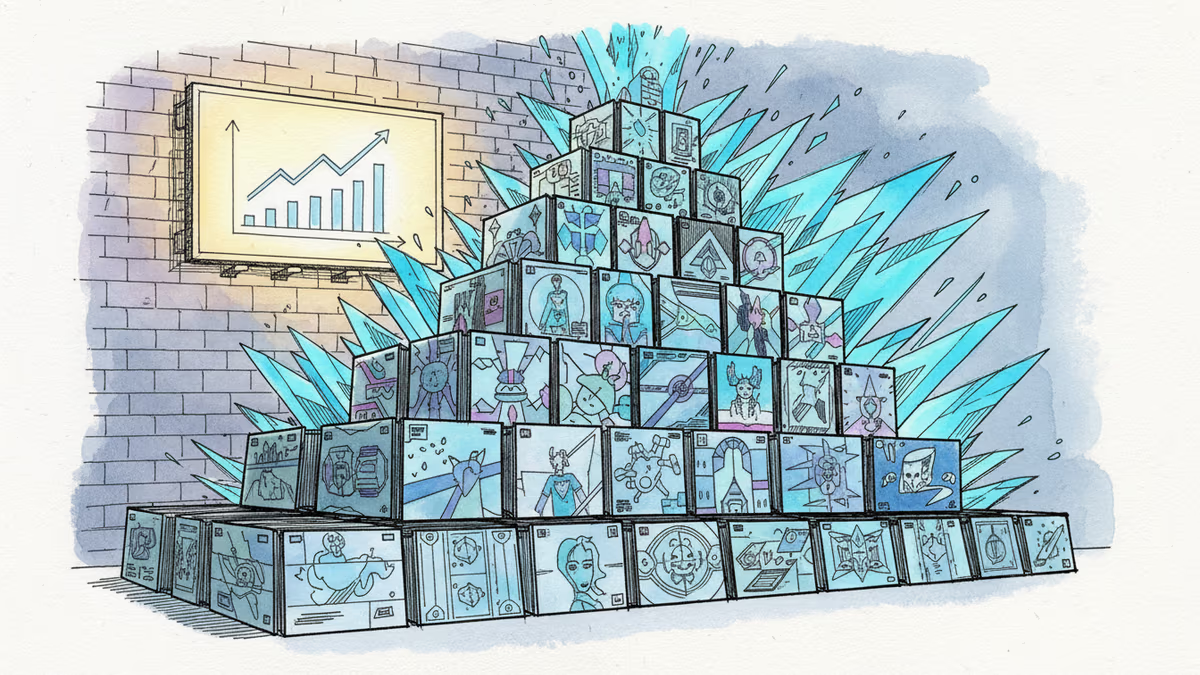
ILLIT Hits Billboard 200 Top 50 — What the Numbers Actually Mean
ILLIT's new mini album debuted at No. 1 on Billboard's World Albums chart and cracked the Billboard 200 top 50. Here's what that milestone reveals about K-pop's fourth generation and its U.S. market strategy.
The album title is a Yaghan word from the southern tip of South America, meaning the wordless, shared look between two people who both want to initiate something but neither will. It is, in other words, a feeling too specific for any single language to own — which is precisely the point.
ILLIT's second mini album, 《MAMIHLAPINATAPAI》, debuted at No. 1 on the Billboard World Albums chart for the week ending May 16, 2026. That alone would be a clean headline. But the more telling figure sits one chart over: this is the first ILLIT release to enter the top 50 of the Billboard 200 — the chart that measures actual consumption across the United States, combining physical sales, streaming equivalent albums, and digital downloads.
The Chart Snapshot and What It Reflects
The full top of this week's World Albums chart reads like a roll call of K-pop's current commercial tier: TXT sliding after two weeks at No. 1, ENHYPEN, BTS, Stray Kids, TWS, NewJeans, and CORTIS filling out the upper positions alongside ILLIT. The presence of BTS on this list is worth pausing on. A group that peaked as a third-generation act is still charting in the same week as groups that debuted in 2024. K-pop's market structure doesn't run on displacement — it runs on accumulation.
ILLIT launched in early 2024 under HYBE's sublabel Belift Lab, and spent much of its debut year navigating a public dispute over alleged musical similarities with NewJeans — a controversy that escalated into legal proceedings. That backdrop makes the quiet, steady fanbase the group has built since then more notable, not less. The Billboard 200 entry is the clearest external validation of that trajectory so far.
Why the Billboard 200 Threshold Matters

The World Albums chart is largely a measure of K-pop fandom's purchasing behavior — coordinated album buys, physical bundle sales, and streaming campaigns. It is a real commercial indicator, but it is also one where K-pop groups have structural advantages through organized fan mobilization. The Billboard 200 is a different animal.
To crack the Billboard 200's top 50, a release has to move units across the broader U.S. music market, not just within the fan community. It's the chart that U.S. radio programmers, playlist curators, and label A&R teams actually watch. When BTS first hit No. 1 on the Billboard 200 in 2020, it signaled that K-pop had crossed from niche to mainstream in the American market. When Stray Kids began placing multiple albums in the chart's upper range from 2023 onward, it suggested that crossover wasn't a BTS-specific anomaly. ILLIT's entry into the top 50 continues that line — though the gap between a first-week chart position and sustained market presence is where most groups' U.S. stories get complicated.
First-week chart performance in K-pop is heavily front-loaded. Fan-driven bulk purchases and streaming pushes concentrate consumption into a narrow window. The more meaningful question — one this chart snapshot can't answer — is what the second, third, and fourth week look like.
The Language Strategy and Its Tradeoffs
Choosing a Yaghan word as an album title isn't a random act of linguistic curiosity. It fits a deliberate pattern: ILLIT has consistently positioned itself as emotionally borderless, drawing on aesthetics and references that don't anchor the group to a specific cultural geography. Structurally, this mirrors what NewJeans did with English-language album titles and Y2K visual codes — a strategy designed to lower the entry barrier for non-Korean listeners.
The tradeoff is real, though. BTS built its global audience while maintaining Korean-language lyrics and narratives rooted in Korean social experience. The argument that K-pop's distinctiveness is its Koreanness — and that diluting it to chase universality is a long-term brand risk — has serious proponents in the industry. Which model proves more durable over a five-to-ten year arc is a question the current chart numbers can't resolve.
This content is AI-generated based on source articles. While we strive for accuracy, errors may occur. We recommend verifying with the original source.
Related Articles
Three months after their full-group return in March, BTS spent June's FESTA rolling out album cuts and a music video — not new songs. Come Over cracked a global top 5 with zero new music behind it. Did the play work?
PRISM Trend Pipeline caught LE SSERAFIM's YouTube KR trending peak. Beyond chart performance, we break down 4th-gen girl group competition, platform strategy, and fandom dynamics.
&TEAM's 'We on Fire' debuted on the Billboard 200 for the first time. Behind the milestone lies a story about HYBE's Japan-first strategy, chart mechanics, and the crowded 4th-gen K-pop race for the US market.

BABYMONSTER announces digital single 'SUGAR HONEY ICE TEA' for June 8. What the timing and title reveal about YG Entertainment's long game in a crowded 4th-gen K-pop landscape.
Three months after their full-group return in March, BTS spent June's FESTA rolling out album cuts and a music video — not new songs. Come Over cracked a global top 5 with zero new music behind it. Did the play work?
PRISM Trend Pipeline caught LE SSERAFIM's YouTube KR trending peak. Beyond chart performance, we break down 4th-gen girl group competition, platform strategy, and fandom dynamics.
&TEAM's 'We on Fire' debuted on the Billboard 200 for the first time. Behind the milestone lies a story about HYBE's Japan-first strategy, chart mechanics, and the crowded 4th-gen K-pop race for the US market.
BABYMONSTER announces digital single 'SUGAR HONEY ICE TEA' for June 8. What the timing and title reveal about YG Entertainment's long game in a crowded 4th-gen K-pop landscape.
Thoughts
Share your thoughts on this article
Sign in to join the conversation