
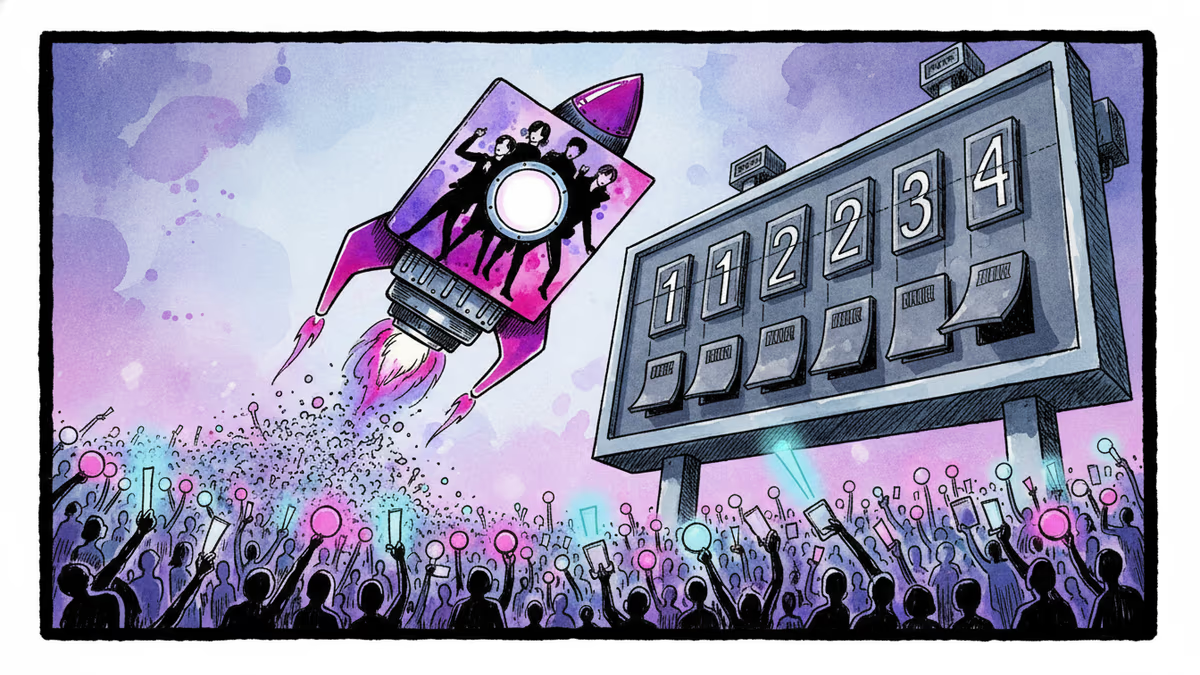
CORTIS Hits No. 3 on Billboard 200 — But What Does That Actually Mean?
CORTIS debuted at No. 3 on the Billboard 200 with EP 'GREENGREEN,' their first-ever top 10 entry. Here's what the number tells us — and what it doesn't.
Debuting at No. 3 on the Billboard 200 is rare. Doing it with an EP, as a K-pop act, in 2026 — that's a different kind of story.
On May 17, Billboard confirmed that CORTIS's new EP GREENGREEN entered the Billboard 200 at No. 3, marking the group's first-ever top 10 appearance on the chart. The Billboard 200 ranks the most popular albums in the United States based on a blended metric of streaming equivalent albums (SEA), track equivalent albums (TEA), and traditional album sales.
The Number in Context
K-pop's relationship with the Billboard 200 has a well-documented history. BTS first topped the chart in 2018, and since then, several acts — Stray Kids, BLACKPINK, TWICE — have cracked the top 10 with varying degrees of consistency. But the chart itself has changed.
Starting in 2023, Billboard tightened its rules around bundled sales — a practice where merchandise or concert ticket purchases are packaged with album downloads to inflate chart positions. The adjustments were widely seen as a direct response to K-pop fandoms' highly organized chart campaigns. That context matters here: GREENGREEN's No. 3 debut lands in a stricter accounting environment than the one earlier K-pop milestones were measured against.
That doesn't automatically make the achievement more or less meaningful, but it does shift the interpretive frame. A top 3 debut today carries a different evidentiary weight than one from 2020 or 2021, when bundle-stacking was more freely factored in.

Why an EP — and Why Now
The choice of an EP format is worth unpacking. Full-length albums have traditionally been the vehicle for major chart pushes, but the streaming economy has quietly rewritten that logic. Shorter, tightly sequenced releases are increasingly effective at concentrating listener attention — and chart-relevant streaming activity — within a compressed window.
The title GREENGREEN signals something deliberate about positioning. Nature imagery and color-coded aesthetics have become a recognizable shorthand in the post-NewJeans, post-IVE wave of K-pop — a move away from the maximalist, high-aggression performance codes that defined the early 2020s. Whether CORTIS is genuinely staking out new sonic territory or efficiently adopting a proven aesthetic template is a question the music itself has to answer. What's clear is that the branding is calibrated for frictionless global consumption.
The Fandom Variable
No honest analysis of K-pop chart performance can sidestep the fandom question. Organized streaming parties, coordinated purchase windows, and chart-week mobilization are standard operating procedure for most major K-pop fandoms. CORTIS is unlikely to be an exception.
But reducing the chart result entirely to fan mechanics misses something. The music industry has spent years trying to design fandom behavior out of chart metrics — and largely failed, because fandom is consumption. The more relevant question isn't whether fans moved the needle; it's whether the needle stayed moved. Second-week chart retention is the industry's actual signal for whether a casual listener base is forming alongside the core fanbase.
For CORTIS, the drop from No. 3 to wherever GREENGREEN lands in week two will be watched closely — not just by fans, but by label strategists and streaming platform curators deciding how much algorithmic real estate to allocate to the group going forward.
This content is AI-generated based on source articles. While we strive for accuracy, errors may occur. We recommend verifying with the original source.
Related Articles

Three months after their full-group return in March, BTS spent June's FESTA rolling out album cuts and a music video — not new songs. Come Over cracked a global top 5 with zero new music behind it. Did the play work?
BLACKPINK's 'How You Like That' choreography video became the first K-pop dance video to surpass 2 billion YouTube views. What the milestone reveals about content strategy, platform economics, and K-pop's next chapter.

&TEAM's 'We on Fire' debuted on the Billboard 200 for the first time. Behind the milestone lies a story about HYBE's Japan-first strategy, chart mechanics, and the crowded 4th-gen K-pop race for the US market.

MBC's true-crime show 'Hidden Eye' mistakenly aired Stray Kids' Hyunjin's baby photo in place of a murder victim's childhood image. Five months later, an apology. What does that timeline reveal?
Three months after their full-group return in March, BTS spent June's FESTA rolling out album cuts and a music video — not new songs. Come Over cracked a global top 5 with zero new music behind it. Did the play work?
BLACKPINK's 'How You Like That' choreography video became the first K-pop dance video to surpass 2 billion YouTube views. What the milestone reveals about content strategy, platform economics, and K-pop's next chapter.
&TEAM's 'We on Fire' debuted on the Billboard 200 for the first time. Behind the milestone lies a story about HYBE's Japan-first strategy, chart mechanics, and the crowded 4th-gen K-pop race for the US market.
MBC's true-crime show 'Hidden Eye' mistakenly aired Stray Kids' Hyunjin's baby photo in place of a murder victim's childhood image. Five months later, an apology. What does that timeline reveal?
Thoughts
Share your thoughts on this article
Sign in to join the conversation