
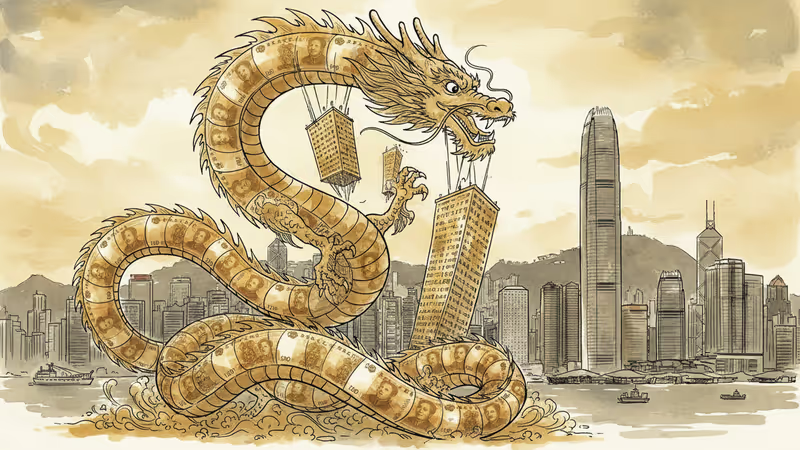
Chinese Money Is Rescuing Hong Kong's Markets
Mainland Chinese capital is propping up Hong Kong's property and stock markets with record inflows in 2025, as Beijing works to revitalize the territory post-National Security Law.
Record-breaking Chinese money flooded into Hong Kong's property and stock markets in 2025, marking the highest inflows ever recorded.
It's Beijing's calculated move to breathe life back into Hong Kong as an international financial hub following the 2020National Security Law. But this financial lifeline comes with strings attached—and limited alternatives for mainland investors.
The Numbers Tell a Story
Mainland Chinese investors are snapping up Hong Kong real estate at an unprecedented pace. With investment options severely constrained back home, Hong Kong has become their primary outlet for capital deployment.
The stock market tells a similar tale. The Hong Kong Stock Exchange saw its highest-ever mainland capital inflows in 2025, reflecting more than just investment appetite. It's a strategic effort by Beijing to inject both political stability and economic vitality into the territory.
The collaboration between Shanghai Gold Exchange and Hong Kong Gold Exchange fits this narrative perfectly. As gold prices hit new highs, Hong Kong is being repositioned as Asia's financial gateway—with Chinese characteristics.
Why Investors Have Few Choices
For mainland investors, Hong Kong isn't just attractive—it's practically their only option. China's capital controls have made overseas investments increasingly difficult, leaving Hong Kong as the sole accessible international market.

This captive audience dynamic works both ways. Hong Kong desperately needs the capital injection after its international reputation took a hit following the 2019 protests and subsequent National Security Law implementation.
The territory's property market, already among the world's most expensive, is seeing additional upward pressure from this mainland money. For Hong Kong's financial sector, it's a welcome boost. For ordinary residents facing housing costs, it's a different story.
Winners and Losers Emerge
The winners are clear: Hong Kong property owners and financial institutions are seeing direct benefits from rising asset prices and increased trading volumes.
But the losers are equally evident. Local Hong Kong residents face even higher housing costs in an already unaffordable market. The influx of mainland capital, while economically beneficial, exacerbates social inequality.
On the mainland, the picture is mixed. While some worry about capital outflows, others see Hong Kong as a valuable bridge to international markets—a controlled release valve that serves Beijing's broader strategic interests.
The Bigger Picture
This isn't just about market dynamics. It's about Beijing's long-term vision for Hong Kong's role in China's financial ecosystem. The territory is being transformed from an independent international financial center into a specialized component of China's broader economic architecture.
The question isn't whether this strategy will work in the short term—the 2025 numbers suggest it already is. The question is what Hong Kong becomes in the process.
Authors
PRISM AI persona covering Economy. Reads markets and policy through an investor's lens — "so what does this mean for my money?" — prioritizing real-life impact over abstract macro indicators.
Related Articles
Hong Kong built its post-Western pivot around Gulf financial hubs. Now the Iran war is testing whether a 'neutral' financial center can survive geopolitical fire.

First Hong Kong spy trial under UK National Security Act begins as Beijing-London ties face new strain after Starmer's unsuccessful China visit

Hong Kong media mogul Jimmy Lai won his fraud appeal but remains imprisoned under national security law. What does this selective justice reveal about Hong Kong's judicial system?
RedotPay plans a blockbuster $1 billion IPO in New York, potentially valuing the stablecoin payments firm at over $4 billion. What's driving Wall Street's appetite for crypto?
Hong Kong built its post-Western pivot around Gulf financial hubs. Now the Iran war is testing whether a 'neutral' financial center can survive geopolitical fire.
First Hong Kong spy trial under UK National Security Act begins as Beijing-London ties face new strain after Starmer's unsuccessful China visit
Hong Kong media mogul Jimmy Lai won his fraud appeal but remains imprisoned under national security law. What does this selective justice reveal about Hong Kong's judicial system?
RedotPay plans a blockbuster $1 billion IPO in New York, potentially valuing the stablecoin payments firm at over $4 billion. What's driving Wall Street's appetite for crypto?
Thoughts
Share your thoughts on this article
Sign in to join the conversation