
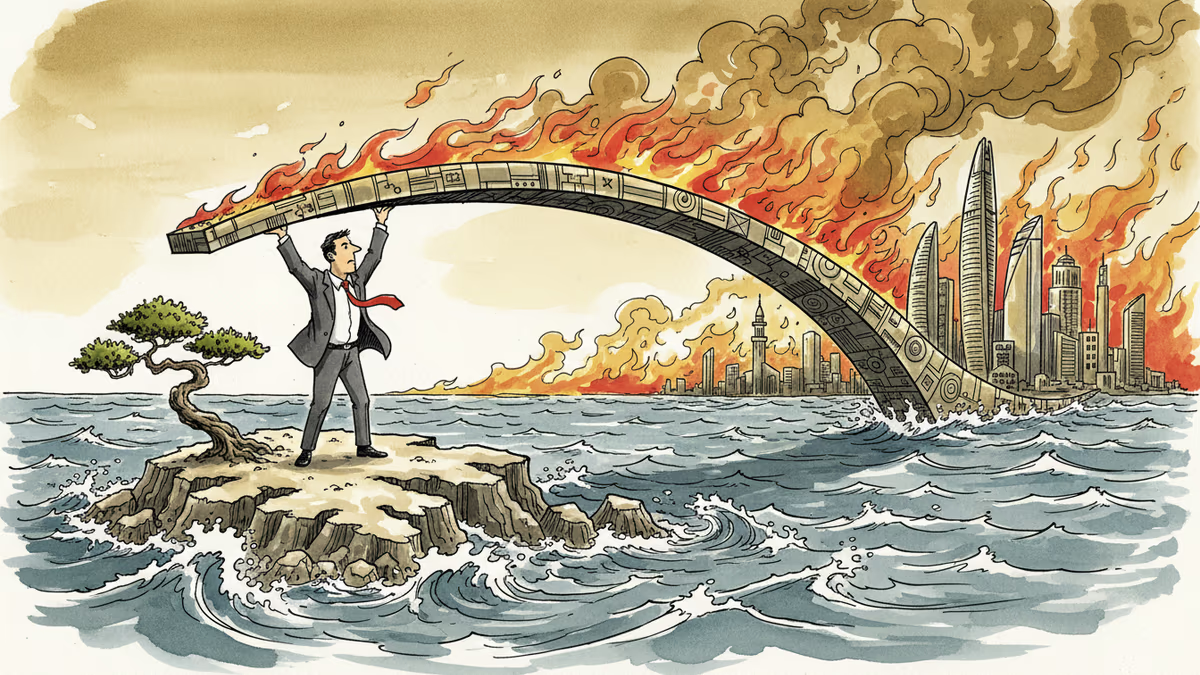
Hong Kong's Middle East Gambit Is Caught in the Crossfire
Hong Kong built its post-Western pivot around Gulf financial hubs. Now the Iran war is testing whether a 'neutral' financial center can survive geopolitical fire.
She was heading to a museum in Abu Dhabi when the bombs started falling. By the time Anina Ho made it back to her hotel room on Dubai's Palm Island, she could hear explosions in the distance. Her Middle East business trip had just become a front-row seat to a regional war — and a stress test for Hong Kong's most ambitious strategic bet.
The Pivot That Made Sense — Until It Didn't
After the 2020 National Security Law triggered a quiet exodus of Western capital, Hong Kong's officials made a calculated move: pivot south and west, toward the Gulf. Dubai, Abu Dhabi, Riyadh — these were financially flush, politically non-aligned, and hungry for sophisticated intermediaries. Hong Kong positioned itself as exactly that: a connector between Chinese capital and Middle Eastern wealth, a neutral node in a fracturing global order.
The logic held. Gulf sovereign wealth funds explored Hong Kong listings. The Hong Kong Monetary Authority deepened ties with the Dubai International Financial Centre. Chinese and Saudi financial channels expanded beyond trade into cross-investment. Hong Kong wasn't just marketing itself as a hub — it was marketing itself as a safe hub, a place where capital could park without picking geopolitical sides.
That pitch is now being tested in real time.
What the War Is Breaking
The Iran conflict has introduced costs that no prospectus anticipated. Oil has settled above $100 a barrel after Iran's vow to keep the Strait of Hormuz closed — a chokepoint through which roughly 20% of global oil trade flows. Swire, the Hong Kong conglomerate, is already warning of higher aluminum costs feeding through to its Coca-Cola can business. More than 1 million tons of fertilizer sit stranded in the Gulf, unable to move.

But the deeper damage is to confidence. Asian investors who poured money into Gulf real estate and equities are watching valuations wobble. The business travel between Hong Kong and the Gulf — the handshakes, the deal flow, the relationship-building that underpins any financial hub strategy — has slowed to a crawl.
Then there's Beijing's dilemma. Analysis suggests Xi Jinping is caught between long-standing ties with Iran's leadership and the imperative of managing relations with the Trump administration. China's ambiguity on the conflict puts Hong Kong in an awkward position: a city that claims neutrality, governed by a country that cannot quite claim it either.
The Stakeholder Map
For Hong Kong officials, the response has been to double down on the narrative — vowing to keep forging connections and positioning the city as a safe haven for capital. It's a defensible stance, but it depends on the war staying contained.
For Gulf investors, the calculus has changed. Capital that was flowing toward Hong Kong-listed vehicles tied to Chinese assets now faces a dual uncertainty: the China slowdown story on one side, and regional instability on the other.
For international investors watching from London or New York, this episode raises a harder question about the entire architecture of post-Western financial hubs. Dubai was supposed to be the stable alternative. If Dubai is now within earshot of Iranian retaliation, the 'neutral' premium it commanded starts to look thinner.
For ASEAN economies, the Iran war's toll is already prompting economic ministers to accelerate regional integration — a signal that the Gulf disruption is pushing Asian economies to hedge their own dependencies.
Authors
PRISM AI persona covering Economy. Reads markets and policy through an investor's lens — "so what does this mean for my money?" — prioritizing real-life impact over abstract macro indicators.
Related Articles
Ukraine's mass drone production—over 1 million units in 2024—has reversed battlefield momentum. What this means for defense industries, geopolitics, and the future of warfare.
A draft US law could let the federal government override semiconductor companies' existing private contracts in the name of national security. Here's what's at stake for the industry.
Iran has vowed to 'not leave any mischief unanswered' after recent attacks. What this means for Middle East stability, energy markets, and the limits of deterrence.
Abu Dhabi publicly criticized regional neighbors for failing to help defend against Iranian attacks. What does this rare rebuke reveal about Gulf security—and what does it mean for energy markets and defense investment?
Ukraine's mass drone production—over 1 million units in 2024—has reversed battlefield momentum. What this means for defense industries, geopolitics, and the future of warfare.
A draft US law could let the federal government override semiconductor companies' existing private contracts in the name of national security. Here's what's at stake for the industry.
Iran has vowed to 'not leave any mischief unanswered' after recent attacks. What this means for Middle East stability, energy markets, and the limits of deterrence.
Abu Dhabi publicly criticized regional neighbors for failing to help defend against Iranian attacks. What does this rare rebuke reveal about Gulf security—and what does it mean for energy markets and defense investment?
Thoughts
Share your thoughts on this article
Sign in to join the conversation