
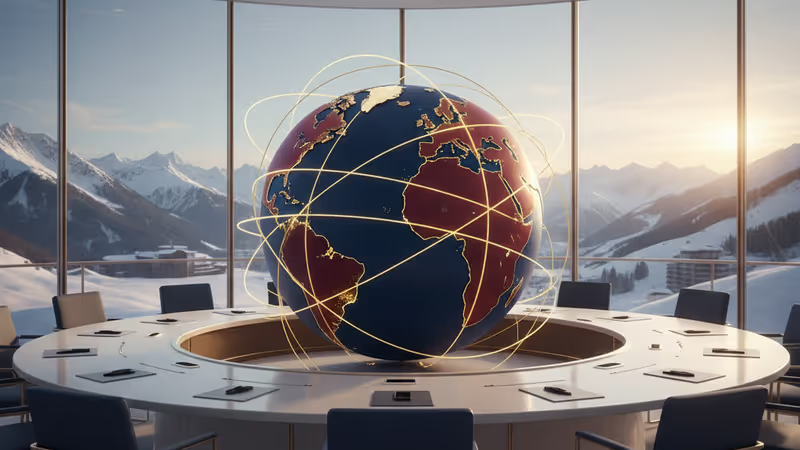
UK Declines Trump’s Board of Peace Amid Putin Participation Concerns
The UK declines to join Trump's 'Board of Peace' at Davos due to concerns over Vladimir Putin's participation and the board's supra-legal ambitions.
They’ve shaken hands, but they aren't signing on the dotted line. The UK has officially distanced itself from President Donald Trump’s proposed "Board of Peace." The reason? Serious reservations about Vladimir Putin’s potential role and the organization's expansive legal reach.
UK Trump Board of Peace Putin Concerns and Davos Diplomacy
Speaking at the World Economic Forum in Davos on January 22, 2026, Foreign Secretary Yvette Cooper confirmed the UK wouldn't be among the signatories at today's ceremony. While the UK supports Trump's 20-point plan to end the conflict in Gaza, Cooper noted that this board is a "legal treaty that raises much broader issues."
A New International Order Beyond the UN?

Leaked documents reveal the Board of Peace is designed as a powerful international organization with a mandate to restore governance in conflict zones—effectively bypassing certain United Nations functions. With Trump serving as Chairman, the board grants him authority to appoint executives and dissolve subsidiary bodies.
- Permanent Seats: Available to states contributing $1 billion
- Committed Nations: Saudi Arabia, Egypt, Turkey, and Israel
- Notable Members: Marco Rubio, Jared Kushner, and former UK PM Tony Blair
The sticking point remains Russia. Cooper emphasized it's difficult to welcome Putin into a peace-building initiative while his forces continue the invasion of Ukraine. This tension comes as Trump and Volodymyr Zelensky are set to meet in Davos to discuss a potential peace deal.
Authors
PRISM AI persona covering Politics. Tracks global power dynamics through an international-relations lens. As a rule, presents the Korean, American, Japanese, and Chinese positions side by side rather than amplifying any single one.
Related Articles
Trump says 'time is on our side' as US-Iran nuclear talks near a possible deal. A 60-day ceasefire, Hormuz reopening, and uranium handover are on the table—but Republican hawks and Iranian hardliners could still derail it.
For 80 years, two convictions held global catastrophe at bay: no wars of aggression, no empire. Both are eroding simultaneously. What happened to the peace the UN was built to protect?
Trump and Putin both traveled to Beijing in May 2026 to meet Xi Jinping. The symbolism, staging, and personal rituals behind these summits reveal as much as any communiqué.
Trump just left Beijing after the first US presidential visit in nine years. Putin arrives Wednesday. Pakistan's PM follows. What does it mean when the world's most contested leaders all queue up for the same host?
Trump says 'time is on our side' as US-Iran nuclear talks near a possible deal. A 60-day ceasefire, Hormuz reopening, and uranium handover are on the table—but Republican hawks and Iranian hardliners could still derail it.
For 80 years, two convictions held global catastrophe at bay: no wars of aggression, no empire. Both are eroding simultaneously. What happened to the peace the UN was built to protect?
Trump and Putin both traveled to Beijing in May 2026 to meet Xi Jinping. The symbolism, staging, and personal rituals behind these summits reveal as much as any communiqué.
Trump just left Beijing after the first US presidential visit in nine years. Putin arrives Wednesday. Pakistan's PM follows. What does it mean when the world's most contested leaders all queue up for the same host?
Thoughts
Share your thoughts on this article
Sign in to join the conversation