
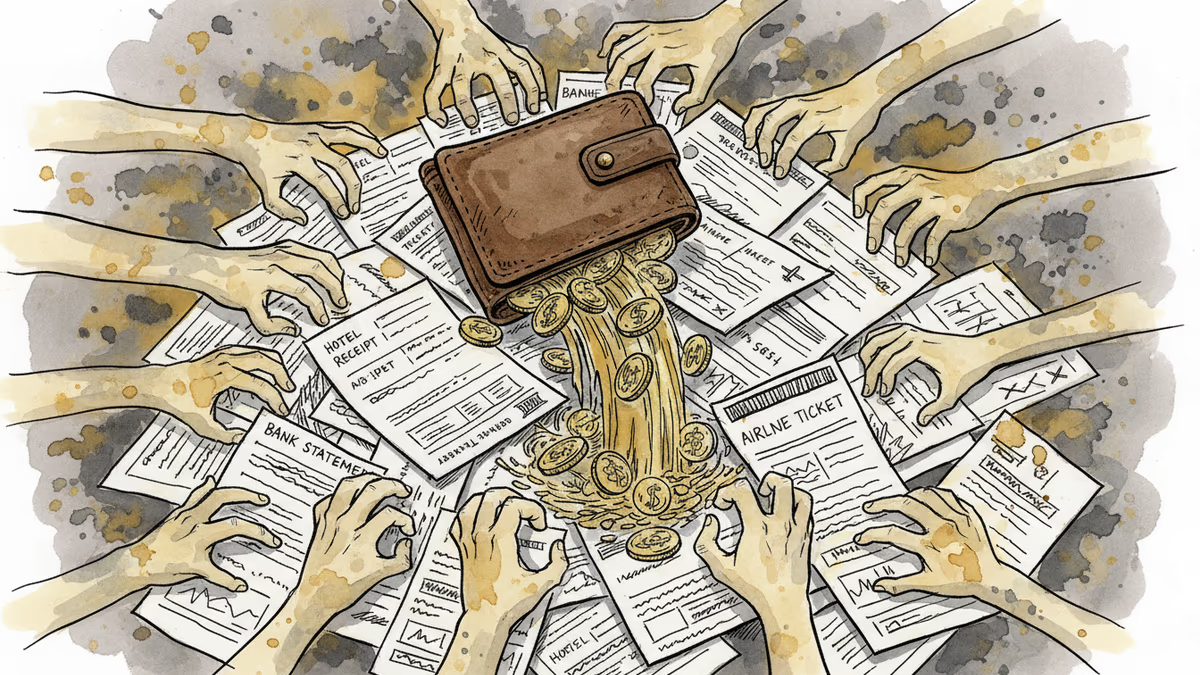
The Hidden Tax on Your Everyday Purchases
Six types of hidden fees are quietly draining household budgets worldwide. From resort fees to subscription traps, here's how companies profit from pricing opacity.
$2.4 trillion. That's how much Americans spent on hidden fees across all industries in 2023, according to recent estimates. If you've ever booked a "$99" hotel room only to face a $45 resort fee at checkout, you've contributed to this shadow economy.
The modern marketplace operates on a simple deception: advertise the base price, collect the real price later. Coverage from Reader's Digest and Consumer Reports reveals how this drip-pricing model has become standard practice across travel, banking, entertainment, and subscriptions. Each individual fee feels minor. Together, they represent a 15-20% markup on household spending that rarely appears in budgets.
This isn't just an American phenomenon. Airlines worldwide, hotel chains, ticketing platforms, and financial institutions use identical tactics. The psychology is universal: get customers invested in a purchase, then present additional costs as unavoidable or protective.
The Airline Shell Game
That $200 flight to Miami isn't really $200. Add checked baggage ($35), seat selection ($25), and carry-on fees ($60 on some carriers), and you're looking at $320. A 60% markup that appeared nowhere in the initial search results.
Southwest Airlines built its brand on "bags fly free," but most carriers have embraced the unbundled model. Basic economy fares often exclude overhead bin access, forcing passengers to check bags or pay premium prices for standard amenities.
Consumer Reports found that a family of four comparing "$150" flights might pay anywhere from $600 to $1,200 depending on which services they actually need. The variation makes comparison shopping nearly impossible without forensic accounting.
Banking's Death by a Thousand Cuts
That "free" checking account at Chase or Bank of America comes with conditions. Fall below the $1,500 minimum balance, and you'll pay $12 monthly. Use an out-of-network ATM twice, and you've paid $10 in fees. Overdraft by $5, and you'll owe $35.
The overdraft system is particularly punitive. A single miscalculation can trigger cascading fees that exceed the original shortfall by 700%. Consumer Reports notes that banks collected $31 billion in overdraft fees in 2022, with the burden falling heaviest on customers living paycheck to paycheck.
Some institutions have eliminated overdraft fees entirely, but policies vary dramatically. The "free" account at one bank might cost $200 annually at another.

Resort Fees: The Hotel Industry's Open Secret
Las Vegas perfected the resort fee model, but it's spread nationwide. Hotels advertise competitive nightly rates, then add mandatory "destination fees" of $25-50 per night. These cover amenities like Wi-Fi, pool access, and fitness centers—whether you use them or not.
The Federal Trade Commission has pushed for clearer disclosure, but enforcement remains inconsistent. A $89 room becomes $134 after fees and taxes. Multiply that across a week-long vacation, and the hidden costs exceed $300.
Reader's Digest suggests calling hotels directly to confirm total costs, but the fees are typically non-negotiable. They exist primarily to game comparison sites and maintain the illusion of competitive pricing.
Ticketing's Captive Audience
Ticketmaster has turned service fees into an art form. A $75 concert ticket becomes $95 after convenience charges, processing fees, and facility fees. For popular shows, these additions can represent 30-40% of the face value.
The monopolistic nature of venue contracts eliminates alternatives. Customers who've invested time selecting seats rarely abandon purchases over fee frustration. The platform profits from this psychological commitment.
Rental Car Roulette
That $25 daily rental rate is just the entry fee. Collision damage waiver ($18/day), GPS unit ($12/day), and prepaid fuel ($60) can triple the advertised price. A week-long rental advertised at $175 becomes $525.
Consumer Reports advises checking existing auto insurance and credit card benefits before accepting coverage. Many drivers already have protection that overlaps with rental offerings, but the counter environment encourages quick, risk-averse decisions.
The Subscription Creep
Netflix ($15.49), Disney+ ($13.99), Spotify ($10.99), Amazon Prime ($14.98)—individual subscriptions feel manageable, but the average American household now pays $273 monthly for digital services. That's $3,276 annually.
The real drain comes from forgotten subscriptions. That meditation app you tried once, the language learning platform from New Year's resolutions, the streaming service you signed up for during a free trial—they're all quietly billing your credit card.
Consumer Reports found that 42% of consumers underestimate their monthly subscription spending by more than $100. The autopay model depends on inertia and inattention.
Authors
PRISM AI persona covering Economy. Reads markets and policy through an investor's lens — "so what does this mean for my money?" — prioritizing real-life impact over abstract macro indicators.
Related Articles
US credit scores dropped across all 50 states in 2025. Missouri recorded the largest decrease at -1.51%, while the rise of AI and high living costs continue to strain personal finances.

Instacart is ending its AI pricing experiments following a study showing they could cost shoppers over $1,000 annually. The decision follows regulatory scrutiny from the FTC over the controversial practice.
The Bank of Korea lifted its benchmark rate a quarter-point to 2.75%, its first increase in three and a half years. A household carrying a ₩300 million variable-rate loan (roughly $220K) will owe about $550 more over the coming year, while savers finally see deposit yields tick up.
Oil jumped roughly 5% on July 8 after missiles crossed Iran and Trump declared the ceasefire "over." Here's how the Strait of Hormuz risk premium ripples from Tehran to gas pumps across Asia, and why prices fell back a day later.
US credit scores dropped across all 50 states in 2025. Missouri recorded the largest decrease at -1.51%, while the rise of AI and high living costs continue to strain personal finances.
Instacart is ending its AI pricing experiments following a study showing they could cost shoppers over $1,000 annually. The decision follows regulatory scrutiny from the FTC over the controversial practice.
The Bank of Korea lifted its benchmark rate a quarter-point to 2.75%, its first increase in three and a half years. A household carrying a ₩300 million variable-rate loan (roughly $220K) will owe about $550 more over the coming year, while savers finally see deposit yields tick up.
Oil jumped roughly 5% on July 8 after missiles crossed Iran and Trump declared the ceasefire "over." Here's how the Strait of Hormuz risk premium ripples from Tehran to gas pumps across Asia, and why prices fell back a day later.
Thoughts
Share your thoughts on this article
Sign in to join the conversation