
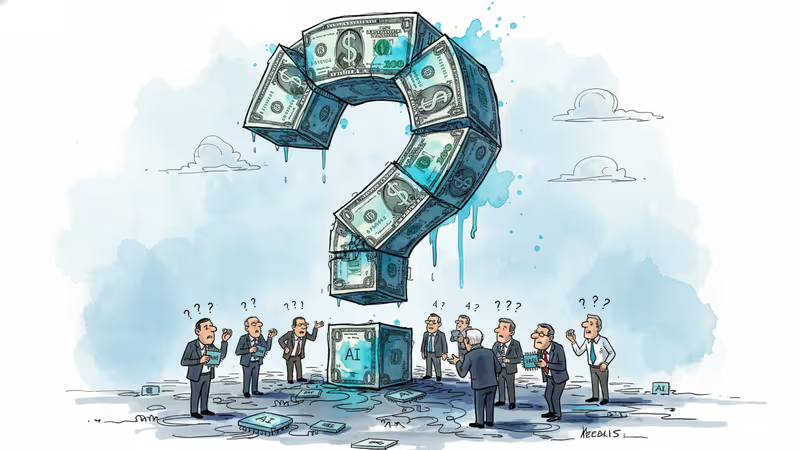
The $207 Billion Question Nobody Wants to Answer
Apple's Tim Cook dodged the AI monetization question that haunts Silicon Valley. While Big Tech spends billions on AI, the path to profitability remains mysteriously vague.
When Apple reported $143.8 billion in quarterly revenue last Thursday—a 16% year-over-year jump—most analysts lobbed softball questions at CEO Tim Cook. But Morgan Stanley'sErik Woodring dared to ask the question that haunts Silicon Valley's sleepless nights: "How do you monetize AI?"
The question hung in the air like an uncomfortable truth. Here was Apple, fresh off crushing earnings expectations, being asked to explain something that no major tech company has convincingly answered despite pouring hundreds of billions into artificial intelligence development.
Cook's response was a masterclass in corporate non-speak: "We're bringing intelligence to more of what people love, and we're integrating it across the operating system in a personal and private way, and I think that by doing so, it creates great value, and that opens up a range of opportunities across our products and services."
Translation: We have no idea either.
The Great AI Spending Spree
The numbers behind Big Tech's AI bet are staggering. OpenAI, despite ChatGPT's cultural dominance, doesn't plan to turn a profit until 2030. HSBC analysts are skeptical even about that timeline, estimating the company will need another $207 billion in funding to reach profitability.
This isn't just an OpenAI problem. Across Silicon Valley, companies are spending astronomical sums on AI infrastructure, talent, and development with business models that remain frustratingly abstract. The industry has adopted what can only be described as a "vibes-driven approach" to AI investment—betting big on technology whose revenue streams exist more in PowerPoint presentations than in actual profit-and-loss statements.

The irony is palpable. An industry built on disrupting traditional business models through clear value propositions has collectively shrugged when asked how AI will actually make money. Ask any tech executive about AI monetization, and you'll get the verbal equivalent of the ¯\_(ツ)_/¯ emoticon.
The Monetization Mirage
What makes Woodring's question so uncomfortable is that it exposes the emperor's new clothes moment in AI development. While companies race to integrate AI features into everything from smartphones to search engines, the fundamental question of customer willingness to pay remains unanswered.
Consider the current landscape: Google has integrated AI into search without charging extra. Microsoft offers Copilot features across its suite, but adoption rates and premium pricing success remain murky. Meta pours billions into AI research while its primary revenue model—advertising—hasn't fundamentally changed.
The assumption seems to be that AI will somehow create value that translates to revenue through undefined "opportunities" and "enhanced user experiences." But this circular logic sidesteps the hard questions: Will consumers pay subscription fees for AI features? Can AI reduce costs enough to justify the investment? Will AI create entirely new revenue streams, or just marginally improve existing ones?
The Apple Advantage
Apple's position in this AI monetization puzzle is particularly interesting. Unlike pure-play AI companies or advertising-dependent platforms, Apple has multiple monetization levers: hardware sales, services revenue, and its tightly controlled ecosystem.
The company could potentially charge premium prices for AI-enhanced devices, integrate AI features into its growing services portfolio, or use AI to drive deeper ecosystem lock-in. But Cook's vague response suggests even Apple—with its proven track record of monetizing new technologies—hasn't cracked the AI revenue code.
This uncertainty becomes more concerning when you consider Apple's typical product development philosophy. The company usually enters markets with clear value propositions and pricing strategies. Its reluctance to articulate AI monetization suggests the path forward is genuinely unclear, even for one of the world's most successful technology companies.
Authors
Related Articles
Google SVP Nick Fox confirmed ads in Gemini are "not ruled out," two months after DeepMind's CEO said the opposite. Here's what that shift means for users, advertisers, and the AI industry.

AI leaders from Google DeepMind, Anthropic, and OpenAI traded sharp jabs at Davos 2026. Explore the details of the Davos 2026 AI lab rivalry and the push for revenue.

Google DeepMind CEO Demis Hassabis expresses surprise at OpenAI's early ad adoption, emphasizing the need for trust in AI assistants over quick monetization.

OpenAI starts testing ads in the ChatGPT app and rolls out the $8 ChatGPT Go plan worldwide. See how this revenue shift impacts you.
Google SVP Nick Fox confirmed ads in Gemini are "not ruled out," two months after DeepMind's CEO said the opposite. Here's what that shift means for users, advertisers, and the AI industry.
AI leaders from Google DeepMind, Anthropic, and OpenAI traded sharp jabs at Davos 2026. Explore the details of the Davos 2026 AI lab rivalry and the push for revenue.
Google DeepMind CEO Demis Hassabis expresses surprise at OpenAI's early ad adoption, emphasizing the need for trust in AI assistants over quick monetization.
OpenAI starts testing ads in the ChatGPT app and rolls out the $8 ChatGPT Go plan worldwide. See how this revenue shift impacts you.
Thoughts
Share your thoughts on this article
Sign in to join the conversation