

Only 10 Guinea Worm Cases Left Worldwide—Eradication Within Reach
Guinea worm infections dropped to just 10 cases globally in 2025, bringing humanity closer to eradicating only the second human disease after smallpox.
Ten people. That's how many Guinea worm cases remained worldwide in 2025—down from 3.5 million in 1986. This microscopic number, announced by the Carter Center, represents humanity's closest approach to eradicating only the second human disease in history, after smallpox.
The path to near-elimination has been neither quick nor easy. For four decades, health workers have fought a parasitic enemy that has no vaccine, no cure, and inflicts excruciating pain on its victims.
The Agony of Guinea Worm
Guinea worm infection begins innocuously—with a drink of contaminated water. The parasitic larvae, harbored in tiny water fleas, enter the human body and begin a year-long journey through tissues and organs. Then comes the nightmare: a spaghetti-length worm emerges through a painful blister, typically on the feet or legs.
The emergence process takes up to eight weeks. Victims, desperate for pain relief, often submerge their blistered limbs in water—unwittingly allowing the parasite to release thousands more larvae and perpetuate the cycle.
Dr. Adam Weiss, who leads the Carter Center's Guinea worm eradication program, describes it as "one of the most painful diseases known to humanity." Unlike other parasitic infections, Guinea worm serves no evolutionary purpose for humans—it's purely destructive.
Why This Disease Matters
Guinea worm predominantly affects the world's poorest communities, particularly in rural Africa where access to clean water remains limited. The disease doesn't just cause individual suffering—it devastates entire communities. Infected people can't work, children can't attend school, and agricultural productivity plummets during harvest season when the worms typically emerge.
The economic impact extends beyond immediate productivity losses. Communities spend resources caring for the infected, and the cyclical nature of outbreaks can trap regions in poverty for generations.

The Eradication Playbook
With no medical interventions available, the fight against Guinea worm relies entirely on prevention and behavior change. The strategy sounds simple: provide clean water, educate communities about filtration, and contain infected individuals to break transmission cycles.
Execution, however, has proven extraordinarily complex. Health workers must reach remote villages, often in conflict zones, and convince communities to change centuries-old water collection practices. They've distributed millions of pipe filters, dug thousands of boreholes, and trained local volunteers to identify and report cases.
The Carter Center, alongside the World Health Organization and CDC, has invested over $400 million in this effort. Former President Jimmy Carter, now 100, has called Guinea worm eradication his presidency's greatest legacy.
New Challenges Emerge
Just as victory seemed certain, Guinea worm threw a curveball. In recent years, infections have appeared in dogs, cats, and other animals—primarily in Chad, Ethiopia, Mali, and South Sudan. This development complicates eradication efforts, as animal reservoirs are harder to monitor and control than human cases.
Scientists are still studying how animals became infected and whether they can transmit the disease back to humans. Some theories suggest changes in fishing practices or climate patterns may have altered the transmission dynamics.
Beyond Guinea Worm
The near-eradication of Guinea worm offers lessons for global health more broadly. Unlike high-tech medical interventions, this success story centers on sustained commitment, community engagement, and international cooperation. It demonstrates that even without vaccines or treatments, coordinated public health efforts can eliminate diseases.
This achievement comes at a crucial time for global health. The COVID-19 pandemic disrupted many disease control programs, and funding for neglected tropical diseases has stagnated. Guinea worm's imminent eradication provides a rare success story to inspire continued investment in global health initiatives.
Authors
Related Articles

Samsung Electronics' union branch revealed that 84% of survey respondents oppose the government's roughly $290 billion (₩400 trillion) semiconductor megaproject in Gwangju. Government, management, the union and shareholders are all reading the same national project in sharply different ways.

Nvidia shipped roughly a billion RISC-V cores in 2024, then announced it would run CUDA on the open standard. We break down how royalty-free instruction sets and open software stacks are trying to route around CUDA's lock-in. Part 2 of the Semiconductor Sovereignty series.
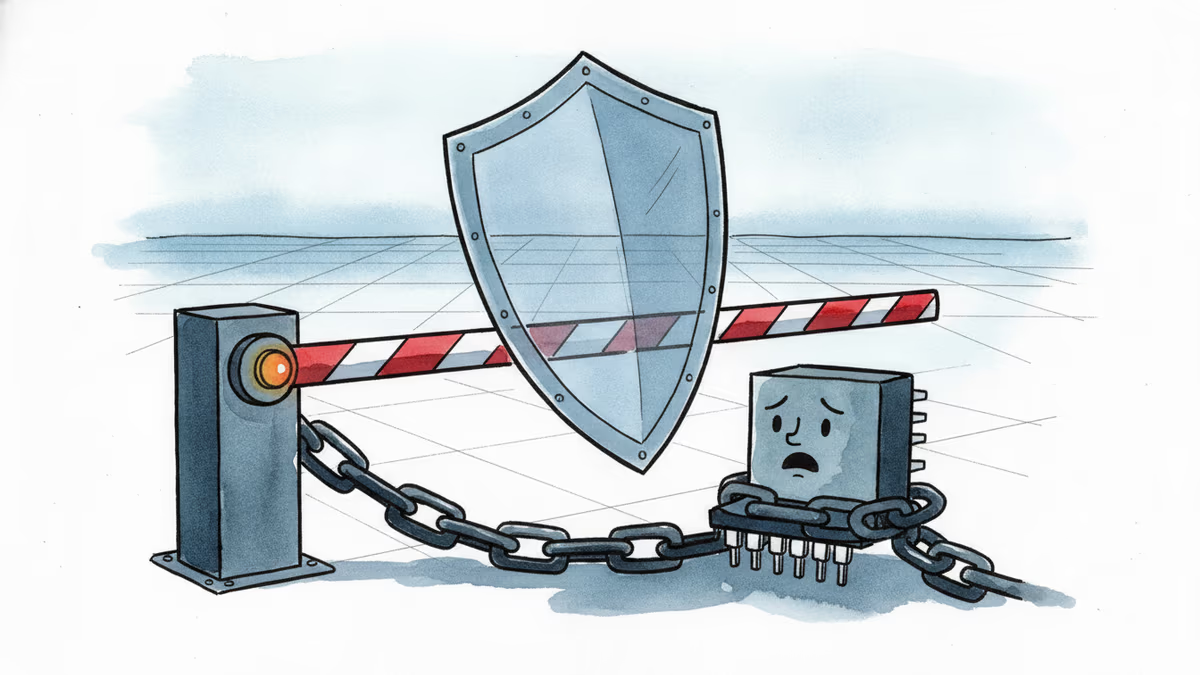
US AI-chip export controls split into three layers in the first half of 2026 — January easing, a May crackdown on circumvention, and a pending bill. Nvidia erased China from its guidance and still posted a record $81.6 billion quarter. A look at the export policy that both shields and cages it.
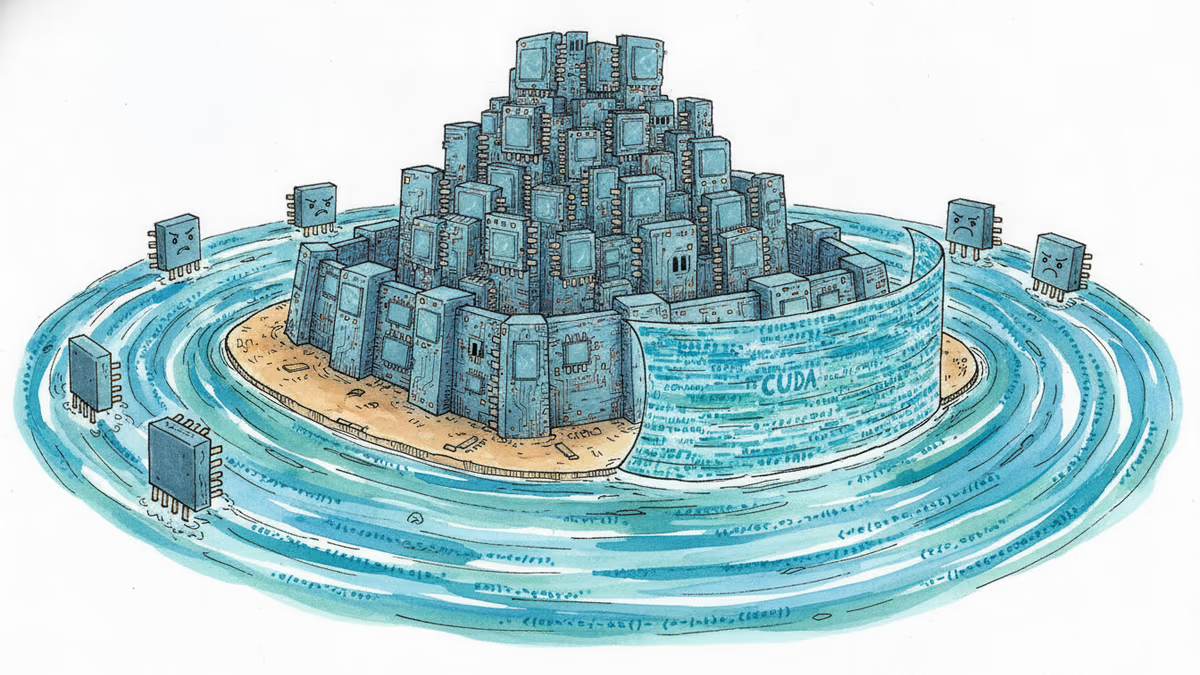
AMD's MI325X matches or beats Nvidia on memory and bandwidth — yet Nvidia's 86-92% share holds. The real moat is CUDA, 20 years in the making. Part 1 of 4.
Samsung Electronics' union branch revealed that 84% of survey respondents oppose the government's roughly $290 billion (₩400 trillion) semiconductor megaproject in Gwangju. Government, management, the union and shareholders are all reading the same national project in sharply different ways.
Nvidia shipped roughly a billion RISC-V cores in 2024, then announced it would run CUDA on the open standard. We break down how royalty-free instruction sets and open software stacks are trying to route around CUDA's lock-in. Part 2 of the Semiconductor Sovereignty series.
US AI-chip export controls split into three layers in the first half of 2026 — January easing, a May crackdown on circumvention, and a pending bill. Nvidia erased China from its guidance and still posted a record $81.6 billion quarter. A look at the export policy that both shields and cages it.
AMD's MI325X matches or beats Nvidia on memory and bandwidth — yet Nvidia's 86-92% share holds. The real moat is CUDA, 20 years in the making. Part 1 of 4.
Thoughts
Share your thoughts on this article
Sign in to join the conversation