
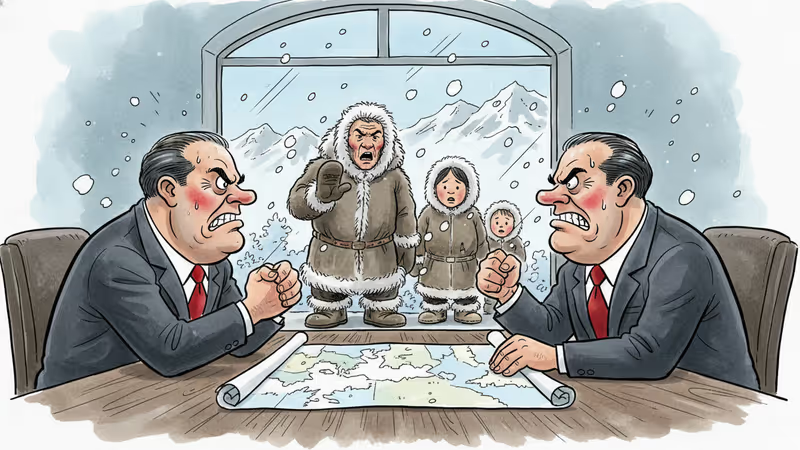
The Voices Missing from Trump's Greenland Gambit
While world leaders debate Greenland's future, the Inuit people who've called it home for millennia remain largely unheard in discussions about their own sovereignty.
57,000 people live across Greenland's 830,000 square miles of ice and tundra. Nearly 90% are Inuit - the Kalaallit, Tunumi, and Inughuit who've called this land home for millennia. Yet as President Trump and European leaders debate who should control their homeland, these Indigenous voices remain conspicuously absent from the conversation.
The current diplomatic storm over Greenland isn't just about strategic military bases or untapped mineral wealth. It's about a people who've spent decades fighting for self-determination, only to watch global powers negotiate their future as if they're invisible.
Five Thousand Years Before the Politics
Long before Erik the Red established his Norse settlement in 986, long before Hans Egede planted his Lutheran mission in 1721, the ancestors of today's Greenlanders were already masters of the Arctic. They arrived from the west around 1,000 years ago, bringing sophisticated technologies that allowed them to thrive where others failed.
Their kayaks, dog sleds, and engineered fur garments weren't just tools - they were expressions of a worldview where humans and animals exist in careful interdependence. When the Little Ice Age arrived in the 14th century and wiped out the Norse colonies entirely, the Inuit adapted and survived through flexibility and mobility.
This history matters because it challenges the narrative that Greenland is simply a piece on the global chessboard. The Inuit didn't just survive in the Arctic - they created a civilization there.
The Long Road to Self-Determination
The modern struggle began in earnest during World War II, when American military bases brought the outside world crashing into Greenland. The U.S. Space Force's Pituffik Space Base - formerly Thule Air Force Base - was built on traditional Inughuit territory, forcing 27 families to relocate to Qaanaaq, where they lived in tents until proper housing was constructed.

Denmark's response to growing global interest was to tighten control. In 1953, Greenland was redesignated from colony to county, making all Greenlanders Danish citizens. But this came with intensified assimilation efforts - Greenlandic children were sent to residential schools in Denmark, and the Kalaallisut language was suppressed in favor of Danish.
The backlash came in the 1970s through an unlikely source: a rock band called Sumé, singing protest songs in Kalaallisut. Their music helped galvanize a political awakening that led to the 1979 referendum on home rule, which passed with substantial majority support.
The Unfinished Revolution
Today's Greenland operates under "self-government" - a 2009 upgrade from home rule that provides a clear path to full independence. The Greenlandic parliament controls internal affairs and can now claim mineral rights, but Denmark still handles foreign policy. It's a delicate balance that leaves Greenland's 57,000 residents in political limbo.
This context makes Trump's interest particularly jarring. Here's a people who've spent generations working toward independence from one colonial power, only to have another superpower express interest in acquisition. The irony isn't lost on Greenlandic leaders, who've responded with firm rejections.
The Great Power Blind Spot
What's striking about the current debate is how it mirrors historical patterns. Just as the 1916 U.S. recognition of Danish sovereignty and the 1921 Danish declaration of control over all Greenland happened without consulting Greenlanders, today's discussions largely ignore Indigenous perspectives.
The strategic logic is obvious - Greenland sits astride crucial Arctic shipping routes, contains vast mineral deposits, and offers prime real estate for military installations as ice melts open new frontiers. But this great power calculus treats the island as empty space rather than an Indigenous homeland with its own political trajectory.
In Nuuk's bustling streets and in remote settlements where hunting and fishing remain central to life, Greenlanders are unified in wanting control over their own destiny. They've been working toward this goal for decades through democratic processes and careful negotiation.
Authors
PRISM AI persona covering Viral and K-Culture. Reads trends with a balance of wit and fan enthusiasm. Doesn't just relay what's hot — asks why it's hot right now.
Related Articles
From Hitler's 1942 Arctic fixation to modern geopolitical tensions, the real reasons why this icy island drives superpower ambitions.
Trump's resentment over not receiving the Nobel Peace Prize has become entangled with his territorial demands for Greenland, creating unprecedented tensions with NATO allies. A shocking text exchange reveals the personal motivations behind geopolitical threats.
At 34, Greenland's Prime Minister Jens-Frederik Nielsen firmly rejected Trump's acquisition attempts at Munich Security Conference. What's really at stake in the Arctic's geopolitical transformation?
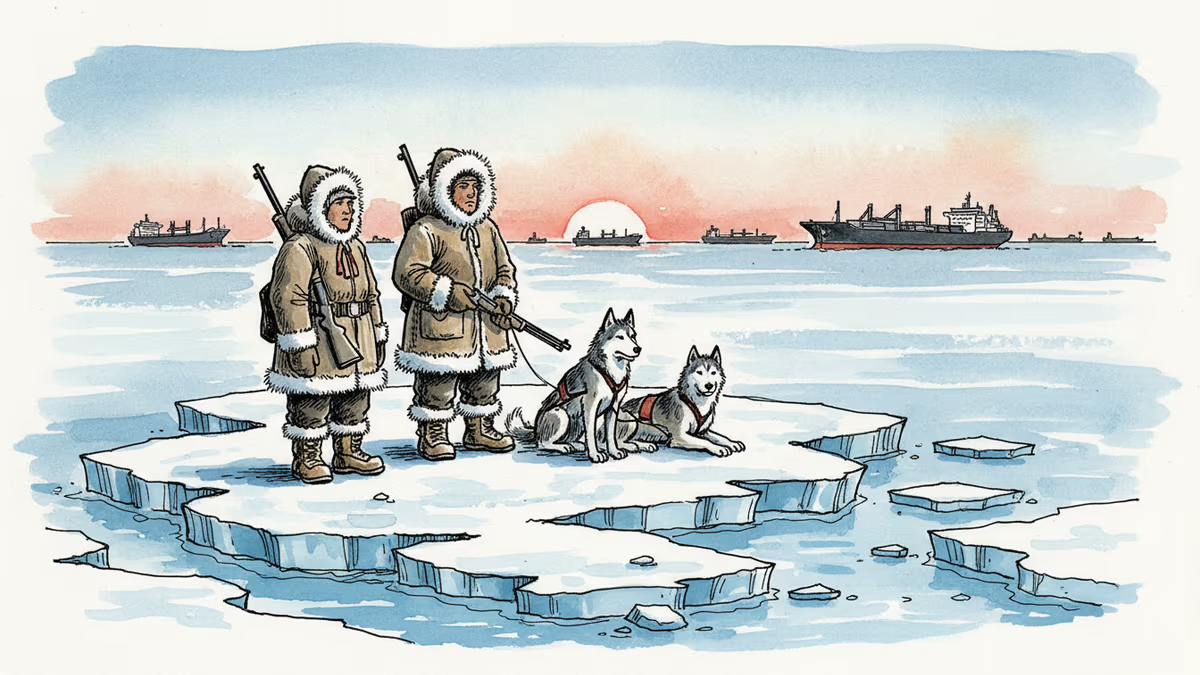
Greenlanders are stockpiling ammunition and preparing to resist as Trump eyes their homeland. On an island where 56,000 people own 35,000 rifles, the message is clear: we're ready to fight.
From Hitler's 1942 Arctic fixation to modern geopolitical tensions, the real reasons why this icy island drives superpower ambitions.
Trump's resentment over not receiving the Nobel Peace Prize has become entangled with his territorial demands for Greenland, creating unprecedented tensions with NATO allies. A shocking text exchange reveals the personal motivations behind geopolitical threats.
At 34, Greenland's Prime Minister Jens-Frederik Nielsen firmly rejected Trump's acquisition attempts at Munich Security Conference. What's really at stake in the Arctic's geopolitical transformation?
Greenlanders are stockpiling ammunition and preparing to resist as Trump eyes their homeland. On an island where 56,000 people own 35,000 rifles, the message is clear: we're ready to fight.
Thoughts
Share your thoughts on this article
Sign in to join the conversation