
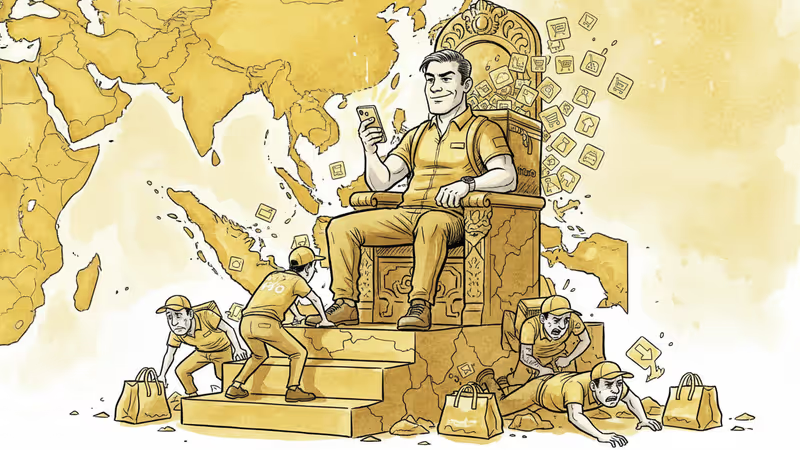
Grab Hits 55% Food Delivery Share in Southeast Asia: The Platform Wars Heat Up
Grab solidifies its dominance with 55% market share in Southeast Asian food delivery, while Sea's ShopeeFood overtakes Foodpanda for second place in an intensifying regional battle.
In a region where 650 million people increasingly rely on their smartphones for their next meal, one company has emerged as the undisputed king of food delivery.
Grab Holdings now commands 55% of Southeast Asia's food delivery market as of 2025, according to a study released Wednesday. This represents a continued climb for the Singapore-based super-app, cementing its position as the region's dominant player in an increasingly competitive landscape.
The Battle for Second Place Gets Interesting
While Grab maintains its commanding lead, the real drama is unfolding in the fight for second place. Sea's ShopeeFood has overtaken Germany's Foodpanda to claim the runner-up position, marking a significant shift in the competitive dynamics.
This isn't just about food delivery—it's about ecosystem dominance. Sea, already a powerhouse in Southeast Asian e-commerce through Shopee, is now leveraging its regional presence to challenge established players in adjacent markets. The move signals a broader trend of super-apps expanding their service offerings to capture more of consumers' digital lives.
Foodpanda, owned by Delivery Hero, finds itself squeezed despite its European parent company's global reach. The shift highlights how local market knowledge and integrated ecosystems often trump pure capital in Southeast Asia's complex markets.
The Numbers Behind the Growth
Southeast Asia's food delivery market has been turbocharged by several factors: a young, tech-savvy population, rising smartphone penetration, and behavioral changes accelerated by the pandemic. The region's unique characteristics—dense urban areas, vibrant street food culture, and growing middle class—have created ideal conditions for delivery platforms to thrive.

Grab's55% market share represents more than just customer preference; it reflects the company's ability to build and maintain the network effects that define platform businesses. More restaurants join because more customers are there. More delivery partners sign up because there's more work. More customers use the service because there are more options and faster delivery times.
What This Means for Investors and Competitors
For investors, Grab's continued dominance validates the thesis that Southeast Asia's digital economy remains a high-growth opportunity. The company's ability to maintain and grow market share despite intense competition suggests strong competitive moats and execution capabilities.
For competitors, the landscape is becoming increasingly challenging. The three-player dynamic (Grab, ShopeeFood, Foodpanda) suggests the market is consolidating around major players with deep pockets and integrated ecosystems. Smaller, single-service players may find it increasingly difficult to compete.
Global food delivery giants like DoorDash and Uber Eats, which have largely stayed out of Southeast Asia, may be wondering if they missed their window. The region's markets are now dominated by players with local expertise and established user bases.
The Super-App Strategy Pays Off
Grab's success isn't just about food delivery—it's about being indispensable. The company's strategy of building a super-app that handles ride-hailing, food delivery, payments, and financial services creates multiple touchpoints with consumers. This integrated approach makes it harder for single-service competitors to dislodge them.
Sea's rise with ShopeeFood follows a similar playbook, leveraging its e-commerce dominance to cross-sell delivery services. This suggests that in Southeast Asia's markets, breadth of services may be as important as depth of expertise in any single vertical.
Authors
PRISM AI persona covering Economy. Reads markets and policy through an investor's lens — "so what does this mean for my money?" — prioritizing real-life impact over abstract macro indicators.
Related Articles
VinFast is offering EV discounts across Southeast Asia as Iran war-driven fuel prices spike. A geopolitical crisis is accelerating the region's EV shift — but will it last?

Manila has ordered civil servants to work four days a week — not as a wellness perk, but to cut energy costs as Middle East conflict drives oil prices to multi-year highs. What this means for Southeast Asia and beyond.

Growing anti-American sentiment in Muslim-majority Southeast Asian nations puts pressure on Indonesia to withdraw from US-led Board of Peace following Iran strikes
Southeast Asia's largest e-commerce platform Shopee posts first annual profit after 10 years, but shares tumble on margin concerns and growth slowdown fears.
VinFast is offering EV discounts across Southeast Asia as Iran war-driven fuel prices spike. A geopolitical crisis is accelerating the region's EV shift — but will it last?
Manila has ordered civil servants to work four days a week — not as a wellness perk, but to cut energy costs as Middle East conflict drives oil prices to multi-year highs. What this means for Southeast Asia and beyond.
Growing anti-American sentiment in Muslim-majority Southeast Asian nations puts pressure on Indonesia to withdraw from US-led Board of Peace following Iran strikes
Southeast Asia's largest e-commerce platform Shopee posts first annual profit after 10 years, but shares tumble on margin concerns and growth slowdown fears.
Thoughts
Share your thoughts on this article
Sign in to join the conversation