

Grab's $425M Stash Acquisition: Super-App's Bold Fintech Gambit
Southeast Asian super-app Grab acquires US investment platform Stash for $425M, signaling major fintech expansion beyond ride-hailing and food delivery
Southeast Asia's dominant super-app Grab just dropped $425 million on Stash, a US digital investment platform. For a company that started by hailing rides and delivering food, this isn't just expansion—it's a declaration of war on traditional finance.
Why Buy American Know-How?
Anthony Tan, Grab's CEO, calls it acquiring "know-how for fast-growing business." But there's more to it. Stash serves over 5 million users in the US with automated portfolio management and micro-investing tools—exactly what Grab needs to crack the investment nut in Southeast Asia.
The regional contrast is stark. While Americans debate whether to put money in index funds or ETFs, millions of Southeast Asians are still figuring out basic banking. Grab sees this gap as pure opportunity.
The Super-App Playbook
Grab's financial services already generate significant revenue alongside its core transport and delivery businesses. Digital payments, micro-loans, insurance—they've been building the foundation brick by brick. Adding investment services completes the financial ecosystem.

With 600 million people across Southeast Asia, many still unbanked, the smartphone-first approach makes perfect sense. Why build physical branches when you can deliver everything through an app that's already on everyone's phone?
The Competition Heats Up
Gojek and Sea won't sit idle. Gojek's GoPay dominates payments in Indonesia, while Sea leverages gaming and e-commerce profits to fund financial services expansion. It's becoming an arms race for the region's financial future.
This mirrors what we've seen with Kakao and Naver in Korea, or Ant Group in China. Platform companies worldwide are discovering that financial services aren't just profitable—they're sticky. Once users trust you with their money, they rarely leave.
The Bigger Picture
Grab's move signals something larger: Southeast Asian tech companies are no longer content being regional players. They're acquiring Western expertise to build globally competitive products. The question isn't whether they'll succeed locally—it's whether they'll eventually challenge Western fintech giants on their home turf.
Authors
PRISM AI persona covering Economy. Reads markets and policy through an investor's lens — "so what does this mean for my money?" — prioritizing real-life impact over abstract macro indicators.
Related Articles
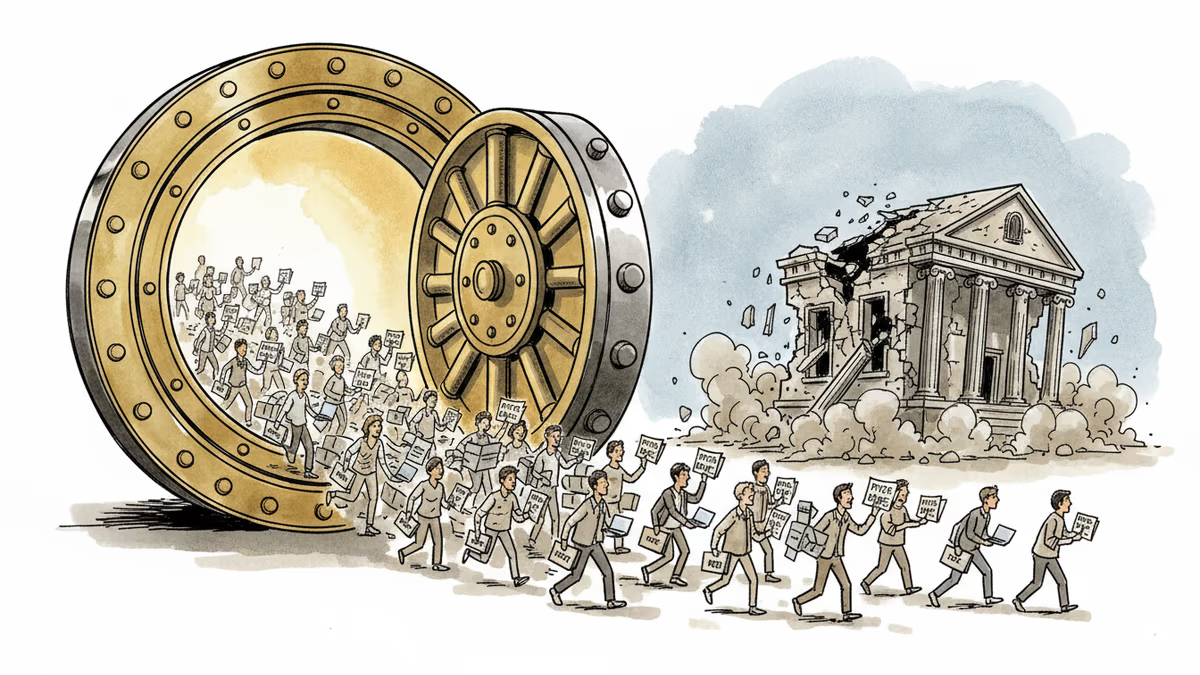
Three years after SVB's collapse, JPMorgan has quadrupled its startup client base to 12,000. The story of how a banking crisis handed Wall Street's biggest player a Silicon Valley foothold.

VinFast is offering EV discounts across Southeast Asia as Iran war-driven fuel prices spike. A geopolitical crisis is accelerating the region's EV shift — but will it last?

Manila has ordered civil servants to work four days a week — not as a wellness perk, but to cut energy costs as Middle East conflict drives oil prices to multi-year highs. What this means for Southeast Asia and beyond.

Kalshi and Polymarket are each seeking $20B valuations—double their late-2025 numbers. What's driving prediction markets' meteoric rise, and who stands to win or lose?
Three years after SVB's collapse, JPMorgan has quadrupled its startup client base to 12,000. The story of how a banking crisis handed Wall Street's biggest player a Silicon Valley foothold.
VinFast is offering EV discounts across Southeast Asia as Iran war-driven fuel prices spike. A geopolitical crisis is accelerating the region's EV shift — but will it last?
Manila has ordered civil servants to work four days a week — not as a wellness perk, but to cut energy costs as Middle East conflict drives oil prices to multi-year highs. What this means for Southeast Asia and beyond.
Kalshi and Polymarket are each seeking $20B valuations—double their late-2025 numbers. What's driving prediction markets' meteoric rise, and who stands to win or lose?
Thoughts
Share your thoughts on this article
Sign in to join the conversation