
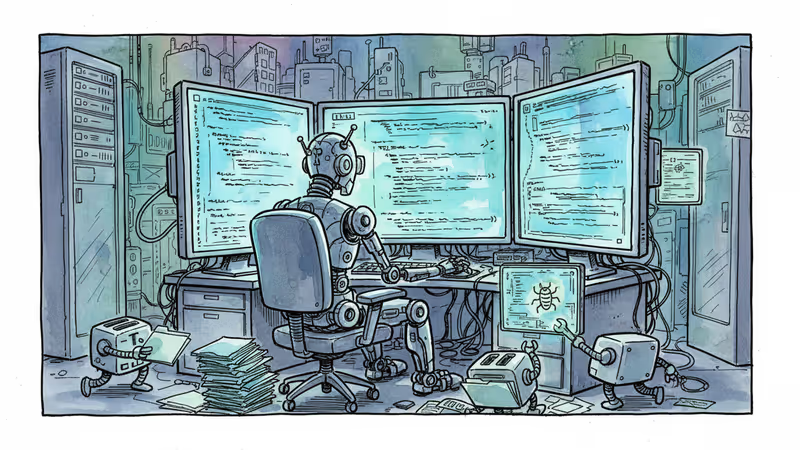
OpenAI's GPT-5.3-Codex: Evolution, Not Revolution
OpenAI releases GPT-5.3-Codex with improved coding capabilities across multiple platforms, but claims of AI building itself need reality-checking.
47% of software developers already use AI coding assistants daily, and today OpenAI just gave them a new reason to reconsider their toolchain. The company announced GPT-5.3-Codex, an enhanced version of its frontier coding model that promises better performance across the development workflow.
The new model will be accessible through multiple channels: command line interfaces, IDE extensions, web interfaces, and a dedicated macOS desktop application. While API access remains unavailable for now, OpenAI has confirmed it's in development.
Performance Claims and Reality Check
According to OpenAI's internal testing, GPT-5.3-Codex outperforms both its predecessor GPT-5.2-Codex and the general GPT-5.2 model on key benchmarks including SWE-Bench Pro and Terminal-Bench 2.0. These improvements suggest enhanced capabilities in real-world software engineering tasks rather than just theoretical coding challenges.
However, the tech media's immediate reaction deserves scrutiny. Headlines proclaiming "Codex built itself" have already started circulating, but this represents a fundamental misunderstanding of what OpenAI actually announced. The company described using the model for deployment management, debugging, and handling test results and evaluations—tasks that mirror what enterprise software development teams already do with existing AI tools.
There's no claim that GPT-5.3-Codex achieved self-improvement or autonomous development. The distinction matters because it separates incremental progress from the kind of recursive self-improvement that would represent a genuine breakthrough in AI development.
The Broader Development Landscape

This release arrives at a pivotal moment for AI-assisted coding. Major enterprises are increasingly integrating AI tools into their development pipelines, with companies like Microsoft (GitHub Copilot), Amazon (CodeWhisperer), and Anthropic (Claude) all competing for developer mindshare.
The multi-platform approach signals OpenAI's recognition that developers work across diverse environments. Command line access appeals to DevOps engineers and system administrators, while IDE integration serves the daily needs of application developers. The dedicated macOS app suggests a push toward standalone developer tools rather than just API-dependent services.
For development teams, the real question isn't whether GPT-5.3-Codex can write better code—it's whether it can meaningfully improve development velocity while maintaining code quality and security standards. Early enterprise adoptions of AI coding tools have shown mixed results, with productivity gains often offset by increased code review overhead and security concerns.
Market Implications and Developer Adoption
The staggered rollout—starting with direct interfaces before API access—reflects OpenAI's cautious approach to enterprise deployment. This strategy allows the company to gather usage data and refine the model before opening it to broader integration scenarios.
For individual developers and small teams, the immediate availability across multiple platforms lowers the barrier to experimentation. However, enterprise adoption will likely depend on factors beyond pure performance: integration complexity, security compliance, and cost predictability.
The timing also coincides with increased scrutiny over AI training data and copyright issues in code generation. While OpenAI hasn't detailed the training methodology for GPT-5.3-Codex, the legal landscape around AI-generated code continues evolving, potentially affecting enterprise adoption decisions.
Authors
Related Articles

OpenAI has reorganized for the second time in a month, merging ChatGPT and Codex into a single agentic platform under president Greg Brockman's unified product leadership.

After two weeks of witnesses calling him a liar, OpenAI CEO Sam Altman testified in his own defense, claiming Elon Musk tried to kill the company twice.

Sam Nelson, 19, died after following ChatGPT's advice to mix Kratom and Xanax. His parents are suing OpenAI for wrongful death, raising urgent questions about AI trust, liability, and design.
OpenAI's new Daybreak initiative uses the Codex AI agent to find and patch security vulnerabilities before attackers do—putting it in direct competition with Anthropic's secretive Claude Mythos.
OpenAI has reorganized for the second time in a month, merging ChatGPT and Codex into a single agentic platform under president Greg Brockman's unified product leadership.
After two weeks of witnesses calling him a liar, OpenAI CEO Sam Altman testified in his own defense, claiming Elon Musk tried to kill the company twice.
Sam Nelson, 19, died after following ChatGPT's advice to mix Kratom and Xanax. His parents are suing OpenAI for wrongful death, raising urgent questions about AI trust, liability, and design.
OpenAI's new Daybreak initiative uses the Codex AI agent to find and patch security vulnerabilities before attackers do—putting it in direct competition with Anthropic's secretive Claude Mythos.
Thoughts
Share your thoughts on this article
Sign in to join the conversation