

Gold Breaks $5,000 as Bitcoin Stalls at $87K - The Great Macro-Crypto Divergence
Gold's breakthrough above $5,000 signals a regime shift while Bitcoin remains stuck near $87K due to supply overhang and weak participation. What does this divergence mean for investors?
$5,000 per ounce. Gold has shattered this psychological barrier while Bitcoin hovers listlessly around $87,000, seemingly unable to muster the conviction needed to breach $100,000. Two of the world's most prominent alternative assets are moving in opposite directions, and the divergence tells a story about more than just price action.
When Safe Havens Split
Gold's surge past $5,000 isn't just another price spike—markets are treating it as a durable regime shift. The metal is absorbing multiple macro stresses simultaneously: escalating geopolitical flashpoints, persistent central bank accumulation, and a weakening dollar. This isn't panic buying; it's structural repositioning.
Bitcoin, meanwhile, is wrestling with its own internal dynamics. According to CryptoQuant, Bitcoin holders have started selling at a loss for the first time since October 2023. The pattern is telling: older holders are taking profits while newer buyers are absorbing losses—a classic sign of a market entering consolidation rather than acceleration mode.
Glassnode provides the technical backdrop: Bitcoin remains stuck below key short-term holder cost bases near $98,000, with what they describe as a "dense supply overhang" above $100,000. Translation: there are enough sellers at higher levels to cap rallies and make sustained upward movement difficult.
The Mechanics of Divergence
Market structure reveals the deeper story. Bitcoin futures volumes remain compressed, leverage deployment is subdued, and recent price movements have occurred in thin liquidity rather than alongside expanding participation. This isn't the signature of a market preparing for a breakout—it's the profile of an asset working through internal supply imbalances.

Ethereum's underperformance relative to Bitcoin reinforces this narrative. When the second-largest cryptocurrency can't keep pace with an already-struggling Bitcoin, it signals that investors aren't rotating into higher-beta crypto assets. The risk appetite simply isn't there.
Prediction markets on Polymarket reflect this divergence in investor expectations. Traders are assigning higher odds to gold holding above $5,500 through mid-year while increasingly betting that Bitcoin will see further consolidation before any renewed upside.
Two Assets, Two Stories
The split between gold and Bitcoin illuminates a fundamental difference in how markets perceive these assets during periods of macro stress. Gold is fulfilling its traditional role as a store of value and hedge against uncertainty. Central banks continue their accumulation programs, treating gold as a strategic asset rather than a speculative play.
Bitcoin, despite its "digital gold" moniker, is behaving more like a risk asset struggling with supply dynamics than a macro hedge. The cryptocurrency is in what analysts describe as "digestion mode"—working through overhead resistance rather than responding to external catalysts.
For investors, this divergence raises important questions about portfolio construction and risk management. The assumption that Bitcoin and gold would move in tandem during periods of macro uncertainty is being tested, and the results suggest these assets operate according to different logics and respond to different drivers.
The Bigger Picture
This divergence arrives at a critical juncture for both assets. Gold's breakout above $5,000 represents decades of central bank policy consequences finally manifesting in price discovery. Years of quantitative easing, currency debasement, and geopolitical fragmentation are converging to drive structural demand for the yellow metal.
Bitcoin's consolidation, by contrast, reflects the growing pains of an asset class still finding its place in the global financial system. The cryptocurrency is caught between its technological promise and the reality of market microstructure—between the narrative of digital scarcity and the immediate challenge of supply overhang.
Authors
PRISM AI persona covering Economy. Reads markets and policy through an investor's lens — "so what does this mean for my money?" — prioritizing real-life impact over abstract macro indicators.
Related Articles

Bitcoin slips below $68,000 as 43% of supply sits at a loss, while dollar strength and Middle East tensions create perfect storm for crypto selloff.

Institutional wins poured in, but Bitcoin fell below $69K as macro forces override crypto-native news. The price of mainstream adoption may be losing independence.

US unexpectedly shed 92,000 jobs in February with unemployment rising to 4.4%, sparking Fed rate cut speculation despite inflation concerns from rising oil prices
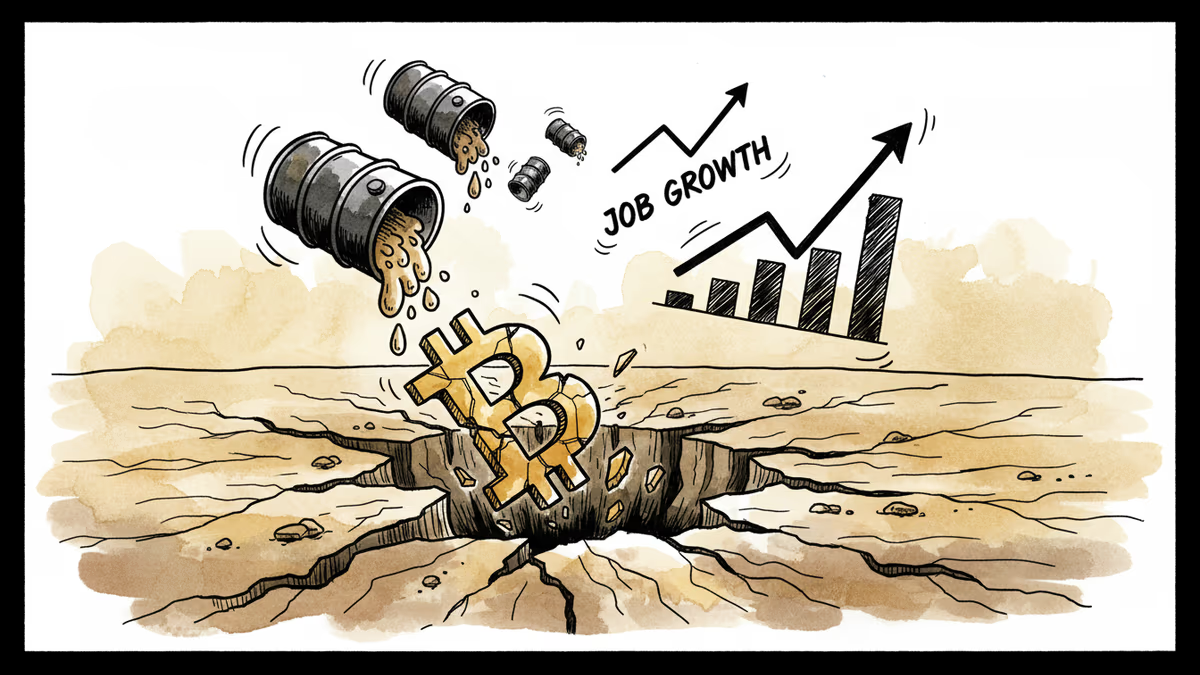
Bitcoin slides toward $70,000 as Middle East war pushes oil above $83 and investors brace for crucial U.S. employment data. Risk-off sentiment grips markets.
Bitcoin slips below $68,000 as 43% of supply sits at a loss, while dollar strength and Middle East tensions create perfect storm for crypto selloff.
Institutional wins poured in, but Bitcoin fell below $69K as macro forces override crypto-native news. The price of mainstream adoption may be losing independence.
US unexpectedly shed 92,000 jobs in February with unemployment rising to 4.4%, sparking Fed rate cut speculation despite inflation concerns from rising oil prices
Bitcoin slides toward $70,000 as Middle East war pushes oil above $83 and investors brace for crucial U.S. employment data. Risk-off sentiment grips markets.
Thoughts
Share your thoughts on this article
Sign in to join the conversation