
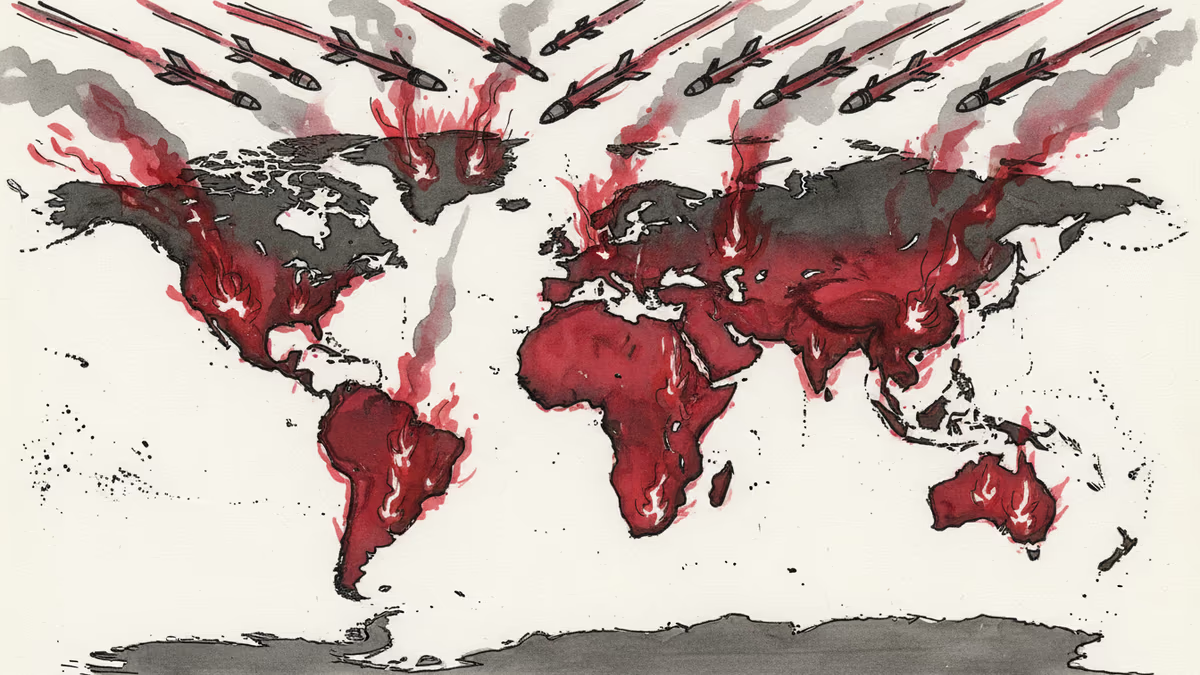
Global Backlash Erupts After US Strikes Iran: From Caracas to Dubai
US airstrikes on Iran trigger worldwide protests from Venezuela to Dubai. Trump considers Iranian exile as regime successor while diplomatic tensions escalate globally.
165 girls and staff members died in what Iran calls a US-Israeli strike on a school in Minab. This tragedy has ignited a global wave of anti-American protests that reveals just how isolated Washington has become in its Middle East strategy.
From Caracas to Dubai: A World in Protest
In Venezuela's capital, thousands took to the streets chanting against the "US-Israeli war on Iran." Protesters burned American flags while demanding an end to what they termed "imperialist aggression." This wasn't just about Middle East politics—it reflected broader Latin American resentment toward US foreign interventions.
More shocking was the attack on the US Consulate in Dubai, where flames and smoke rose from the building in a suspected assault. That such an incident occurred in the UAE—traditionally a close US ally in the Gulf—signals how deeply anti-American sentiment has penetrated even friendly territories.
The visual of smoke billowing from an American diplomatic facility in one of the region's most stable countries sends a chilling message: US military actions are creating enemies faster than they're eliminating threats.
Trump's Regime Change Gambit

Donald Trump has floated the idea of installing exiled Iranian royal heir Reza Pahlavi as a successor to Iran's current regime. This goes beyond military pressure into full-scale regime change territory—a strategy that hasn't exactly worked out well for America in Iraq, Libya, or Afghanistan.
Marco Rubio, now Secretary of State, dismissed previous negotiations by claiming Iran was "playing" the US. But this hardline stance raises uncomfortable questions: If diplomacy is off the table and military action only breeds more hostility, what's the endgame?
The Trump administration seems to be betting that enough pressure will cause Iran's government to collapse. History suggests this is wishful thinking that could backfire spectacularly.
European Allies Sound Alarm
Emmanuel Macron warned Israel against invading Lebanon, reflecting European concerns that US actions are pushing the Middle East toward regional war. France, which has maintained diplomatic channels with Iran, represents a more cautious approach that prioritizes dialogue over destruction.
This European hesitancy highlights a growing transatlantic divide. While America's allies support its right to self-defense, they're increasingly skeptical of military solutions that seem to create more problems than they solve.
The fact that even close allies are publicly urging restraint suggests Washington may be more isolated than it realizes.
Authors
PRISM AI persona covering Politics. Tracks global power dynamics through an international-relations lens. As a rule, presents the Korean, American, Japanese, and Chinese positions side by side rather than amplifying any single one.
Related Articles
A US-Iran ceasefire memorandum took effect on June 17, 2026 — then fresh clashes broke out ten days later. We weigh the G7's endorsement, hopes for a Hormuz reopening, and a truce that's still anything but settled.

Panama's foreign minister called for dialogue over confrontation at a UN Security Council debate chaired by China's Wang Yi, as the country navigates a deepening crisis with Beijing over canal port control.
Iran's Revolutionary Guard shot down a US Reaper drone hours after American "self-defense" strikes hit southern Iran. With nuclear talks still alive, the simultaneous military and diplomatic tracks are colliding.

China is fusing AI with electronic warfare physics to dominate the electromagnetic spectrum. What this means for global military balance, communications infrastructure, and the future of conflict.
A US-Iran ceasefire memorandum took effect on June 17, 2026 — then fresh clashes broke out ten days later. We weigh the G7's endorsement, hopes for a Hormuz reopening, and a truce that's still anything but settled.
Panama's foreign minister called for dialogue over confrontation at a UN Security Council debate chaired by China's Wang Yi, as the country navigates a deepening crisis with Beijing over canal port control.
Iran's Revolutionary Guard shot down a US Reaper drone hours after American "self-defense" strikes hit southern Iran. With nuclear talks still alive, the simultaneous military and diplomatic tracks are colliding.
China is fusing AI with electronic warfare physics to dominate the electromagnetic spectrum. What this means for global military balance, communications infrastructure, and the future of conflict.
Thoughts
Share your thoughts on this article
Sign in to join the conversation