
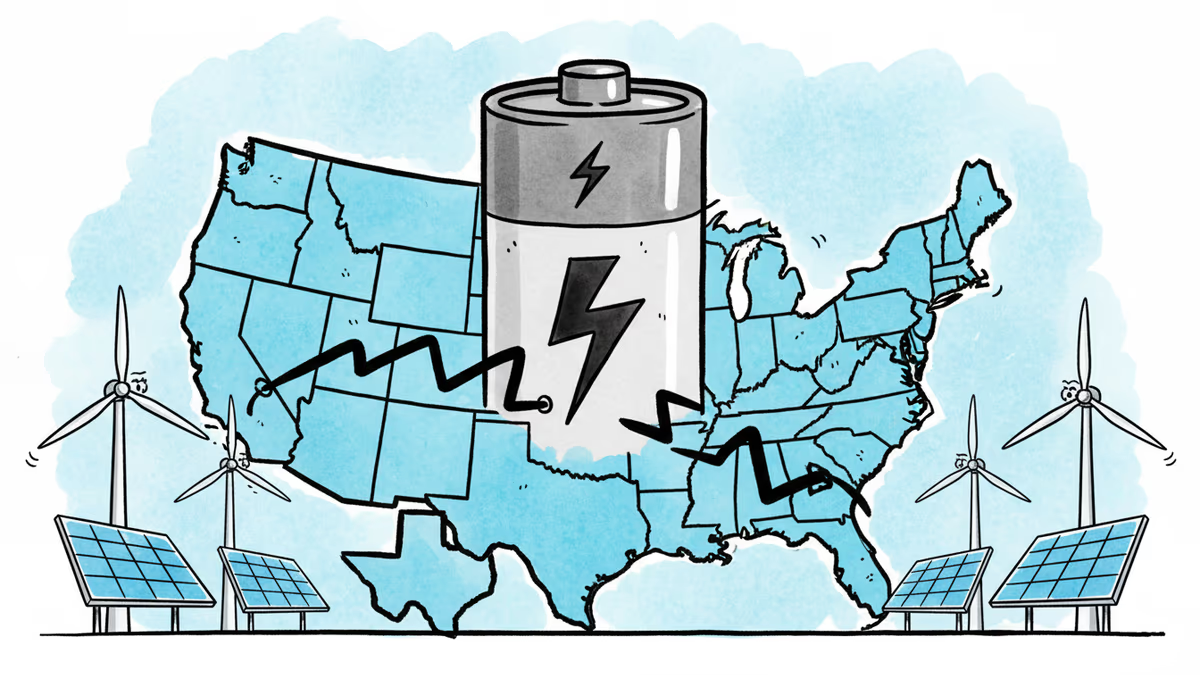
57 Gigawatt Hours: What America's Battery Boom Really Means
US energy storage installations surged 30% in 2025 despite Trump's renewable hostility. Why batteries succeeded where solar and wind struggled.
The Number That Changed Everything
57 gigawatt hours. That's how much new energy storage America added in 2025—enough to power 5 million homes for a year. To put this in perspective, less than a decade ago, the entire US had just half a gigawatt of storage on the grid.
This isn't just impressive growth. It's a political anomaly. While the Trump administration slashed tax credits for wind and solar as part of last summer's "One Big Beautiful Bill," batteries largely escaped the chopping block. The result? A 30% jump in storage installations, making 2025 a record-breaking year.
When Texas Beats California at Its Own Game
The most surprising storyline is unfolding in Texas. This year, the Lone Star State is expected to overtake California as America's storage leader. Last summer, solar power met more than 15% of Texas demand, beating coal for the first time in state history.
Jigar Shah, former director of the Department of Energy's Loan Programs Office, credits Texas's deregulated grid. "Texas basically says, 'I don't care about your cultural bias. These are the market signals. You want to build coal plants? Great. You want to build batteries? Great.'" The market chose batteries.
This free-market success story is so compelling that even MAGA voters are coming around to solar power, according to recent polling. Katie Miller, former top communications official for the Department of Government Efficiency, has been tweeting approvingly about solar energy in recent weeks.
The Politics of Storage
Why did batteries survive the renewable energy purge? Simple economics. Unlike solar panels or wind turbines, batteries solve an immediate problem that everyone understands: grid reliability. They're not just about clean energy—they're about keeping the lights on.

Republican lawmakers with clean energy projects in their districts fought the renewable cuts, but batteries needed less defending. They're politically resilient because they're technologically essential.
The Grid's Hidden Potential
Here's what most people don't realize: American power grids typically use only 50% of available capacity on any given day. The other half sits idle, waiting for peak demand periods that happen just 200-300 hours per year.
Batteries change this equation. "The only way to really get more out of the grid we've already paid for is to put batteries on both sides," Shah explains. "When the grid is underutilized, we charge batteries. Then we use those batteries to reduce those peaks."
This isn't just theory. The majority of 2025's battery installations were stand-alone units, not tied to specific solar projects. They're grid assets first, renewable enablers second.
The Data Center Connection
Behind-the-meter installations—storage not connected to the larger grid—also drove growth this year. Data centers, impatient with long grid connection lead times, are increasingly going it alone with private power solutions.
This trend could reshape how we think about electricity infrastructure. Instead of everything flowing through centralized grids, we're moving toward a more distributed model where major users generate and store their own power.
Storm Clouds Ahead
Despite the success, challenges loom. The "One Big Beautiful Bill" reinforced restrictions on manufacturers from China, Russia, Iran, and North Korea. Since China dominates solar and battery supply chains, this could create bottlenecks.
Project cancellations due to shortened solar tax credits could also impact the storage pipeline. And with an administration prone to policy U-turns, nothing is guaranteed.
The 2025 battery boom isn't just about storing electricity. It's about storing power itself.
Authors
Related Articles
Sodium-ion batteries emerge as cheaper, safer alternatives to lithium, entering EVs and grid storage. MIT Technology Review names it a 2026 breakthrough technology.
Samsung Electronics' union branch revealed that 84% of survey respondents oppose the government's roughly $290 billion (₩400 trillion) semiconductor megaproject in Gwangju. Government, management, the union and shareholders are all reading the same national project in sharply different ways.
Nvidia shipped roughly a billion RISC-V cores in 2024, then announced it would run CUDA on the open standard. We break down how royalty-free instruction sets and open software stacks are trying to route around CUDA's lock-in. Part 2 of the Semiconductor Sovereignty series.
US AI-chip export controls split into three layers in the first half of 2026 — January easing, a May crackdown on circumvention, and a pending bill. Nvidia erased China from its guidance and still posted a record $81.6 billion quarter. A look at the export policy that both shields and cages it.
Sodium-ion batteries emerge as cheaper, safer alternatives to lithium, entering EVs and grid storage. MIT Technology Review names it a 2026 breakthrough technology.
Samsung Electronics' union branch revealed that 84% of survey respondents oppose the government's roughly $290 billion (₩400 trillion) semiconductor megaproject in Gwangju. Government, management, the union and shareholders are all reading the same national project in sharply different ways.
Nvidia shipped roughly a billion RISC-V cores in 2024, then announced it would run CUDA on the open standard. We break down how royalty-free instruction sets and open software stacks are trying to route around CUDA's lock-in. Part 2 of the Semiconductor Sovereignty series.
US AI-chip export controls split into three layers in the first half of 2026 — January easing, a May crackdown on circumvention, and a pending bill. Nvidia erased China from its guidance and still posted a record $81.6 billion quarter. A look at the export policy that both shields and cages it.
Thoughts
Share your thoughts on this article
Sign in to join the conversation