
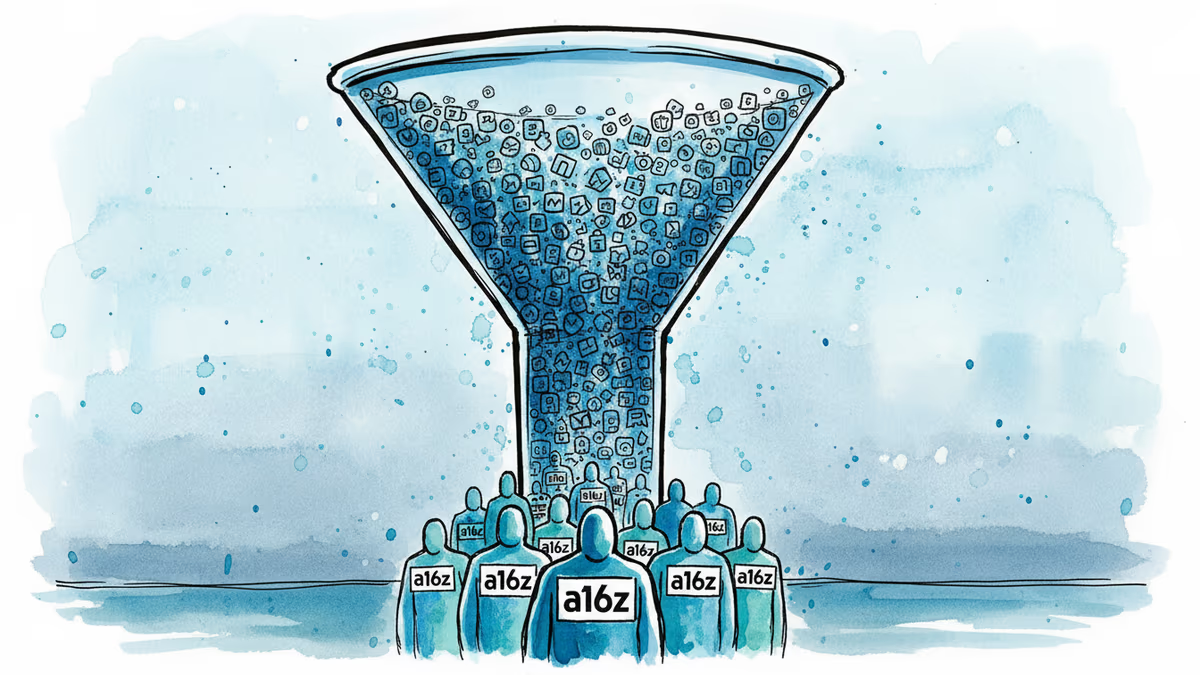
Why 19,000 Startups Are Fighting for 80 Spots at a16z Speedrun
With a 0.4% acceptance rate and higher equity demands than YC, a16z's Speedrun accelerator is reshaping how startups think about early-stage funding.
19,000 startups applied. Fewer than 80 got in. That's a 0.4% acceptance rate—lower than Harvard's.
Welcome to Andreessen Horowitz's Speedrun program, the hottest ticket in startup land. Launched in 2023, this accelerator has become the subject of intense founder fascination. But here's the puzzling part: it's more expensive than its competitors, yet applications keep flooding in.
The Premium Price Tag
Speedrun's deal structure raises eyebrows. The program invests $500,000 upfront for 10% equity via a SAFE note. Hit your next funding milestone within 18 months? Another $500,000 flows in. That's potentially $1 million for 10% of your company.
Compare that to Y Combinator's $125,000 for 7%, plus an additional $375,000 on more flexible terms. By any measure, Speedrun costs more.
So why are founders lining up? "We're more equity expensive because of what we offer," explains Joshua Lu, the program's general manager and a16z partner. "We have around 600 people at a16z, and 10% are on the investment team. Everyone else is an operator supporting our companies."
Beyond the Money Game
The real draw isn't the cash—it's the infrastructure. Speedrun provides $5 million in credits across vendors like AWS, OpenAI, Nvidia, and Deel. More importantly, it offers access to a16z's sprawling network of operators who handle everything from go-to-market strategy to talent acquisition.
"What you get out of Speedrun is what you put into it," Lu tells founders. "We think founders who want to take advantage of world experts in many different domains early in their startup journey would be really smart to choose us."

It's a bet that expertise trumps equity preservation—at least for the right founders.
The Team-First Philosophy
Mohamed Mohamed, whose proptech startup Smart Bricks just raised $5 million after graduating from Speedrun, treated his application like "an internal strategy memo rather than a pitch." His advice? "Instead of polishing buzzwords, we focused on clarity—the real problem, why it's structurally hard, and why our team is unusually well-positioned to solve it."
Speedrun obsesses over founding teams. Not the typical "one technical, one business" formula, but teams that genuinely complement each other's blind spots. They particularly favor co-founders with shared history.
"There are lots of things that a founding team has to navigate," Lu explains. "Having pattern recognition, knowing how to disagree and come out the other side—teams with shared histories have an easier time with this."
The AI Paradox
Here's where it gets interesting. While AI has lowered barriers to building software, Speedrun actually prefers teams that already show market traction. "AI has made it much faster to build and validate hypotheses," Lu notes. "We look for teams that have endeavored to build and show us there's a little spark we can fan the flames on."
The program encourages founders to use AI for application cleanup—no excuse for grammar errors anymore. But if AI does all the heavy lifting in explaining your startup, you'll struggle in the live video interviews where only 10% of applicants advance.
The Network Effect
What Speedrun is really selling isn't money or mentorship—it's network effects. In an ecosystem where connections often matter more than credentials, a16z's 600-person operation becomes a competitive moat.
The best-performing cohort companies, Lu observes, are the "greediest" about accessing the firm's resources. They know exactly which experts they want to meet and why.
Authors
Related Articles
Cluely CEO admits to fabricating $7M revenue figure, exposing how startup "fake it till you make it" culture has gone too far. What this means for the ecosystem.
AI startups are using dual-tier valuations to manufacture unicorn status. Why are investors playing along with this new valuation game?
AI startups captured 90% of record $189B February VC funding, with OpenAI, Anthropic, and Waymo dominating 83% of all investments, reshaping venture landscape
Anduril's $60B valuation bid signals a seismic shift in defense tech. As VCs pour billions into weapons, what does this mean for warfare's future?
Cluely CEO admits to fabricating $7M revenue figure, exposing how startup "fake it till you make it" culture has gone too far. What this means for the ecosystem.
AI startups are using dual-tier valuations to manufacture unicorn status. Why are investors playing along with this new valuation game?
AI startups captured 90% of record $189B February VC funding, with OpenAI, Anthropic, and Waymo dominating 83% of all investments, reshaping venture landscape
Anduril's $60B valuation bid signals a seismic shift in defense tech. As VCs pour billions into weapons, what does this mean for warfare's future?
Thoughts
Share your thoughts on this article
Sign in to join the conversation