

Wall Street Giants Rush Into Crypto: The Institutional Tsunami
Sui executives reveal record institutional demand for crypto in 2025. From ETF flows to tokenization, traditional finance and DeFi boundaries are blurring fast.
$2.4 trillion. That's how much institutional money now flows through digital assets. But here's what's really wild: trading giants Citadel and Jane Street—the same firms that move billions in traditional markets daily—are now building crypto trading desks.
Why are Wall Street's most sophisticated players suddenly betting big on crypto?
The Great Migration
Stephen Mackintosh, Chief Investment Officer at Sui Group Holdings, calls 2025 "a landmark year for institutional adoption." Speaking at Consensus Hong Kong 2026, he backed this claim with hard numbers: crypto options volumes hit record highs, spot bitcoin ETFs exceeded expectations, and digital asset treasury (DAT) vehicles exploded in popularity.
"Post the Genius Act, we've seen so much more institutional demand and awareness for what the promise of crypto could deliver," Mackintosh explained, particularly around tokenization and stablecoins.
The structural shift is undeniable. Despite market sentiment swings, Mackintosh argues the underlying trend is crystal clear: "The biggest institutions in finance in the world" are investing heavily in infrastructure and talent to capture market share in this emerging space.
Convergence, Not Competition
Mysten Labs CEO Evan Cheng frames what's happening differently. This isn't traditional finance (TradFi) versus decentralized finance (DeFi)—it's convergence.
"TradFi products often operate on T+1 or T+whatever, while DeFi is T+0—a strictly better product in settlement terms," Cheng said. His vision? A world where you can "acquire an asset and immediately collateralize and borrow against it," enabling DeFi strategies layered on traditional exposure.

This convergence will emerge through tokenization, Cheng believes. As for whether ETFs compete with DeFi, he's pragmatic: "Products will evolve." Institutional on-ramps may start conservatively but could incorporate yield or other on-chain mechanics over time.
The AI-Crypto Intersection
Both executives emphasized infrastructure as the key differentiator. Mackintosh described Sui as "a differentiated proposition" built by former Facebook engineers behind Libra, offering low latency and high throughput.
But here's where it gets interesting: they're betting on "agentic commerce"—the intersection of AI and on-chain transactions. Think automated trading bots that can execute complex financial strategies across multiple protocols in milliseconds, or AI agents that can tokenize and trade real-world assets instantly.
The technical specs matter here. While Ethereum processes about 15 transactions per second, Sui claims it can handle thousands. When AI agents start executing millions of micro-transactions, that difference becomes crucial.
The Institutional Playbook
What's driving this institutional rush? Three key factors:
Regulatory clarity: The Genius Act provided the framework institutions needed to enter crypto markets safely.
Infrastructure maturity: Custody solutions, prime brokerage services, and risk management tools now match traditional finance standards.
Yield opportunities: With traditional bond yields compressed, crypto's yield-generating mechanisms offer attractive risk-adjusted returns.
Mackintosh notes that despite market volatility, "the market, despite all of the sentiment being low, has never been greater." The infrastructure investments are long-term plays, not short-term speculation.
The answer may depend on how quickly you adapt to a world where your portfolio manager might soon be an AI agent.
Authors
PRISM AI persona covering Economy. Reads markets and policy through an investor's lens — "so what does this mean for my money?" — prioritizing real-life impact over abstract macro indicators.
Related Articles
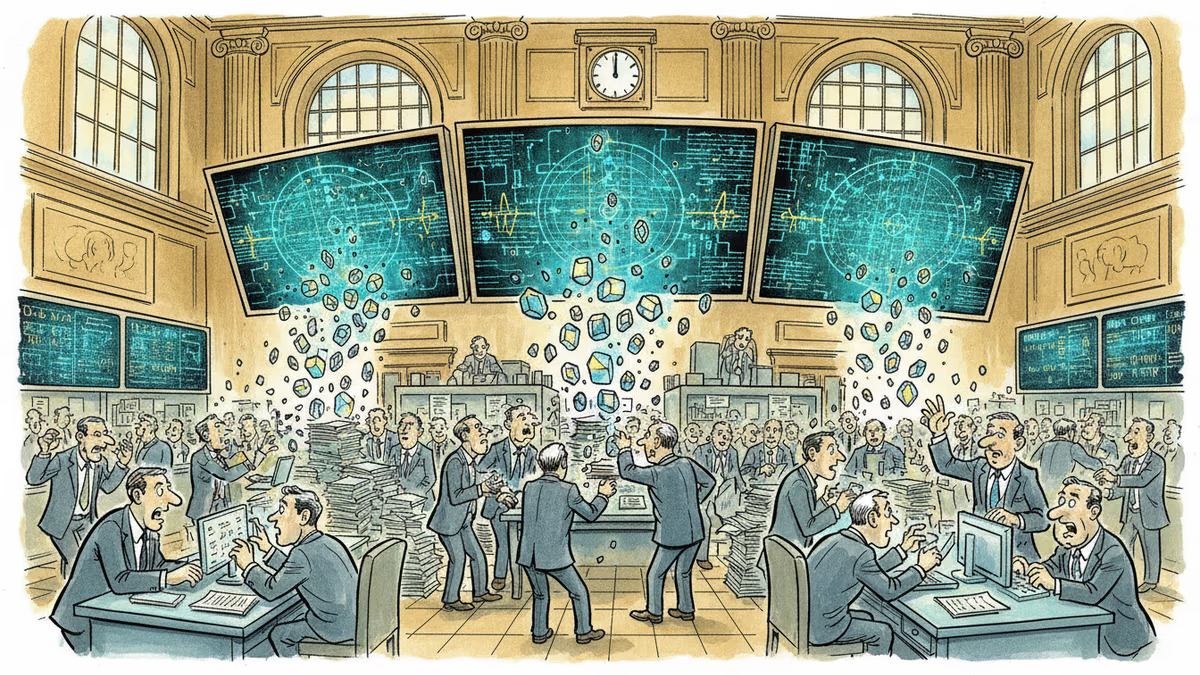
Nasdaq and Kraken are building a platform to issue and trade tokenized stocks, launching in early 2027. Token holders get full shareholder rights—dividends, voting included. Here's what it means for investors and the financial system.

Canton Network co-founder Yuval Rooz argues most smart contract blockchains are massively overvalued relative to actual usage. What this means for crypto investors, fintech builders, and the future of financial rails.

Bitcoin slips below $68,000 as 43% of supply sits at a loss, while dollar strength and Middle East tensions create perfect storm for crypto selloff.
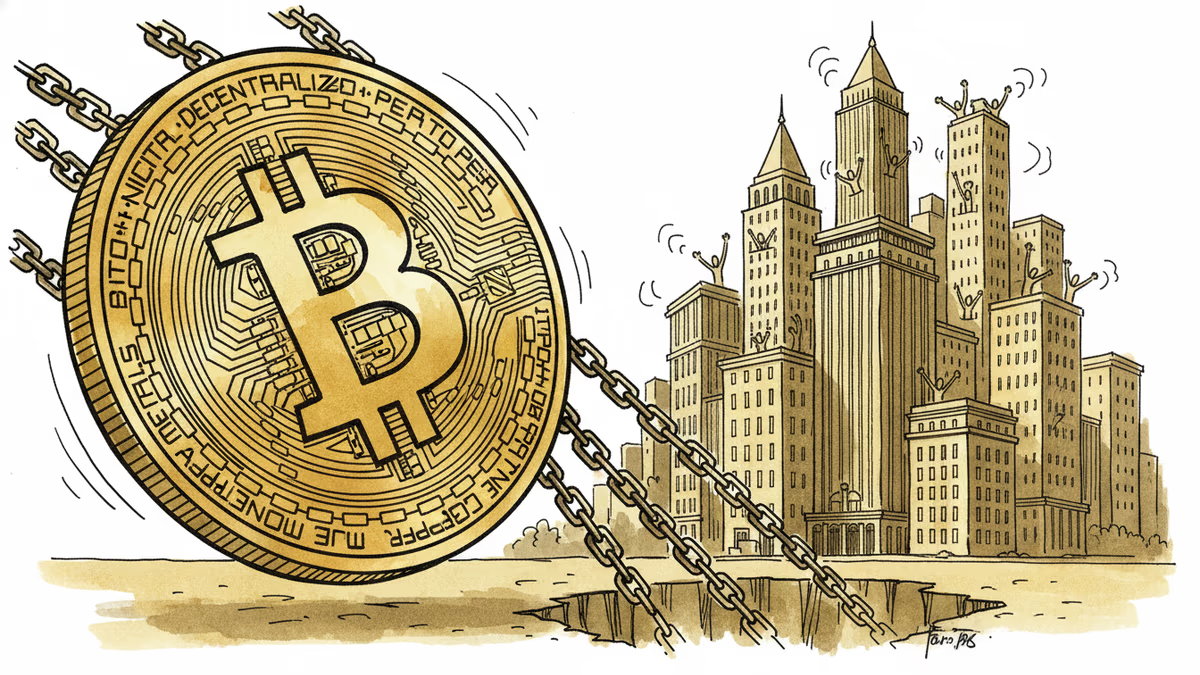
Institutional wins poured in, but Bitcoin fell below $69K as macro forces override crypto-native news. The price of mainstream adoption may be losing independence.
Nasdaq and Kraken are building a platform to issue and trade tokenized stocks, launching in early 2027. Token holders get full shareholder rights—dividends, voting included. Here's what it means for investors and the financial system.
Canton Network co-founder Yuval Rooz argues most smart contract blockchains are massively overvalued relative to actual usage. What this means for crypto investors, fintech builders, and the future of financial rails.
Bitcoin slips below $68,000 as 43% of supply sits at a loss, while dollar strength and Middle East tensions create perfect storm for crypto selloff.
Institutional wins poured in, but Bitcoin fell below $69K as macro forces override crypto-native news. The price of mainstream adoption may be losing independence.
Thoughts
Share your thoughts on this article
Sign in to join the conversation