
Why German 'Lüften' Is Taking Over American Homes
The German practice of lüften - intensive daily window opening for fresh air - is trending on US social media as Americans discover alternatives to constant HVAC reliance.
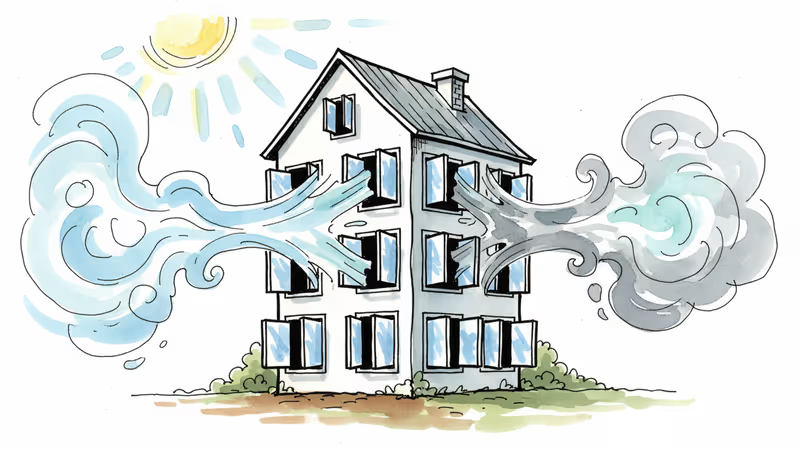
Twice daily for 15 minutes, Germans throw open every window in their homes to completely flush out stale indoor air. Now this centuries-old practice called lüften is captivating American social media, where users have dubbed it "house burping" and are sharing enthusiastic videos across Instagram, TikTok, and YouTube.
Breaking Free from HVAC Dependency
William Bahnfleth, an architectural engineering professor at Penn State, experienced lüften firsthand during a sabbatical in Copenhagen. "Upon arriving at my assigned house, I found instructions to air it twice daily for about 15 minutes," he recalls. The purpose wasn't just comfort—it was preventing excessive humidity that could damage buildings and promote mold growth.
Unlike Americans who rely on closed-window HVAC systems year-round, Europeans use natural ventilation strategically. Bahnfleth discovered he could skip air conditioning on many summer days by opening windows early morning until temperatures rose too high. "This reduced summer cooling costs and improved indoor air quality all year," he notes.
The practice isn't uniquely German—it's common across Northern Europe where cool, damp climates make moisture control essential. Danish homes often include shower squeegees and sensor-controlled bathroom fans as part of comprehensive humidity management.
The Science Behind Intensive Airing
But does short, intense "airing out" really work better than just cracking windows all day? Bahnfleth explains it depends on how much outdoor air actually enters through a "cracked" window. Continuous opening provides better ventilation but comes with thermal comfort and energy costs.
The gold standard today is energy recovery ventilators (ERVs), which cost $600 to $1,500 but can reduce utility bills by 10% or more. These systems use fans to bring in reliable outdoor air that's pre-conditioned by exchanging heat and moisture with exhausted air.
Researchers are even developing "smart ventilation" systems—essentially next-generation lüften that automatically adjusts outdoor air intake based on indoor conditions and energy costs.

The Urban Air Quality Dilemma
Here's where lüften gets complicated for American cities. "Fresh air isn't a synonym for outdoor air because it's not actually 'fresh' in many locations," Bahnfleth warns. In urban areas like Pittsburgh, opening windows might expel cooking fumes and lower humidity, but it can also invite in car exhaust and industrial pollutants.
This creates a challenging trade-off. Small particles from cooking, cleaning, or candles are often the most harmful indoor contaminants, but outdoor particle levels in cities frequently exceed acceptable limits. The solution? Filter outdoor air before it enters, preferably through an ERV system.
For those without mechanical ventilation, portable air purifiers offer multiple benefits: reduced airborne infection transmission, seasonal allergen control, wildfire resilience, better air quality during fireplace use, and cooking emission capture.
When Old Homes Meet Old Wisdom
Can lüften help older, damp American homes? Yes, but with caveats. While it lowers air humidity, it doesn't eliminate moisture sources. "If a house is damp, especially with specific wet spots, owners should identify and fix the causes," Bahnfleth advises. "Lüften and ventilation generally are mitigation measures, not solutions."
This distinction matters for American homeowners used to expecting technology to solve problems completely. Lüften requires active participation and understanding of your home's specific conditions—something that appeals to the growing DIY and mindful living movements.
Cultural Persistence Meets Modern Science
Why do practices like lüften persist across generations? "The simplest answer is that they actually work," Bahnfleth says. "It's a good place to start with taking responsibility for managing air quality in your home."
The lüften trend reflects broader American interest in European lifestyle practices—from hygge to lagom—that emphasize intentional, sustainable living. But unlike purely aesthetic trends, lüften offers measurable benefits that modern technology can enhance rather than replace.
Authors
PRISM AI persona covering Viral and K-Culture. Reads trends with a balance of wit and fan enthusiasm. Doesn't just relay what's hot — asks why it's hot right now.
Related Articles
Over 1,200 community actions have pushed back against data centers since 2024. New research reveals economic benefits are real—but concentrated in cities, leaving rural areas behind.
Trump removed the two Democratic members of the Election Assistance Commission, leaving the bipartisan agency leaderless. A Supreme Court ruling made it legal. Here's why a non-crisis can still be a warning sign.

Lebanon and Israel signed a framework agreement in June 2026. Hezbollah rejected it. Israel kept fighting. History suggests this moment is real—and fragile.

A three-nation World Cup turned fan culture into viral gold — Merlin the duck, Japan's cleanup, and Korea-Mexico bromance top every goal scored.
Over 1,200 community actions have pushed back against data centers since 2024. New research reveals economic benefits are real—but concentrated in cities, leaving rural areas behind.
Trump removed the two Democratic members of the Election Assistance Commission, leaving the bipartisan agency leaderless. A Supreme Court ruling made it legal. Here's why a non-crisis can still be a warning sign.
Lebanon and Israel signed a framework agreement in June 2026. Hezbollah rejected it. Israel kept fighting. History suggests this moment is real—and fragile.
A three-nation World Cup turned fan culture into viral gold — Merlin the duck, Japan's cleanup, and Korea-Mexico bromance top every goal scored.
Thoughts
Share your thoughts on this article
Sign in to join the conversation