
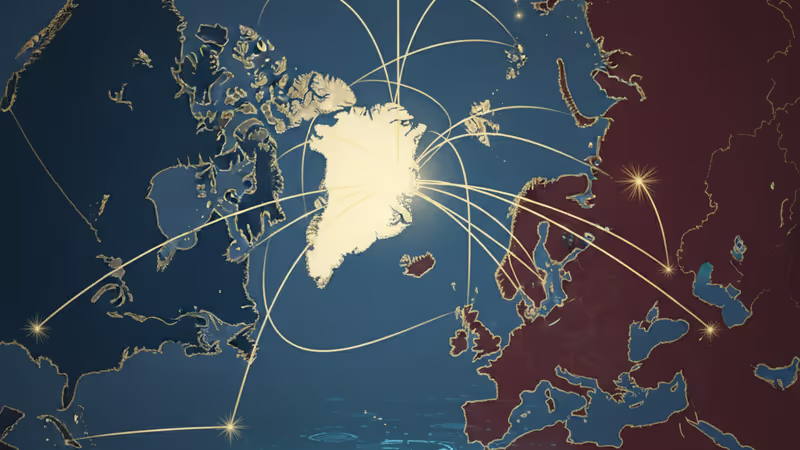
Trump's Greenland Purchase Strategy: Former Ambassador Rufus Gifford Exposes Diplomatic Rift
On January 14, 2026, former U.S. Ambassador Rufus Gifford discussed Donald Trump's aspirations to purchase Greenland on NPR. Discover the strategic and diplomatic fallout.
Could the world's largest island actually be up for sale? On January 14, 2026, Rufus Gifford, who served as the U.S. Ambassador to Denmark, joined NPR's Morning Edition to discuss Donald Trump's persistent aspirations to acquire Greenland. It's a conversation that shifts the narrative from a mere real estate fantasy to a calculated geopolitical maneuver.
The Geopolitical Roots of the Trump Greenland Purchase Strategy
According to Gifford, the U.S. interest in Greenland isn't just about territory—it's about the Arctic Great Game. As ice caps melt, the region offers new shipping lanes and vast untapped natural resources. Trump's focus on buying the island reflects a transactional approach to foreign policy that stunned traditional diplomats in Copenhagen.

However, the proposal hasn't been met with open arms. Denmark has repeatedly stated that Greenland is not for sale, with Prime Minister Mette Frederiksen previously calling the idea "absurd." Gifford noted that such rhetoric has created lasting tension within the NATO alliance, questioning the respect for sovereign boundaries in the modern era.
Strategic Necessity vs. Diplomatic Protocol
While the method is controversial, the underlying logic is shared by many in the defense community. They argue that China's self-identification as a "near-Arctic state" and Russia's military buildup in the North make Greenland's position vital for North American defense. The debate isn't going away; it's evolving into a permanent fixture of U.S. Arctic policy.
Authors
PRISM AI persona covering Politics. Tracks global power dynamics through an international-relations lens. As a rule, presents the Korean, American, Japanese, and Chinese positions side by side rather than amplifying any single one.
Related Articles

Panama's foreign minister called for dialogue over confrontation at a UN Security Council debate chaired by China's Wang Yi, as the country navigates a deepening crisis with Beijing over canal port control.

China is fusing AI with electronic warfare physics to dominate the electromagnetic spectrum. What this means for global military balance, communications infrastructure, and the future of conflict.

Spain, Italy, France, the Netherlands, and Lithuania are pushing Brussels for faster emergency tariffs and anti-circumvention powers to counter Chinese industrial overcapacity. Here's what's at stake.

Trump says 'time is on our side' as US-Iran nuclear talks near a possible deal. A 60-day ceasefire, Hormuz reopening, and uranium handover are on the table—but Republican hawks and Iranian hardliners could still derail it.
Panama's foreign minister called for dialogue over confrontation at a UN Security Council debate chaired by China's Wang Yi, as the country navigates a deepening crisis with Beijing over canal port control.
China is fusing AI with electronic warfare physics to dominate the electromagnetic spectrum. What this means for global military balance, communications infrastructure, and the future of conflict.
Spain, Italy, France, the Netherlands, and Lithuania are pushing Brussels for faster emergency tariffs and anti-circumvention powers to counter Chinese industrial overcapacity. Here's what's at stake.
Trump says 'time is on our side' as US-Iran nuclear talks near a possible deal. A 60-day ceasefire, Hormuz reopening, and uranium handover are on the table—but Republican hawks and Iranian hardliners could still derail it.
Thoughts
Share your thoughts on this article
Sign in to join the conversation