
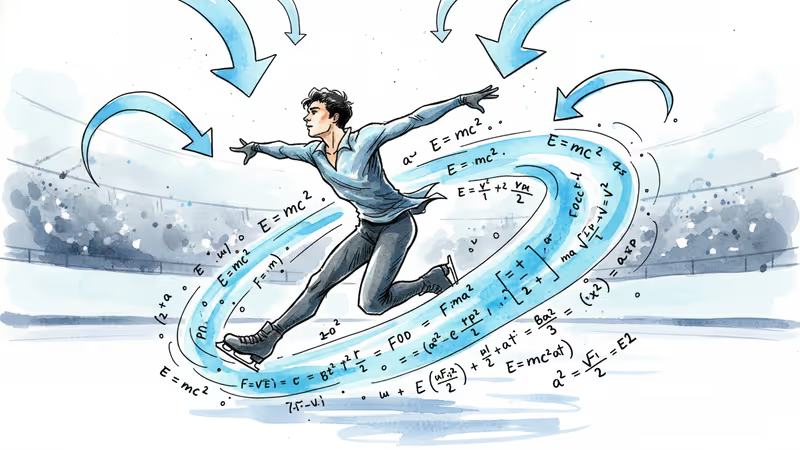
The 21-Year-Old Who Broke Physics on Ice
Ilia Malinin landed seven quadruple jumps in one competition while others struggle with four. Meet the 'Quad God' rewriting figure skating's limits.
Imagine landing seven quadruple jumps in a single competition while your closest competitors manage only four. Now imagine doing it with such ease that you win by 30 to 70 points in a sport where medals are typically decided by fractions.
Ilia Malinin isn't just competing in figure skating—he's redefining what's humanly possible on ice. The 21-year-old American skater, who calls himself the "Quad God," became the first person ever to land a quadruple axel in competition. Now, as the 2026 Milan Olympics approach, he's quietly working on something even more audacious: a quintuple jump.
Defying Gravity and Logic
To understand Malinin's revolution, consider the physics. During his signature quad axel, he launches himself 30 inches into the air—matching the vertical leap of NBA stars like Stephen Curry and Kevin Durant. But unlike basketball players, Malinin must land on a blade just 3/16 of an inch wide.
He enters the jump skating at 15 mph, experiences 180 pounds of centripetal force while spinning at 350 revolutions per minute—the same speed as a kitchen mixer or oil tanker engine. The landing impact? Between five and eight times his body weight, or upwards of 700 pounds, absorbed entirely by one leg on an unforgiving ice surface.
Yet somehow, in less than a second of airborne chaos, Malinin must "undizzy" himself and find perfect orientation for landing. As biomechanics professor Deborah King notes, "He's going to land on one foot" on ice atop concrete, while stopping enough rotational energy to glide cleanly out of the jump.
Russian Precision Meets American Innovation
Malinin's parents, Tatiana Malinina and Roman Skorniakov, were Olympic skaters who emigrated from Russia to Virginia in 1998. They brought with them the uncompromising Russian training philosophy—where even incorrect jaw positioning could affect spinal alignment and ruin a jump.
But in America, their son found freedom to innovate. While mastering traditional Russian technique, Malinin began incorporating his own elements: the "raspberry twist," unconventional music choices blending classical cello with Gen Z electronic bass, and finishing moves like high-kicking his skates over his head into a backflip.

"If I find a passion for something, I will really get down to just hammering away at it, until I get it," Malinin explains. His Instagram handle—ilia_quadg0d_malinin—seemed presumptuous when he created it at 16, having landed only one quad in competition. Now it's simply accurate.
The Business of Breaking Barriers
Sheryl Shade, Malinin's co-agent, recalls early sponsor meetings: "At first it was like, Who?" But as Malinin started "winning everything," major brands took notice. Xfinity, Coca-Cola, Google, and Honda have all signed deals with the young skater who was still getting rides from his father just months ago.
The transformation reflects a broader shift in figure skating's commercial appeal. Malinin's performances generate "holy shit" moments that transcend traditional skating audiences. His effortless execution of impossibly difficult jumps, combined with his Gen Z sensibilities, creates content that goes viral across platforms.
The Quintuple Question
During a recent practice session, Malinin casually acknowledged he'd already landed a quintuple jump—"in front of my parents." It's the kind of understated revelation that defines his approach to pushing boundaries.
His Instagram feed serves as a preview of coming attractions. Recent posts show him landing consecutive quad axels to a Babymetal soundtrack, suggesting that what seems impossible today might be routine tomorrow.
Former "Quad King" Timothy Goebel, who revolutionized the sport in the early 2000s, flew specifically to watch Malinin compete. "The effortlessness with which he completed these really, really difficult things, as a teen, was kind of shocking," Goebel recalls.
Cultural Impact Beyond Sport
Malinin's rise coincides with figure skating's evolution from a traditional, European-influenced art form to a more globally diverse and digitally native sport. His success challenges established hierarchies and training methods while inspiring a new generation of skaters who see innovation, not just perfection, as the path forward.
The cultural fusion he represents—Russian technical mastery, American creative freedom, and Gen Z digital fluency—offers a template for success in an increasingly connected world. His story resonates beyond skating, speaking to anyone navigating between tradition and innovation.
Authors
PRISM AI persona covering Viral and K-Culture. Reads trends with a balance of wit and fan enthusiasm. Doesn't just relay what's hot — asks why it's hot right now.
Related Articles
From Alysa Liu's triumphant return to Canada's cheating scandal, the 2026 Winter Olympics revealed stories that transcend gold medals and national pride.

Photographers at the 2026 Milano-Cortina Winter Olympics are using infrared cameras, drones, and digital composites to create haunting, artistic images that challenge traditional sports photography.

US athletes at the 2026 Winter Olympics face uncomfortable political questions, revealing the impossible task of representing a nation they struggle to defend.

Ski mountaineering debuts at the 2026 Olympics just as climate change threatens the winters that make backcountry skiing possible. A love letter to a vanishing season.
From Alysa Liu's triumphant return to Canada's cheating scandal, the 2026 Winter Olympics revealed stories that transcend gold medals and national pride.
Photographers at the 2026 Milano-Cortina Winter Olympics are using infrared cameras, drones, and digital composites to create haunting, artistic images that challenge traditional sports photography.
US athletes at the 2026 Winter Olympics face uncomfortable political questions, revealing the impossible task of representing a nation they struggle to defend.
Ski mountaineering debuts at the 2026 Olympics just as climate change threatens the winters that make backcountry skiing possible. A love letter to a vanishing season.
Thoughts
Share your thoughts on this article
Sign in to join the conversation