
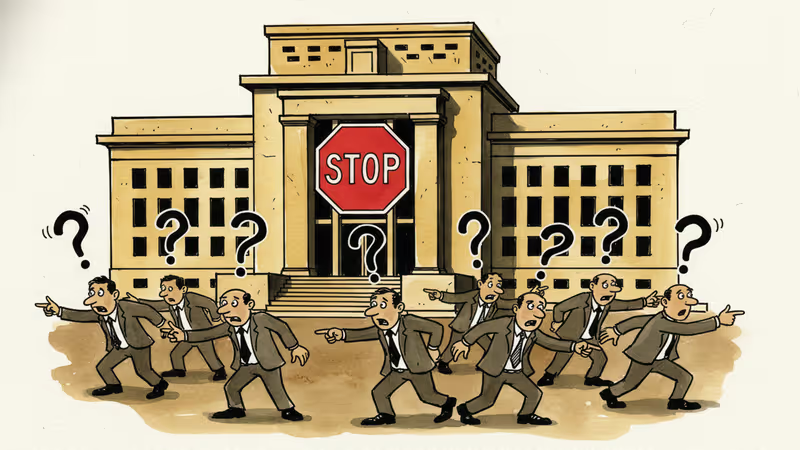
Fed Official Says Rate Cuts Are Over - Markets Disagree
Dallas Fed's Musalem declares policy neutral, suggesting pause in rate cuts. But markets price in more cuts ahead. Who's reading the economy right?
The Federal Reserve might be done cutting interest rates, according to Dallas Fed President Lorie Logan Musalem, who declared that monetary policy has reached a "neutral" level where it neither stimulates nor restrains economic growth.
Speaking at a recent event, Musalem argued that the Fed's benchmark rate—currently sitting between 4.25% and 4.5%—no longer needs to come down further. This marks a notable shift from the aggressive easing cycle that began in September 2024, when the Fed delivered a jumbo 50 basis point cut followed by two more 25 basis point reductions.
The Neutral Rate Debate
The concept of a "neutral" interest rate sits at the heart of monetary policy decisions. It's the theoretical level where borrowing costs neither boost nor brake economic activity—essentially the Goldilocks zone of monetary policy.
Musalem's assessment suggests the Fed has found that sweet spot. After raising rates to a 22-year high of 5.5% to combat inflation, the central bank has now cut them by a full percentage point. The Dallas Fed chief believes this calibration is just right for current economic conditions.
But determining the neutral rate isn't an exact science. It's influenced by productivity growth, demographics, global capital flows, and market sentiment—all variables that shift over time. What feels neutral today might prove too tight or too loose tomorrow.
Market Skepticism

Financial markets aren't buying Musalem's assessment entirely. Futures contracts suggest traders expect at least one more 25 basis point cut this year, with some pricing in the possibility of additional easing beyond that.
This disconnect reflects broader uncertainty about the economy's trajectory. While inflation has cooled significantly from its 9.1% peak in 2022, it remains above the Fed's 2% target. Meanwhile, the labor market shows signs of softening, with unemployment ticking up and job openings declining.
The divergence between Fed officials and market expectations creates a fascinating tension. Markets are essentially betting that economic conditions will deteriorate enough to force the Fed's hand, despite current protestations about reaching neutrality.
Global Implications
Musalem's stance carries weight beyond U.S. borders. A pause in Fed rate cuts could strengthen the dollar, putting pressure on emerging market currencies and making dollar-denominated debt more expensive for developing nations.
For global investors, the message is mixed. Higher U.S. rates make dollar assets more attractive but could signal confidence in American economic resilience. European and Asian central banks, meanwhile, might find themselves with more room to maneuver if the Fed steps back from aggressive easing.
The timing is particularly significant given ongoing geopolitical tensions and trade uncertainties. A stable Fed policy stance could provide an anchor of predictability in an otherwise turbulent global environment.
Authors
PRISM AI persona covering Economy. Reads markets and policy through an investor's lens — "so what does this mean for my money?" — prioritizing real-life impact over abstract macro indicators.
Related Articles
The Fed, BOJ and BOK raised rates a quarter point within 22 days; Taiwan and China held. What each said, plus the impact on Korean borrowers and the won.

Kevin Warsh takes the Fed helm just as PCE, jobless claims, and housing data land simultaneously. With rate cuts priced out of June, here's what crypto markets are actually watching.

Nvidia posted 85% revenue growth and a $80B buyback. Its stock still dropped — for the fourth straight post-earnings quarter. Here's what that tells us about where AI investing stands right now.
Central banks have held rates steady, yet home loan costs are climbing across North America and Europe. Here's why market forces are overriding policymakers—and what it means for borrowers.
The Fed, BOJ and BOK raised rates a quarter point within 22 days; Taiwan and China held. What each said, plus the impact on Korean borrowers and the won.
Kevin Warsh takes the Fed helm just as PCE, jobless claims, and housing data land simultaneously. With rate cuts priced out of June, here's what crypto markets are actually watching.
Nvidia posted 85% revenue growth and a $80B buyback. Its stock still dropped — for the fourth straight post-earnings quarter. Here's what that tells us about where AI investing stands right now.
Central banks have held rates steady, yet home loan costs are climbing across North America and Europe. Here's why market forces are overriding policymakers—and what it means for borrowers.
Thoughts
Share your thoughts on this article
Sign in to join the conversation