
The Screenwriter Who Saw AI Coming: Jonathan Nolan's Vision
From Person of Interest to Fallout, Jonathan Nolan has consistently explored AI and tech themes. His latest insights on AI's role in filmmaking and society's future.
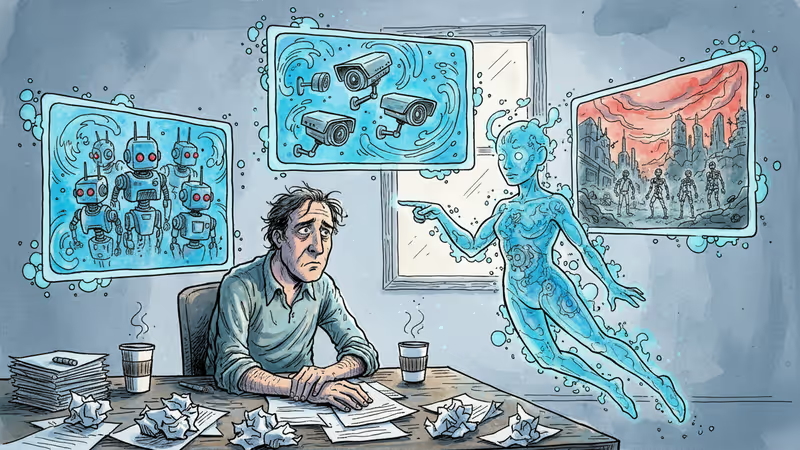
Long before ChatGPT became a household name, Jonathan Nolan was writing about AI surveillance systems that could predict crimes before they happened. The screenwriter behind Person of Interest, Westworld, and Amazon's hit series Fallout has spent two decades exploring humanity's relationship with artificial intelligence—and his predictions are starting to look eerily accurate.
In a recent interview, Nolan shared his surprisingly optimistic view of AI's role in filmmaking, his thoughts on social media's future, and why he still shoots everything on film in an increasingly digital world. But perhaps most intriguingly, he revealed why he believes AI won't replace human filmmakers—it might actually help them.
The Prophet of Silicon Valley Surveillance
When Person of Interest premiered on CBS in 2011, its premise seemed like pure science fiction: a reclusive tech billionaire creates surveillance software that can predict violent crimes by analyzing massive data streams. The show ran for five seasons, ending in 2016—just as real-world AI capabilities began catching up to Nolan's imagination.
"I got fascinated with this idea of what happens when you have this fire hose of data that's out there," Nolan explained. "What if something could pick through it and find patterns and find meaning?"
The timing feels prophetic now. Today's AI systems do exactly that—sifting through enormous datasets to identify patterns humans might miss. From predictive policing algorithms to social media content moderation, the technology Nolan imagined has become reality.
But unlike many Hollywood portrayals of AI as inevitably malevolent, Nolan took a different approach. In Interstellar, he wrote robot characters that were "brave, self-sacrificing, sarcastic, and funny." His vision: "What if they just embodied those values the whole way through?"
AI as Creative Assistant, Not Replacement
Despite his deep engagement with artificial intelligence themes, Nolan maintains a clear boundary in his own work. He won't use AI in his writing process, but he sees potential benefits for aspiring filmmakers.
"I don't think AI is going to replace human filmmakers," he said. "In fact, I think it could help aspiring directors get a foot in the door."

This perspective challenges the prevailing narrative about AI displacing creative professionals. Instead of viewing AI as competition, Nolan sees it as a potential democratizing force—a tool that could lower barriers to entry for new voices in filmmaking.
His reasoning stems from 25 years of experience watching technology promises in Hollywood. "There is no technology that I've ever been presented with that has made anything that we do for television cheaper, ever," he noted, explaining why he still shoots on film despite digital alternatives.
The Social Media Dilemma
Nolan's techno-optimism doesn't extend to all platforms. He'd "like to see the demise of (most) social media"—though he acknowledges it may never happen. This selective skepticism reflects a nuanced view of technology's impact on society.
His concern isn't with technology itself, but with how certain platforms have evolved. While AI might enhance creative expression, social media's current iteration seems to detract from meaningful human connection and discourse.
Lessons from Post-Apocalyptic Storytelling
Fallout, Nolan's latest project entering its second season, offers another lens through which to view technology's role in society. Set in a post-apocalyptic America filled with 1950s-era retrofuturism, the show explores themes of survival, community, and technological hubris.
The series' success—and its blend of dark themes with "wicked" humor—suggests audiences are hungry for stories that grapple seriously with technology's implications while remaining entertaining and accessible.
The Bigger Picture: Technology and Creative Control
Nolan's career trajectory reveals a consistent theme: the tension between technological capability and human agency. From surveillance systems that know too much to post-apocalyptic worlds where technology has failed, his work consistently asks: How do we maintain human control and values as our tools become more powerful?
His decision to keep using film in an digital age isn't mere nostalgia—it's a philosophical stance about maintaining creative control and quality standards regardless of technological trends.
As AI capabilities continue expanding, will more creators follow Nolan's model—embracing technology's potential while maintaining creative sovereignty? And what does it mean when our most prescient tech storytellers are also our most selective tech adopters?
Authors
Related Articles
Amazon Prime Video dominated 2025 with Reacher Season 3, Fallout, and Invincible. Discover the best shows that made the subscription worth it this year.
Disney's landmark deal with OpenAI to bring Marvel and Star Wars to Sora is more than a tech partnership. It's a strategic reset for IP in the AI era. Here's why it matters.
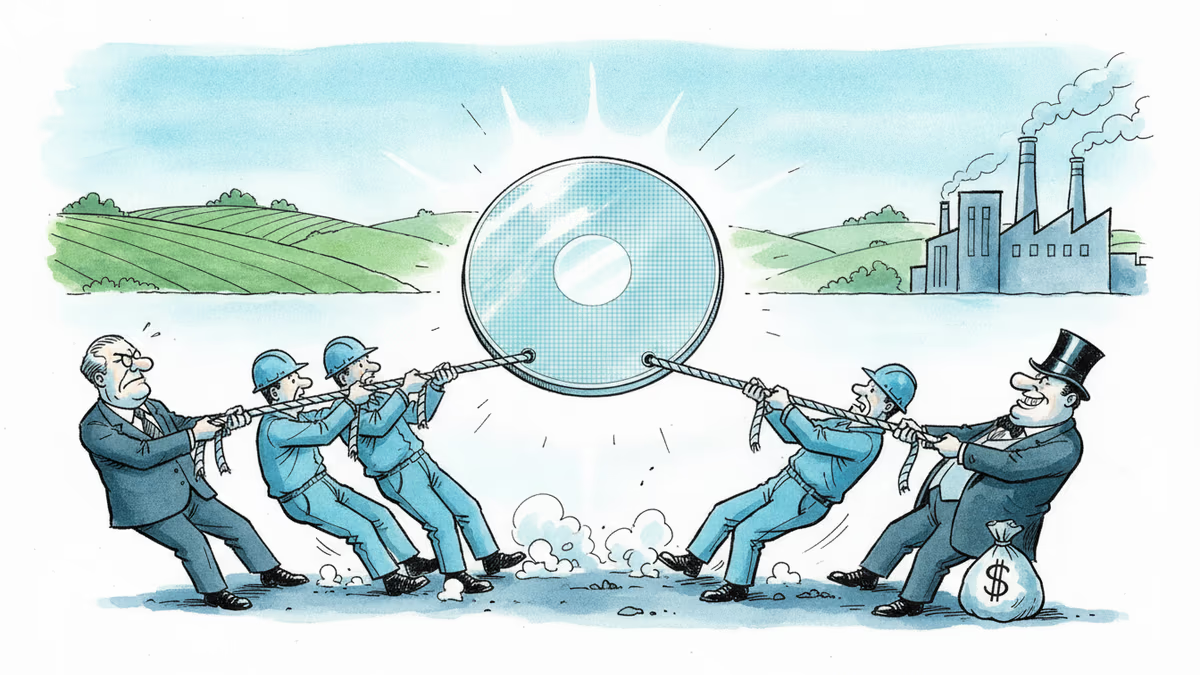
Samsung Electronics' union branch revealed that 84% of survey respondents oppose the government's roughly $290 billion (₩400 trillion) semiconductor megaproject in Gwangju. Government, management, the union and shareholders are all reading the same national project in sharply different ways.
Nvidia shipped roughly a billion RISC-V cores in 2024, then announced it would run CUDA on the open standard. We break down how royalty-free instruction sets and open software stacks are trying to route around CUDA's lock-in. Part 2 of the Semiconductor Sovereignty series.
Amazon Prime Video dominated 2025 with Reacher Season 3, Fallout, and Invincible. Discover the best shows that made the subscription worth it this year.
Disney's landmark deal with OpenAI to bring Marvel and Star Wars to Sora is more than a tech partnership. It's a strategic reset for IP in the AI era. Here's why it matters.
Samsung Electronics' union branch revealed that 84% of survey respondents oppose the government's roughly $290 billion (₩400 trillion) semiconductor megaproject in Gwangju. Government, management, the union and shareholders are all reading the same national project in sharply different ways.
Nvidia shipped roughly a billion RISC-V cores in 2024, then announced it would run CUDA on the open standard. We break down how royalty-free instruction sets and open software stacks are trying to route around CUDA's lock-in. Part 2 of the Semiconductor Sovereignty series.
Thoughts
Share your thoughts on this article
Sign in to join the conversation