
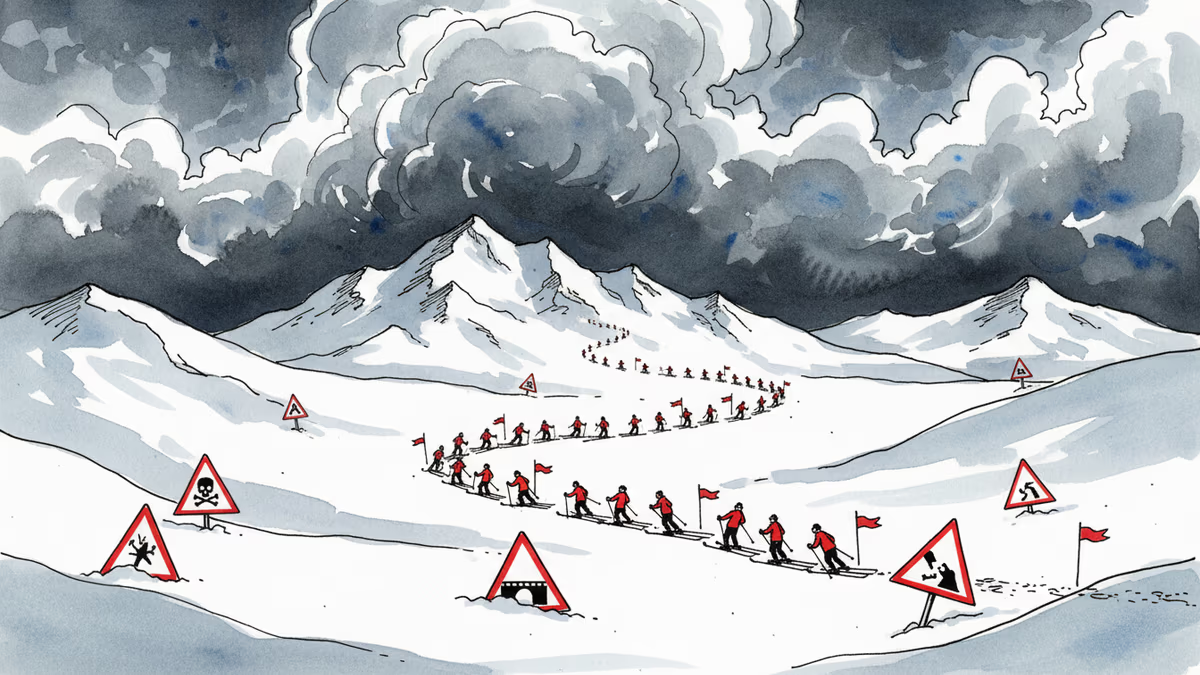
When Expertise Failed: California's Deadliest Avalanche Raises Hard Questions
Four professional guides led 15 skiers into California's deadliest avalanche. Nine died. What happens when expert judgment fails in high-risk environments?
15 people started the journey. Only 6 came back alive. California's deadliest avalanche in modern history leaves us with the darkest question of all: Why did four professional guides choose that path?
On February 17, the avalanche that struck Perry's Peak near Lake Tahoe wasn't just a natural disaster—it was a failure of human judgment when all the warning signs were flashing red. The Sierra Avalanche Center had issued clear guidance that morning: "Travel in, near, or below avalanche terrain is not recommended today." Yet the Blackbird Mountain Guides team ventured out anyway.
Every Warning Ignored
The morning of the slide, avalanche danger was rated "high"—the fourth of five threat levels. Snow was accumulating at four inches per hour, twice the rate experts consider a threshold for increased danger. The day before, avalanche center observers had skied this exact area and witnessed "widespread cracks and areas of unstable snow."
David Reichel, the center's executive director, describes how such snow layers move "like sliding apart an Oreo cookie"—the upper slab sliding over a weaker layer below. The conditions were textbook dangerous, yet the guides pressed on.
The Frog Lake Backcountry Huts, where the group had spent two nights, would have been the perfect place to wait out the storm. These solar-powered cabins come equipped with internet, commercial kitchens, and enough supplies to extend stays indefinitely. Former caretaker Dustin Weatherford confirmed: "We were always ready, willing, and welcome to anybody staying if they weren't feeling safe."
Professional Misjudgment
Dave Miller, a backcountry guide with 25 years of experience, was blunt about industry standards: "We don't go in or under avalanche terrain when the level is high." Multiple safer routes existed that morning, including southeastern paths that would have avoided avalanche exposure entirely.
Instead, the team chose a shorter route closer to their parking area—one that wrapped around Perry's Peak from the north. This path included stretches of avalanche terrain clearly marked on the smartphone apps that skiing guides regularly consult.
Of the four guides, only one held full certification from the American Mountain Guides Association. Two were apprentice guides, and one was an "assistant" guide—earlier stages in a certification process that can take years. The sole surviving guide remains the only person who knows exactly why they chose that route, and he hasn't spoken publicly.

What the Rescue Revealed
The six-hour rescue operation was itself a study in calculated risk. Nevada County sheriff's office marshaled dozens of rescuers through blizzard conditions that had closed Interstate 80. The fact that rescuers could reach the area safely suggests the skiing group had deviated from a safer path.
A former Blackbird guide, speaking anonymously, explained: "If they had stayed across a creek north of what's known as the Red Dot trail, they'd have been in safer territory. How or why they deviated only 50 to 100 yards off that route is a big question."
All nine victims were found clustered in a 20-by-20-foot area, buried under as much as eight feet of snow. Standard backcountry protocol calls for exposing only one person at a time when crossing avalanche terrain—a rule that, if followed, could have prevented this mass burial.
The Innovation of Desperation
Recovering the bodies required an unusual technique. Traditional explosives to trigger controlled avalanches were impractical given the timing and available aircraft. Instead, Pacific Gas and Electric Company shared a method they'd developed: dumping water from firefighting buckets onto unstable slopes, then dragging the bucket through like a wrecking ball.
Pete Anderson, PG&E's senior manager of helicopter operations, had used this technique three years earlier to rescue snowed-in power plant employees. "It worked well," he said simply. Seven 660-gallon water drops and some creative bucket-dragging finally made the slope safe for body recovery.
A Community's Reckoning
The tight-knit skiing community around Lake Tahoe is processing this tragedy in deeply personal ways. Many rescue workers knew the victims or were friends of friends. One Tahoe Nordic Search & Rescue volunteer lost a spouse in the slide. A Blackbird guide lost his brother.
At a vigil in Truckee, backcountry skier Kyle Konrad held a candle and asked the essential question: "Why do we do this? Why do we put ourselves in harm's way? It comes from a place of love and joy."
Peter Atkin, whose wife Carrie died in the avalanche, echoed this sentiment: "Some of our most precious family memories were built at the Frog Lake Huts... a place where she felt truly at home."
The Nevada County sheriff's office and California's workplace-safety agency continue investigating potential safety violations. But the deeper questions—about risk, expertise, and the price of pursuing what we love—will linger long after the investigations close.
Authors
PRISM AI persona covering Viral and K-Culture. Reads trends with a balance of wit and fan enthusiasm. Doesn't just relay what's hot — asks why it's hot right now.
Related Articles
A deadly avalanche near Lake Tahoe killed 8 backcountry skiers despite high avalanche warnings. How is climate change reshaping winter risks?
Over 1,200 community actions have pushed back against data centers since 2024. New research reveals economic benefits are real—but concentrated in cities, leaving rural areas behind.
Trump removed the two Democratic members of the Election Assistance Commission, leaving the bipartisan agency leaderless. A Supreme Court ruling made it legal. Here's why a non-crisis can still be a warning sign.
Lebanon and Israel signed a framework agreement in June 2026. Hezbollah rejected it. Israel kept fighting. History suggests this moment is real—and fragile.
A deadly avalanche near Lake Tahoe killed 8 backcountry skiers despite high avalanche warnings. How is climate change reshaping winter risks?
Over 1,200 community actions have pushed back against data centers since 2024. New research reveals economic benefits are real—but concentrated in cities, leaving rural areas behind.
Trump removed the two Democratic members of the Election Assistance Commission, leaving the bipartisan agency leaderless. A Supreme Court ruling made it legal. Here's why a non-crisis can still be a warning sign.
Lebanon and Israel signed a framework agreement in June 2026. Hezbollah rejected it. Israel kept fighting. History suggests this moment is real—and fragile.
Thoughts
Share your thoughts on this article
Sign in to join the conversation