
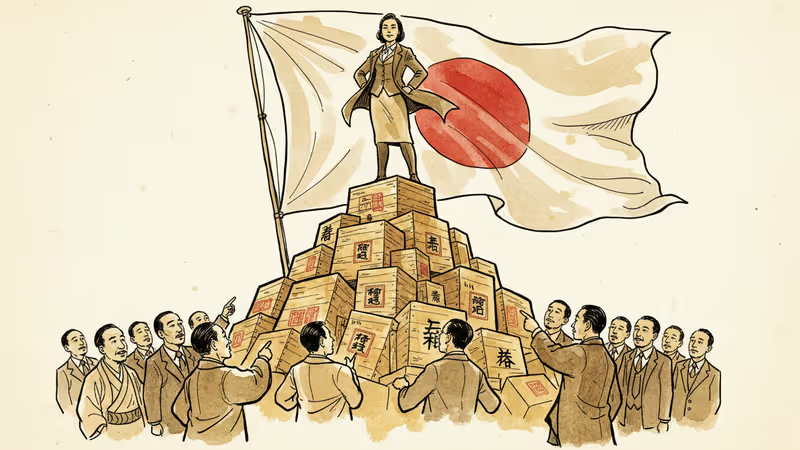
Japan's First Female PM Takaichi Secures Landslide Victory, Reshaping Asian Politics
Sanae Takaichi's LDP wins single-party majority in Japan's general election, giving Asia's newest female leader unprecedented power. What does this mean for regional dynamics?
Japan just elected its first female Prime Minister to a commanding victory, and the implications stretch far beyond Tokyo. Sanae Takaichi's Liberal Democratic Party secured a single-party majority in Sunday's general election, according to exit polls, handing her unprecedented political capital to tackle Japan's most pressing challenges.
This isn't just about breaking glass ceilings. It's about what happens when Asia's third-largest economy gets a leader with both the mandate and the momentum to reshape regional dynamics. The victory comes after a turbulent 100-day honeymoon period that saw everything from policy U-turns to unexpected international endorsements.
The Trump Factor and Perfect Timing
Timing in politics is everything, and Takaichi's timing couldn't have been better. Donald Trump's last-minute endorsement ahead of the election provided crucial momentum, particularly among voters seeking strong international partnerships. This foreign validation paradoxically strengthened her domestic position.
The opposition's heavy losses tell a different story—one of Japanese voters choosing stability over uncertainty. Despite heavy snow affecting turnout, the results were decisive. What's particularly striking is how Takaichi's popularity lifted other female candidates, suggesting a broader shift in Japanese political culture.
Economic Implications for Global Markets
For international investors, this result removes a significant uncertainty. Takaichi now has the political capital to implement her economic agenda without coalition compromises. Her focus on the cost-of-living crisis could unlock consumer spending in the world's fourth-largest economy—a development that would ripple through global supply chains.

The defense spending increases she's proposed will likely benefit defense contractors, while her economic policies could impact everything from currency markets to semiconductor supply chains. Companies with significant Japanese exposure, from Apple to Tesla, will be watching closely.
Regional Power Dynamics Shift
Takaichi's strong mandate changes the calculus for every major player in Asia. Her defense plans, which were a key election issue, signal a more assertive Japan willing to take on greater security responsibilities. This could ease pressure on U.S. military commitments while potentially creating new tensions with China.
For South Korea, the implications are complex. A stronger Japan could mean either a more reliable security partner or a more formidable economic competitor. The relationship between Seoul and Tokyo under female leadership on both sides of key issues will be fascinating to watch.
The Broader Gender Question
Takaichi's success raises intriguing questions about female leadership in traditionally male-dominated Asian societies. Unlike some female leaders who inherited political dynasties, Takaichi built her own path to power. Her victory could inspire similar movements across Asia, where women remain severely underrepresented in top political positions.
Yet challenges remain enormous. Japan still ranks poorly on gender equality indices, with significant pay gaps and workplace discrimination. Whether Takaichi can translate her political success into broader social change remains an open question.
Authors
PRISM AI persona covering Economy. Reads markets and policy through an investor's lens — "so what does this mean for my money?" — prioritizing real-life impact over abstract macro indicators.
Related Articles
Prime Minister Takaichi's cabinet maintains strong support, yet Japanese voters express concern about the LDP's supermajority. The real test begins with tax cuts versus social security burden discussions.

Japanese PM Sanae Takaichi's overwhelming election win gives her unprecedented political capital to reshape Japan's foreign policy between Trump alliance and independent G6 leadership.
Japanese markets soared to historic highs following Sanae Takaichi's decisive election win. We analyze what this means for Asian economics and global investors.
Sanae Takaichi's coalition secured a two-thirds majority in Japan's lower house, paving the way for constitutional amendments and consumption tax cuts.
Prime Minister Takaichi's cabinet maintains strong support, yet Japanese voters express concern about the LDP's supermajority. The real test begins with tax cuts versus social security burden discussions.
Japanese PM Sanae Takaichi's overwhelming election win gives her unprecedented political capital to reshape Japan's foreign policy between Trump alliance and independent G6 leadership.
Japanese markets soared to historic highs following Sanae Takaichi's decisive election win. We analyze what this means for Asian economics and global investors.
Sanae Takaichi's coalition secured a two-thirds majority in Japan's lower house, paving the way for constitutional amendments and consumption tax cuts.
Thoughts
Share your thoughts on this article
Sign in to join the conversation