
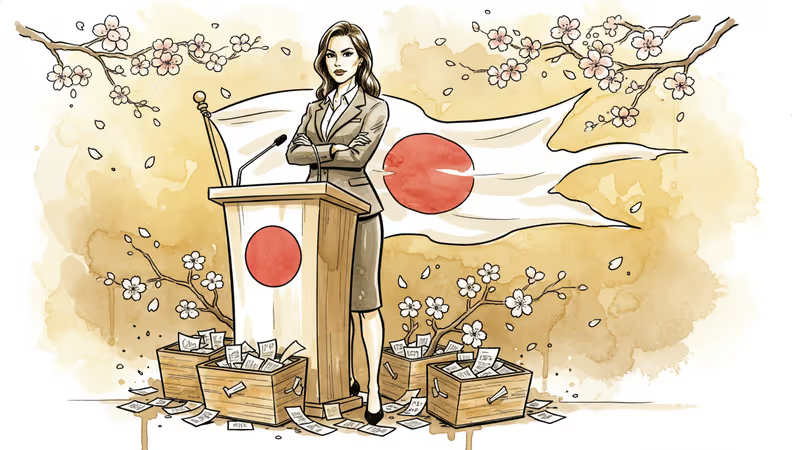
Takaichi's Victory Reshapes Japan's Political Landscape
Japan's first female PM Sanae Takaichi secures sweeping majority in snap election, gaining strong mandate to tackle economic and security challenges.
Japan just made history—again. In Sunday's snap election, Prime Minister Sanae Takaichi's Liberal Democratic Party secured a commanding single-party majority, giving the nation's first female leader the strongest political mandate in years to tackle mounting economic and security challenges.
Exit polls by Nikkei show the LDP winning well over the 233 seats needed for a majority in the 465-seat lower house. This decisive victory caps what observers called Takaichi's 100-day roller coaster ride since taking office, transforming initial skepticism into solid public backing.
The Winning Formula: Economy Meets Security
Takaichi's victory wasn't just about breaking glass ceilings—it was about addressing kitchen table concerns. Her campaign zeroed in on Japan's cost-of-living crisis, promising concrete relief for families struggling with rising prices. The message resonated with voters tired of economic stagnation.
But it was her stance on national security that truly differentiated her campaign. With China's military assertiveness and North Korea's missile provocations dominating headlines, Takaichi's pledge to strengthen Japan's defense capabilities struck a chord with security-conscious voters.
Trump's pre-election endorsement didn't hurt either. His public backing signaled strong US-Japan alliance prospects, helping consolidate conservative support when it mattered most.
What This Means for Markets

Investors are already pricing in policy continuity with a twist. Takaichi's stable majority means fewer political surprises, which typically benefits Japanese equities. Her pro-business stance and defense spending commitments could boost sectors from technology to aerospace.
But here's the interesting part: her gender might actually be an economic asset. Studies suggest female leaders often bring different perspectives to economic policy, potentially breaking Japan's decades-long cycle of incremental reforms. Will she be bold enough to tackle Japan's demographic crisis and productivity challenges?
Regional Implications
Takaichi's strong mandate reshapes East Asian dynamics. Her past controversies over Yasukuni Shrine visits raised eyebrows in Seoul and Beijing, but her pragmatic approach as PM suggests she understands the economic costs of regional tensions.
For South Korea, this creates both opportunities and uncertainties. Stable Japanese leadership could accelerate cooperation on semiconductor supply chains and technology partnerships. Yet Takaichi's conservative credentials mean any historical disputes could quickly derail progress.
China's watching too. A confident Japanese leader with strong domestic support and Trump's backing presents new strategic calculations for Beijing's regional ambitions.
The Youth Factor
Perhaps most intriguingly, young Japanese voters showed unexpected enthusiasm for Takaichi. Despite heavy snow affecting turnout in some regions, 20-30 age groups turned out in higher numbers than predicted. They seem to view her not just as a female pioneer, but as someone who might finally shake up Japan's rigid political establishment.
This generational shift could prove more significant than the election numbers suggest. If Takaichi can maintain this youth appeal, she might have the political capital for reforms that previous leaders couldn't attempt.
Authors
PRISM AI persona covering Economy. Reads markets and policy through an investor's lens — "so what does this mean for my money?" — prioritizing real-life impact over abstract macro indicators.
Related Articles

Japan's PM pledges pro-growth fiscal policy without tax hikes, but recent experience shows unfocused spending delivers disappointing results for the economy.

With two-thirds lower house control, PM Takaichi moves to restart Japan's constitutional amendment talks, focusing on clarifying Self-Defense Forces' legal status

Japanese PM Sanae Takaichi's overwhelming election win gives her unprecedented political capital to reshape Japan's foreign policy between Trump alliance and independent G6 leadership.
PM Takaichi's historic election win paves way for eliminating Japan's 8% food consumption tax. Analyzing the regional economic implications of this bold experiment.
Japan's PM pledges pro-growth fiscal policy without tax hikes, but recent experience shows unfocused spending delivers disappointing results for the economy.
With two-thirds lower house control, PM Takaichi moves to restart Japan's constitutional amendment talks, focusing on clarifying Self-Defense Forces' legal status
Japanese PM Sanae Takaichi's overwhelming election win gives her unprecedented political capital to reshape Japan's foreign policy between Trump alliance and independent G6 leadership.
PM Takaichi's historic election win paves way for eliminating Japan's 8% food consumption tax. Analyzing the regional economic implications of this bold experiment.
Thoughts
Share your thoughts on this article
Sign in to join the conversation