
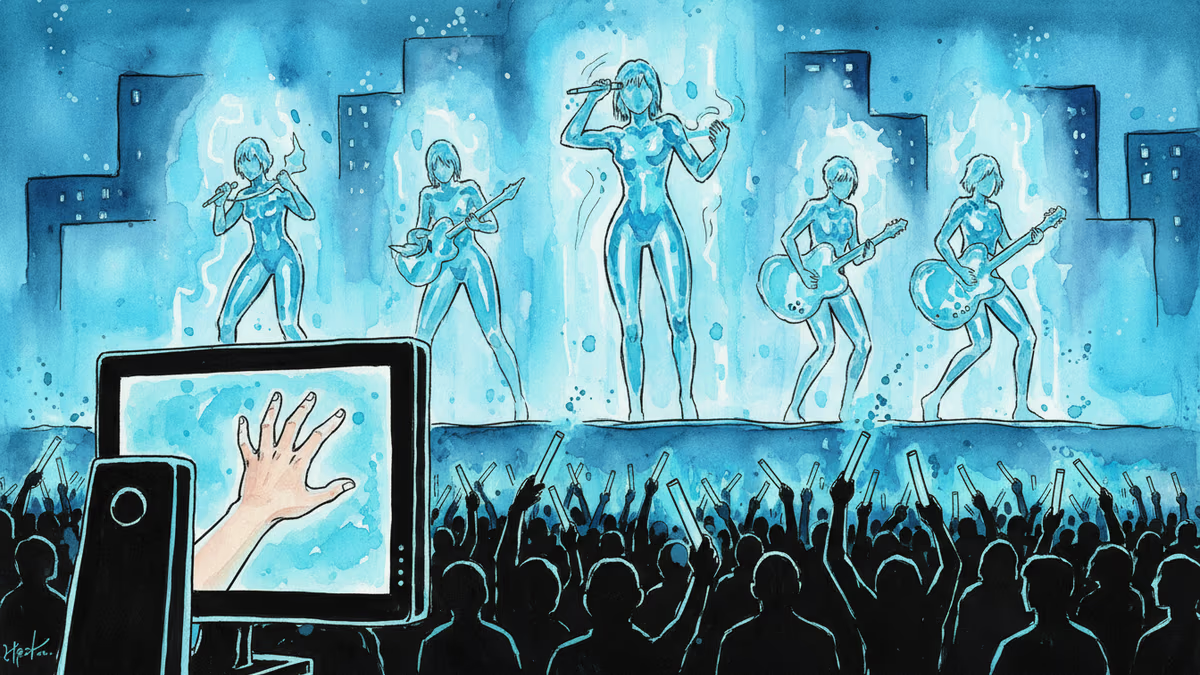
PLAVE and the Virtual Idol Bet K-Pop Is Quietly Winning
PLAVE's comeback with 'Caligo Pt.2' and their Soompi interview reveal how virtual idol format is reshaping K-pop's risk calculus, fandom economics, and the future of parasocial entertainment.
What if the most loyal fanbase in K-pop belonged to a group that has never physically existed? PLAVE, a five-member virtual idol group from South Korean studio VLAST, is quietly turning that question into a business case study. Fresh off their fourth mini-album 'Caligo Pt.2,' the group sat down with Soompi for an exclusive interview—discussing songwriting, the ongoing 'Caligo' narrative arc, and what it means to build an identity as a virtual group. The conversation reads like any other idol comeback interview. That's precisely the point.
The Architecture of a Virtual Fandom
PLAVE debuted in 2023 with a format that borrows heavily from K-pop's established playbook—comeback cycles, album lore, fan community rituals—but replaces human faces with 3D avatars. Real people provide motion capture and vocals behind the scenes, but the public-facing personas are entirely digital. This distinguishes them from Japan's VTuber ecosystem, which tends toward individual streamers and gaming culture. PLAVE is something more structurally ambitious: a full idol group running on K-pop's industrial logic, with the human element abstracted away.
The 'Caligo' series is a telling choice. Rather than standalone albums, PLAVE is building a serialized narrative universe—Pt.1 established the world, Pt.2 deepens it. This mirrors what SM Entertainment did with aespa's SMCU lore and what HYBE built with the BTS Universe. The difference is that virtual avatars can inhabit a narrative world without the physical constraints that make live-action worldbuilding expensive and logistically complicated. The format and the storytelling strategy reinforce each other.
What the Industry Is Actually Betting On

For K-pop agencies, virtual idols solve several problems at once. Scandal risk—the perennial threat that a single member's private life can crater an entire group's brand value—is structurally minimized when the public persona is an avatar. Long-term IP continuity becomes easier to manage when it isn't tied to individual contracts, military service timelines, or the physical aging of real people. And for a generation of fans raised on Twitch streamers and Hololive VTubers, the line between virtual and real has always been more permeable than older industry assumptions allowed.
The fandom metrics back this up. PLAVE cracked Melon's monthly chart upper tier in 2024, and their fanbase EVERSE has grown to a scale that holds its own against comparable non-virtual groups. The early skepticism—that fans wouldn't emotionally invest in avatars the way they do in human idols—has been challenged by actual data. The more interesting open question now isn't whether virtual idols can build fandoms. It's whether those fandoms can sustain the same economic depth: high-ticket concerts, merchandise attachment, long-term parasocial loyalty across years and format changes.
The Tension the Format Can't Fully Resolve
There's something the virtual idol format sidesteps rather than solves. A significant part of K-pop fandom psychology runs on perceived vulnerability—watching someone struggle, grow, cry, and come back. Avatars can simulate this through scripted narrative, but the authenticity signal is different. PLAVE's interview leaning into creative process and individual member personalities reads as a deliberate effort to close that gap: to insist that there is genuine interiority behind the avatars, even if it can't be verified in the way a fan might verify it with a human idol.
This tension is also a design challenge for the broader virtual entertainment industry. PLAVE sits at an intersection that companies like Epic Games (with MetaHuman), major entertainment studios exploring AI performers, and even sports franchises experimenting with digital athlete personas are all watching. The question of how much emotional realness can be engineered—versus how much has to be discovered accidentally through long-term relationship—is not one the industry has answered yet.
This content is AI-generated based on source articles. While we strive for accuracy, errors may occur. We recommend verifying with the original source.
Related Articles

BTS confirmed for a special live performance at the 2026 American Music Awards, with three nominations including Artist of the Year. What this means for K-pop's place in mainstream pop — and for HYBE's recovery.
Circle Chart's April 19–25 weekly results reveal a split market: AKMU's B-side dominates streaming while BTS locks down the global chart. What the numbers actually mean.
TXT claimed their third Music Bank win for "Stick With You" with 10,515 points, edging out PLAVE's "Born Savage." But the real story is what K-pop music show wins actually mean in 2026.

Korea's Business Research Institute ranked 755 boy group members by brand reputation this April. But when fan love becomes data, who really benefits from the score?
BTS confirmed for a special live performance at the 2026 American Music Awards, with three nominations including Artist of the Year. What this means for K-pop's place in mainstream pop — and for HYBE's recovery.
Circle Chart's April 19–25 weekly results reveal a split market: AKMU's B-side dominates streaming while BTS locks down the global chart. What the numbers actually mean.
TXT claimed their third Music Bank win for "Stick With You" with 10,515 points, edging out PLAVE's "Born Savage." But the real story is what K-pop music show wins actually mean in 2026.
Korea's Business Research Institute ranked 755 boy group members by brand reputation this April. But when fan love becomes data, who really benefits from the score?
Thoughts
Share your thoughts on this article
Sign in to join the conversation