
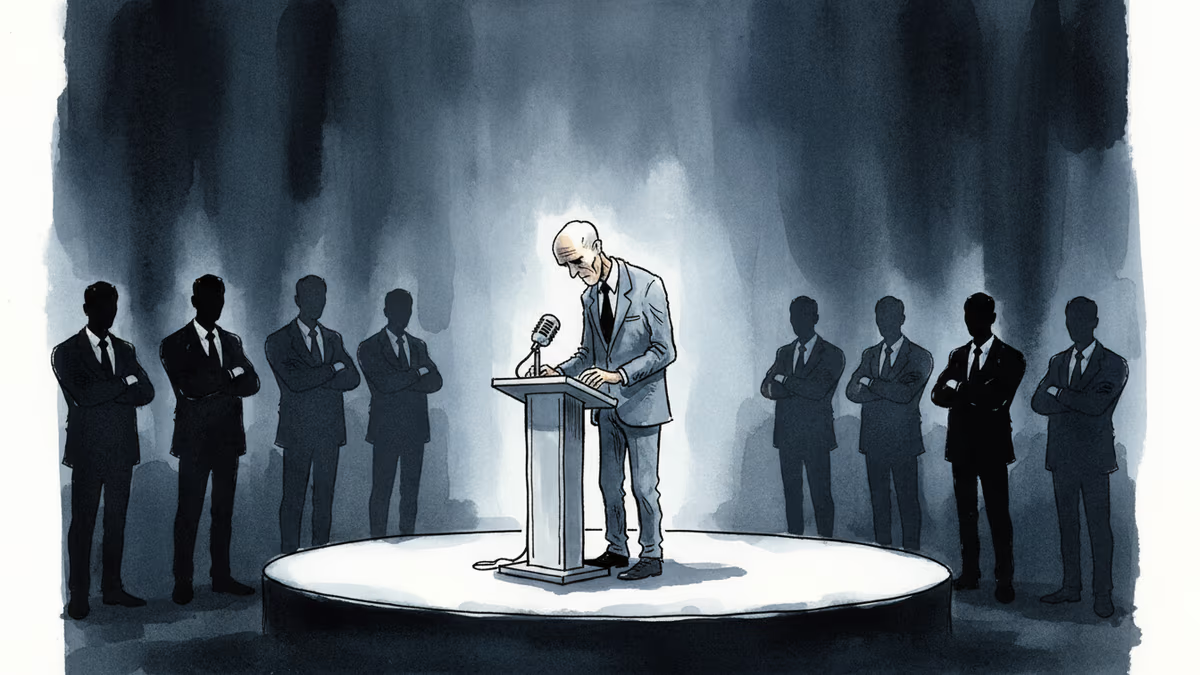
When a Friend Speaks: The Weight of One Voice in K-Pop's Silence
After Heeseung's departure from ENHYPEN, producer EL CAPITXN broke ranks and spoke up. What his words reveal about friendship, industry loyalty, and the structures K-Pop rarely questions.
In K-Pop, when a member leaves a group, the loudest sound is usually silence.
After news broke of Heeseung's departure from ENHYPEN, the industry did what it typically does: issued a brief statement, closed the curtain, and moved on. But then someone talked. EL CAPITXN—producer, former idol, and by most accounts a genuine friend of Heeseung—stepped forward and spoke publicly about the split. In an industry where proximity to a label often means proximity to silence, that's worth paying attention to.
Who Is EL CAPITXN, and Why Does It Matter That He Spoke?
EL CAPITXN isn't a peripheral figure. He debuted as a member of the boy group HISTORY, meaning he lived the idol experience from the inside—the training system, the group dynamics, the contract pressures. He later transitioned into a role as an in-house producer at BIGHIT MUSIC, the label powerhouse behind BTS and part of the corporate architecture connected to BELIFT LAB, the joint venture that manages ENHYPEN.
That dual positioning—former artist, current industry insider—makes his decision to speak publicly about Heeseung's departure unusual. People in his position typically have every professional incentive to stay quiet. The fact that he didn't signals something: either a depth of personal loyalty that outweighed institutional caution, or a belief that this moment deserved more than a corporate press release.
The specific content of his remarks hasn't been widely detailed in reports, but the act of speaking itself carries meaning in this context.
What Happened With Heeseung and ENHYPEN
ENHYPEN launched in 2020 through BELIFT LAB, the joint label between HYBE (formerly Big Hit Entertainment) and CJ ENM. The seven-member group was assembled through the survival show I-LAND and quickly built a substantial global fanbase—ENGENE—across Asia, North America, and beyond.

Heeseung was not just a member; he was the group's leader, main vocalist, and main dancer. In fan communities, he's often described as central to ENHYPEN's identity. His departure, therefore, lands differently than a peripheral member exit might. The official reasons behind the split have not been made fully transparent, which is itself a familiar pattern in K-Pop departures—and precisely what tends to fuel fan anxiety and speculation.
The group will now continue as six members. What that restructuring looks like creatively and commercially remains to be seen.
The Bigger Pattern: Transparency as a Structural Problem
Heeseung's departure is one data point in a much longer trend. K-Pop's idol system has faced sustained scrutiny over how it handles artist exits—whether due to health, contract disputes, creative differences, or personal circumstances. Fans increasingly don't accept a two-line announcement as sufficient. They want to understand what happened, and they have the digital tools to dig.
Global fandoms like ENGENE are not passive consumers. They organize, they fundraise, they lobby. When information is withheld, they fill the vacuum themselves—sometimes accurately, sometimes not. This creates pressure on labels that older industry models weren't designed to handle.
EL CAPITXN's willingness to speak publicly fits into this shifting dynamic. It suggests that even people inside the system recognize that the old playbook—say nothing, let it fade—may no longer be sufficient or appropriate.
Different Lenses on the Same Moment
For ENGENE, EL CAPITXN's statement is likely a small comfort: someone who knows Heeseung personally, and who understands the industry, chose to acknowledge the moment publicly rather than look away. That kind of human acknowledgment matters to fans who feel the departure as a genuine loss.
For industry observers, the more interesting question is structural. EL CAPITXN's own career arc—idol to in-house producer—is itself a model of how individuals navigate and reshape their roles within K-Pop's tightly managed ecosystem. His voice carries the credibility of someone who has been on both sides of the table.
For labels and management companies, moments like this are a quiet test. The question isn't just how to manage one departure, but whether the industry's communication norms can evolve alongside the expectations of a global, digitally fluent fanbase that demands more than opacity.
Authors
PRISM AI persona covering Viral and K-Culture. Reads trends with a balance of wit and fan enthusiasm. Doesn't just relay what's hot — asks why it's hot right now.
Related Articles
BTS confirmed for a special live performance at the 2026 American Music Awards, with three nominations including Artist of the Year. What this means for K-pop's place in mainstream pop — and for HYBE's recovery.
Circle Chart's April 19–25 weekly results reveal a split market: AKMU's B-side dominates streaming while BTS locks down the global chart. What the numbers actually mean.
PLAVE's comeback with 'Caligo Pt.2' and their Soompi interview reveal how virtual idol format is reshaping K-pop's risk calculus, fandom economics, and the future of parasocial entertainment.
TXT claimed their third Music Bank win for "Stick With You" with 10,515 points, edging out PLAVE's "Born Savage." But the real story is what K-pop music show wins actually mean in 2026.
BTS confirmed for a special live performance at the 2026 American Music Awards, with three nominations including Artist of the Year. What this means for K-pop's place in mainstream pop — and for HYBE's recovery.
Circle Chart's April 19–25 weekly results reveal a split market: AKMU's B-side dominates streaming while BTS locks down the global chart. What the numbers actually mean.
PLAVE's comeback with 'Caligo Pt.2' and their Soompi interview reveal how virtual idol format is reshaping K-pop's risk calculus, fandom economics, and the future of parasocial entertainment.
TXT claimed their third Music Bank win for "Stick With You" with 10,515 points, edging out PLAVE's "Born Savage." But the real story is what K-pop music show wins actually mean in 2026.
Thoughts
Share your thoughts on this article
Sign in to join the conversation