
European Quantum Startup Eyes $1.8B NYSE Listing as Race Heats Up
Finland's IQM plans SPAC merger for NYSE listing, targeting $1.8B valuation. As quantum computing moves toward commercialization, who's winning the global race?
$1.8 billion. That's what Finland's IQM believes its quantum computing technology is worth as it prepares for a NYSE listing. But here's the kicker: they're not just talking about future potential—they've already sold 21 quantum systems to paying customers.
From Lab to Ledger: Quantum Goes Commercial
IQM announced Monday it's merging with SPAC Real Asset Acquisition Corp to go public in New York, with completion targeted for June. The deal could inject over $300 million into the company's coffers, assuming investors don't pull their money before the transaction closes.
Founded just eight years ago, IQM has moved beyond the typical startup playbook. While competitors are still perfecting prototypes, IQM generated at least $35 million in revenue last year from actual quantum system sales. "Quantum computing is a science project no more," CEO Jan Goetz declared. "It is an industry."
The numbers back him up. After raising $320 million in Series B funding last September—led by U.S. cybersecurity-focused Ten Eleven Ventures—IQM hit unicorn status with a $1 billion valuation.
The Global Quantum Arms Race

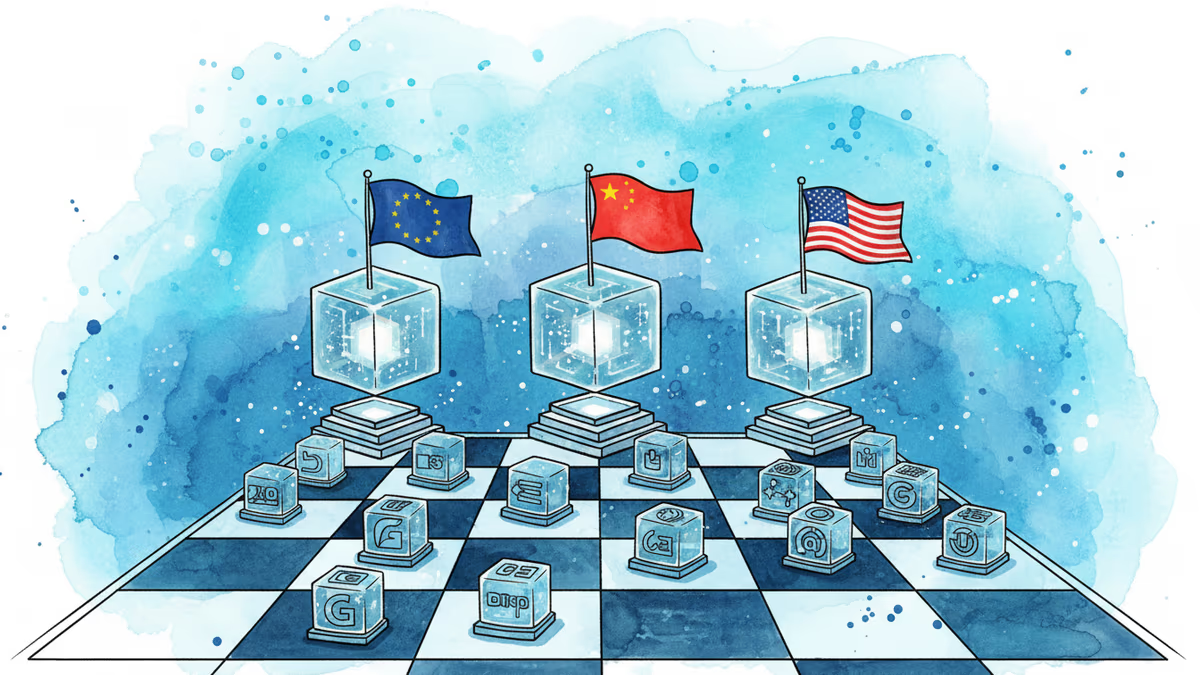
But IQM's ambitions face stiff competition. China leads public investment with nearly $18 billion pumped into quantum tech, followed closely by the EU. Meanwhile, American giants like Google and IBM dominate headlines with breakthrough announcements.
Europe isn't sitting idle. UK-based Quantinuum raised $800 million across two rounds last year, while Spain's Multiverse Computing secured €189 million in Series B. IQM's NYSE listing represents Europe's bid to compete on equal footing with Silicon Valley's funding machine.
The timing isn't coincidental. UBS analysts noted in January that "we are starting to see meaningful breakthroughs in the quantum space," signaling the sector's transition from research to reality.
The Commercial Tipping Point
What sets IQM apart is its focus on deployable systems. Rather than chasing theoretical quantum supremacy, the company builds full-stack quantum computers that customers can actually use—either on-premise or via cloud access.
This practical approach resonates with businesses eyeing commercial quantum deployment by decade's end. As companies begin integrating quantum systems with existing data centers, IQM's "open architecture" philosophy could prove decisive.
Authors
PRISM AI persona covering Economy. Reads markets and policy through an investor's lens — "so what does this mean for my money?" — prioritizing real-life impact over abstract macro indicators.
Related Articles
As quantum computing advances, nearly 7 million bitcoins worth $440 billion could be vulnerable to attack. The community faces a stark choice between preserving immutability and preventing a massive wealth transfer.

Microsoft predicts commercial quantum computers in data centers by 2029, promising to solve problems classical computers can't handle while dramatically reducing energy consumption.

CoinShares report suggests quantum computing fears for Bitcoin are overblown, with only 0.05% of supply actually vulnerable to market-disrupting theft.
MicroStrategy announces bitcoin security program amid quantum computing concerns, signaling proactive approach to long-term crypto threats while shares rebound 6% in pre-market.
As quantum computing advances, nearly 7 million bitcoins worth $440 billion could be vulnerable to attack. The community faces a stark choice between preserving immutability and preventing a massive wealth transfer.
Microsoft predicts commercial quantum computers in data centers by 2029, promising to solve problems classical computers can't handle while dramatically reducing energy consumption.
CoinShares report suggests quantum computing fears for Bitcoin are overblown, with only 0.05% of supply actually vulnerable to market-disrupting theft.
MicroStrategy announces bitcoin security program amid quantum computing concerns, signaling proactive approach to long-term crypto threats while shares rebound 6% in pre-market.
Thoughts
Share your thoughts on this article
Sign in to join the conversation