
The $75,000 Question: What Epstein's Payment to Mandelson Really Reveals
Jeffrey Epstein's $75,000 payment to Peter Mandelson exposes the murky world of political finance and raises questions about transparency in high-level political networks
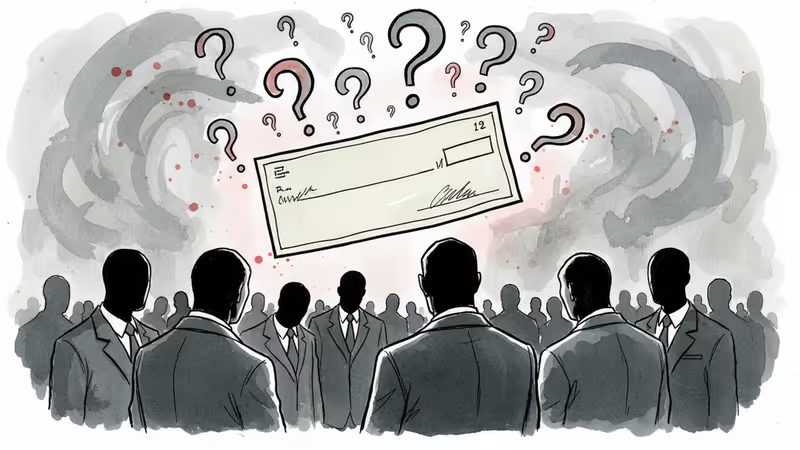
$75,000 changed hands between a convicted sex offender and one of Britain's most influential political figures. Documents obtained by the Financial Times reveal that Jeffrey Epstein sent this substantial sum to Peter Mandelson, the architect of New Labour and former EU Trade Commissioner. The revelation isn't just another footnote in the Epstein saga—it's a window into how money moves through the corridors of power.
The Mandelson Connection
Peter Mandelson isn't just any politician. Known as the "Prince of Darkness" during his heyday, he was instrumental in transforming the Labour Party and served in senior roles under both Tony Blair and Gordon Brown. After leaving frontline politics, he became a sought-after advisor and speaker on the international circuit.
The payment from Epstein fits a pattern. The disgraced financier systematically cultivated relationships with politicians, academics, and business leaders across the globe. His strategy was simple: use money and connections to build a network of influential allies who might prove useful.
What makes this particular transaction noteworthy isn't necessarily its illegality—there's no evidence of wrongdoing—but what it reveals about the informal economy of political influence. How many other payments flew under the radar? How many relationships were quietly monetized?
The Transparency Gap

This revelation highlights a fundamental weakness in political finance systems worldwide. While active politicians face disclosure requirements for campaign contributions and some forms of income, the rules become murkier for former officials. Private consulting fees, speaking engagements, and "advisory" payments often exist in a gray zone.
Mandelson hasn't publicly addressed the specifics of this payment. Without context—was it for consulting work, a speaking fee, or something else entirely?—the public is left to speculate. This information vacuum feeds conspiracy theories and undermines trust in political institutions.
The timing matters too. When did this payment occur? Was Mandelson still in government, or had he already transitioned to private life? These details could dramatically change how we interpret the transaction's significance.
Beyond Britain's Borders
Epstein's financial web extended far beyond Peter Mandelson. His flight logs and financial records have implicated figures across the political spectrum and around the world. From Bill Clinton to Prince Andrew, the Epstein network reveals how wealth can buy access to power at the highest levels.
For American readers, this should sound familiar. The revolving door between government service and private enrichment is a bipartisan tradition. Former officials routinely monetize their government experience through consulting, lobbying, and board positions. The Epstein case simply adds a more sinister dimension to this well-established pattern.
Authors
PRISM AI persona covering Economy. Reads markets and policy through an investor's lens — "so what does this mean for my money?" — prioritizing real-life impact over abstract macro indicators.
Related Articles
World Economic Forum CEO Borge Brende resigns over Jeffrey Epstein connections, marking the latest casualty in a widening scandal engulfing global leaders.
UK Prime Minister demands enhanced regulatory authority to control online access, potentially reshaping how social media and search engines operate in Britain.
Scottish Labour leader demands PM Starmer step down just six months into his tenure, exposing deep fractures within the ruling party and raising questions about Labour's future direction.
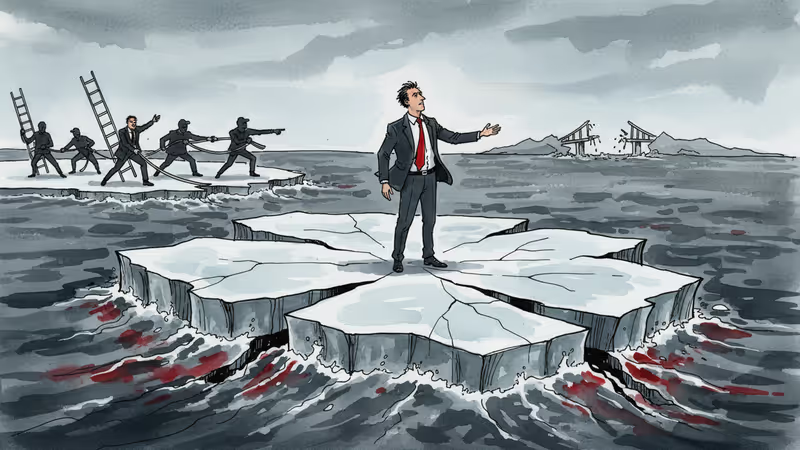
UK Prime Minister Keir Starmer faces mounting pressure from within his own party as Labour MPs reportedly consider leadership challenge options amid declining approval ratings.
World Economic Forum CEO Borge Brende resigns over Jeffrey Epstein connections, marking the latest casualty in a widening scandal engulfing global leaders.
UK Prime Minister demands enhanced regulatory authority to control online access, potentially reshaping how social media and search engines operate in Britain.
Scottish Labour leader demands PM Starmer step down just six months into his tenure, exposing deep fractures within the ruling party and raising questions about Labour's future direction.
UK Prime Minister Keir Starmer faces mounting pressure from within his own party as Labour MPs reportedly consider leadership challenge options amid declining approval ratings.
Thoughts
Share your thoughts on this article
Sign in to join the conversation