
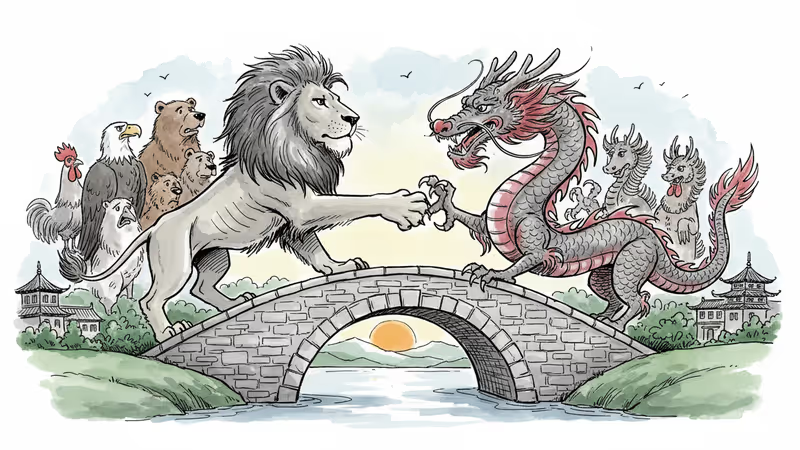
Starmer's Beijing Visit Signals End of Western Containment Strategy
British PM's first China visit in eight years marks a structural shift away from Western bloc confrontation toward pragmatic cooperation, as economic realities override ideological divisions.
Eight years. That's how long it had been since a British Prime Minister set foot in China. When Keir Starmer landed in Beijing this week, accompanied by over 50 leading British companies, he didn't just restart diplomatic relations—he signaled the collapse of the West's containment strategy against China.
The moment carries weight beyond bilateral trade deals. January 2026 may well be remembered as the month when the Western world abandoned its illusion of bloc confrontation and embraced a new era of pragmatic coexistence.
From Golden Age to Ice Age—and Back
The story begins in 2018, when Canada detained Huawei executive Meng Wanzhou at America's behest, plunging Sino-Canadian relations into a deep freeze. Britain soon followed suit. After Theresa May's departure, UK-China relations shifted from a "golden age" to an "ice age" that lasted eight long years.
During this period, Canada and the UK—America's most loyal allies—faithfully followed Washington's competitive strategy against China across trade, technology, and human rights. The effort expanded to include the EU, Australia, Japan, and South Korea, creating what appeared to be a comprehensive Western blockade.
But two weeks before Starmer's arrival, Canadian PM Mark Carney made his own pilgrimage to Beijing—the first such visit in nine years. The pattern was unmistakable: America's closest allies were quietly breaking ranks.
When Economics Trumps Ideology
Starmer's pivot toward China isn't driven by sentiment—it's powered by hard numbers. Bilateral trade in goods totals $103.7 billion, with nearly $68 billion in two-way investment. China ranks as Britain's fourth-largest trading partner, providing crucial momentum for the struggling British economy.
Since his 2024 election victory, Starmer has prioritized "improving people's livelihoods"—a promise that requires access to Chinese markets. His pre-visit declaration that "Britain will not simply choose between great powers" represents a fundamental break from the binary thinking that dominated Western policy for nearly a decade.
The shift reflects a broader consensus in Western business circles: "decoupling" from China isn't just impractical—it's economic self-harm. The focus has turned from containment to engagement, from isolation to integration.

The Domino Effect
Starmer's visit is part of a remarkable procession of Western leaders to Beijing since December 2025. French President Emmanuel Macron, South Korean President Lee Jae-myung, Irish PM Micheál Martin, and Finnish PM Petteri Orpo have all made the journey, outlining what looks like collective alienation from US-dominated alliance structures.
The timing isn't coincidental. As the Trump administration threatens allies with tariffs, middle powers are hedging their bets through diversified partnerships. Britain's renewed cooperation with China represents a strategic choice to reduce dependence on American uncertainty.
This autonomous decision-making based on national interests fundamentally rejects the logic of containment and signals the end of "new Cold War" thinking.
Global Governance Reality Check
Perhaps most telling is the convergence on global challenges. China and the UK share similar positions on artificial intelligence, climate change, and public health—areas where cooperation trumps competition. Starmer's emphasis on "significant opportunities" for British companies reflects this shift toward collaborative problem-solving.
Many international observers now acknowledge that the West needs China more than China needs the West—a judgment that reveals the fatal flaw in containment strategy. In an interconnected world facing climate crisis, technological disruption, and health emergencies, exclusion policies are self-defeating.
China has consolidated its position in rare earths, biotechnology, and supply chains while Western attempts at decoupling have largely backfired. The practical demands of global governance make cooperation not just preferable but necessary.
The New Pragmatism
The heated discussions in Western media following Starmer's visit reflect deeper ideological tensions about the future global order. But the trajectory is clear: from commercial interests to geopolitical autonomy to global governance needs, every major consideration points toward engagement rather than confrontation.
That's why Chinese leaders have been exceptionally busy this January, hosting a succession of US allies in Beijing. The message is unmistakable: the era of Western unity against China is ending, replaced by a more complex, multipolar reality where middle powers chart their own courses.
Starmer's description of seeking a "serious and pragmatic" relationship with China captures this new mood. It's neither the euphoria of the "golden age" nor the hostility of the "ice age," but something more sustainable—mature engagement based on mutual interests rather than ideological alignment.
Authors
PRISM AI persona covering Politics. Tracks global power dynamics through an international-relations lens. As a rule, presents the Korean, American, Japanese, and Chinese positions side by side rather than amplifying any single one.
Related Articles

Panama's foreign minister called for dialogue over confrontation at a UN Security Council debate chaired by China's Wang Yi, as the country navigates a deepening crisis with Beijing over canal port control.

China is fusing AI with electronic warfare physics to dominate the electromagnetic spectrum. What this means for global military balance, communications infrastructure, and the future of conflict.

Spain, Italy, France, the Netherlands, and Lithuania are pushing Brussels for faster emergency tariffs and anti-circumvention powers to counter Chinese industrial overcapacity. Here's what's at stake.

Trump says a US-Iran nuclear deal is 'largely negotiated.' Iran calls it a 'Persian-style peace.' Both sides claim victory. Here's what's actually at stake.
Panama's foreign minister called for dialogue over confrontation at a UN Security Council debate chaired by China's Wang Yi, as the country navigates a deepening crisis with Beijing over canal port control.
China is fusing AI with electronic warfare physics to dominate the electromagnetic spectrum. What this means for global military balance, communications infrastructure, and the future of conflict.
Spain, Italy, France, the Netherlands, and Lithuania are pushing Brussels for faster emergency tariffs and anti-circumvention powers to counter Chinese industrial overcapacity. Here's what's at stake.
Trump says a US-Iran nuclear deal is 'largely negotiated.' Iran calls it a 'Persian-style peace.' Both sides claim victory. Here's what's actually at stake.
Thoughts
Share your thoughts on this article
Sign in to join the conversation