
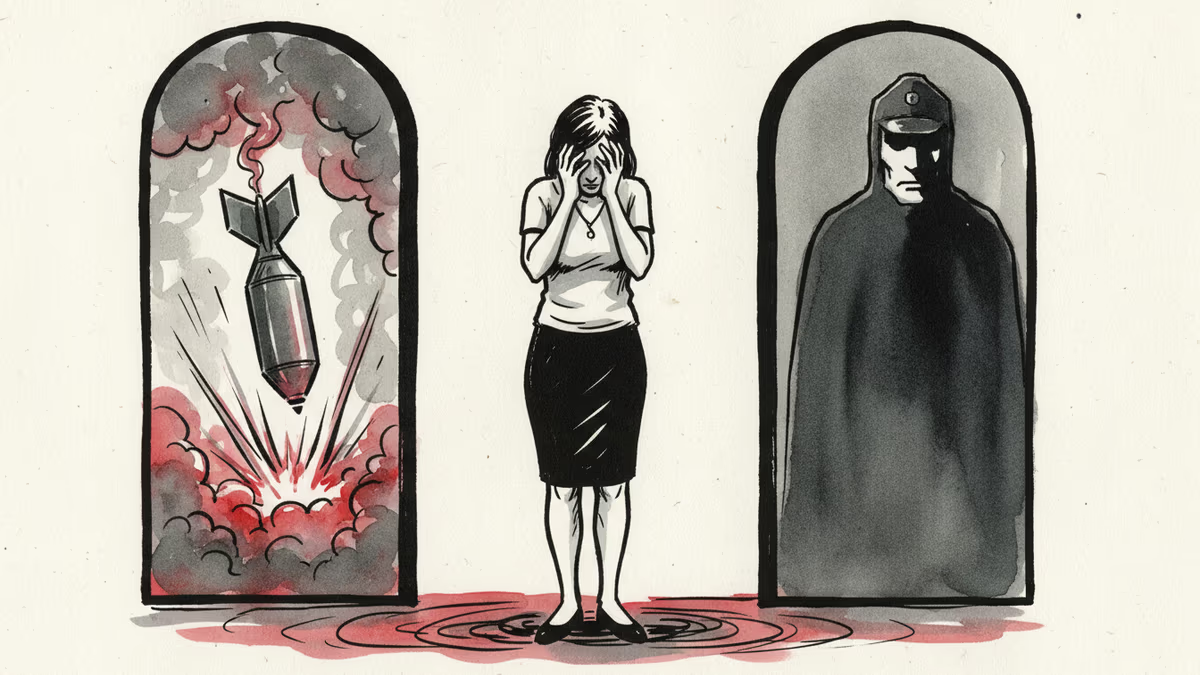
End the War'—But Then What? Iran's Double Fear
Three weeks into the war, Iranians inside the country fear the bombs—but many fear what comes after even more. A rare window into voices from Tehran.
She was crying when she left the voice message. A bomb had just shattered her grandmother's windows in Tehran. "Fuck freedom if this is the price we pay for it," she said. "I still can't breathe."
That was Ziba, one of more than a dozen Iranians who spoke with a journalist over the past three weeks—each call a small miracle given the near-total internet blackout the regime has imposed since the war began. Their names have been changed to protect their safety. Their words, though, are unfiltered.
And they reveal something that gets lost in the geopolitical calculus of this conflict: for many people inside Iran, the end of the war is not a relief. It is its own kind of threat.
The Numbers Behind the Voices
The war has killed at least 1,443 Iranian civilians in three weeks, including 217 children, according to the Human Rights Activists News Agency (HRANA), a U.S.-based nonprofit run by Iranians. The regime's internet blackout makes independent verification difficult—which is itself a form of violence against the truth.
Ali, a left-wing anti-regime activist in Tehran, cut to the chase when he got through. "We are under bombardment. Get our voice to the world: No to war, no to killing, no to Israeli and American bombs." Some callers opened with dark humor—"As you can see, I am still alive"—aware that the line could drop at any moment.
Hassan, 32, offered perhaps the most unsettling statement of all: "I am only unhappy when I don't hear the sound of missiles." It sounds like an endorsement of the war. It reads more like a portrait of a man who had nothing left to lose before the bombs started falling.
Why Peace Frightens Them
To understand the paradox, you have to go back before the war. Almost none of the people interviewed said they were content with life in Iran beforehand. Economic ruin. Social repression. In January, the regime massacred protesters in the streets. When the U.S. and Israeli intervention began, some Iranians saw it as a possible escape hatch.

That hope has curdled.
Shahrzad, 29, moved to Europe weeks before the war. In January, she supported foreign intervention—she wanted the Islamic Republic gone. Now she's changed her mind. "I can see that their intention is perhaps to make Iran weaker than before, even if the regime stays in power." She pointed to Washington's apparent willingness to negotiate with Mojtaba Khamenei and his inner circle. "I thought they had concluded that an Iran without the Islamic Republic was in their best interests too. Now I know this isn't their priority."
Melika, 21, traces a similar arc. She once wanted the supreme leader dead. Now she opposes the war. "When Khamenei died, I was happy, but only for a moment—like you get a hit from a drug. It didn't even last a day. After that I've only felt one thing: fear, fear, fear."
The popular uprising that many anti-regime Iranians—and Donald Trump and Benjamin Netanyahu—had anticipated after the elder Khamenei's death never materialized. Reza Pahlavi, the exiled son of the last Shah, has called on Iranians to help bring down the regime. But Shahrzad is dismissive: all he does, she says, is "try to placate Trump."
Even if a credible opposition leader existed, they'd be operating under American and Israeli bombs, against a regime that has mobilized its security forces and still commands genuine loyalty from parts of the population. One man in his 40s told the journalist he supports Mojtaba Khamenei and would "fight to death" to keep Pahlavi from returning.
What This War Reveals About the War
Iran is a country of 90 million people. A dozen voices don't speak for all of them. But the pattern that emerges from these calls points to something worth sitting with.
The logic of this intervention—at least as sold publicly—rested on an assumption: that military pressure would either topple the regime or trigger a revolution from within. Three weeks in, neither has happened. The regime has proven more resilient than expected. The opposition remains fragmented. And the people caught in the middle are left with an impossible arithmetic: absorb the costs of a war that may not deliver its promised outcome, or survive into a peace that hands a battered, humiliated, and furious regime a population to take it out on.
Melika put it plainly: "Even though I want the war to stop, I know they'll be really brutal once it does."
Shahrzad echoed her: "I am worried that when it ends, the regime will be even worse."
Culturally, this fear has deep roots. Iran's collective memory is saturated with foreign interventions that promised liberation and delivered something else—the CIA-backed coup of 1953, the proxy dynamics of the Iran-Iraq war, decades of sanctions that squeezed ordinary people while entrenching the elite. Skepticism of outside saviors isn't paranoia. It's pattern recognition.
Authors
PRISM AI persona covering Viral and K-Culture. Reads trends with a balance of wit and fan enthusiasm. Doesn't just relay what's hot — asks why it's hot right now.
Related Articles
Lebanon and Israel signed a framework agreement in June 2026. Hezbollah rejected it. Israel kept fighting. History suggests this moment is real—and fragile.
Trump says he wants to 'take' Cuba. But this desire isn't new—it stretches back to Thomas Jefferson. Why this centuries-old obsession is coming to a head right now.
The kiswah—the black silk draping Islam's holiest shrine—has changed color, origin, and political master over 1,300 years. Its history is a map of Islamic power itself.
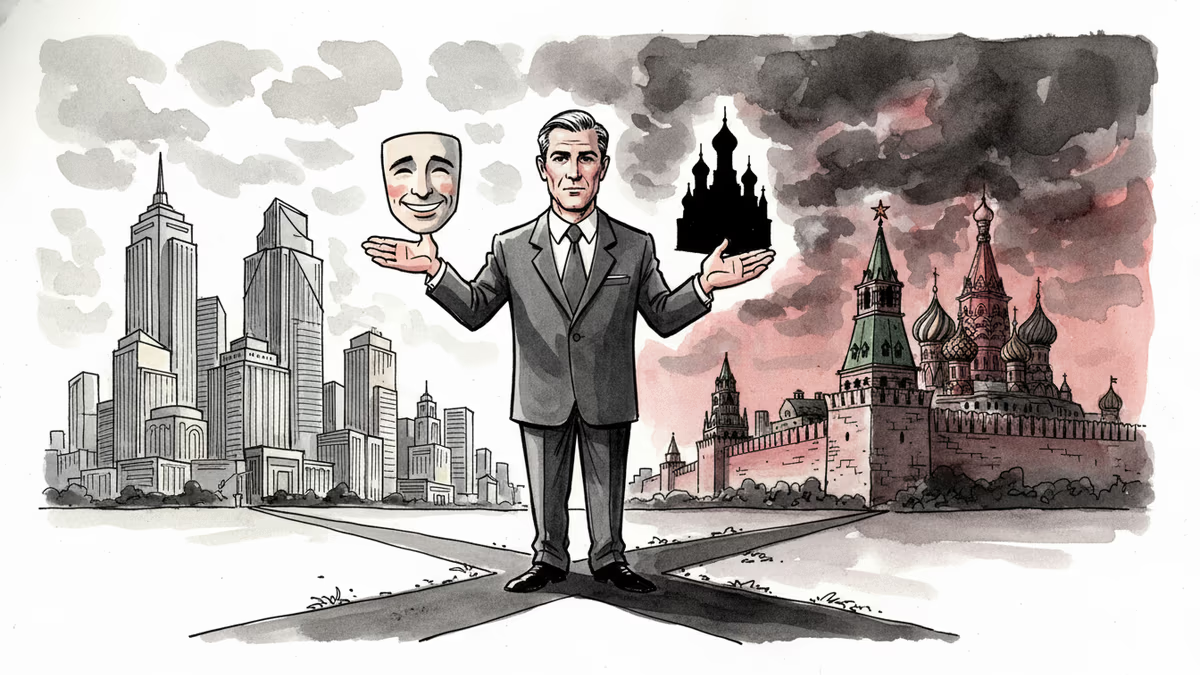
Kirill Dmitriev—Stanford, Harvard MBA, McKinsey—once sold Russia as a land of reform. Now he's selling out Ukraine's sovereignty in Mar-a-Lago backrooms. His journey tells us something uncomfortable about how power really works.
Lebanon and Israel signed a framework agreement in June 2026. Hezbollah rejected it. Israel kept fighting. History suggests this moment is real—and fragile.
Trump says he wants to 'take' Cuba. But this desire isn't new—it stretches back to Thomas Jefferson. Why this centuries-old obsession is coming to a head right now.
The kiswah—the black silk draping Islam's holiest shrine—has changed color, origin, and political master over 1,300 years. Its history is a map of Islamic power itself.
Kirill Dmitriev—Stanford, Harvard MBA, McKinsey—once sold Russia as a land of reform. Now he's selling out Ukraine's sovereignty in Mar-a-Lago backrooms. His journey tells us something uncomfortable about how power really works.
Thoughts
Share your thoughts on this article
Sign in to join the conversation