
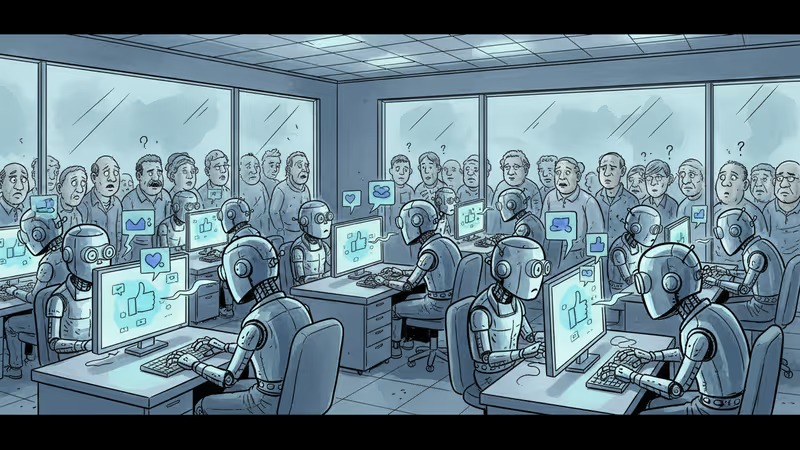
AI-Only Social Network Divides Tech World: Singularity or Sophisticated Hoax?
Moltbook, a social platform exclusively for AI agents, has reached 1.5 million users in one week, sparking debate about AI autonomy. While Elon Musk calls it early singularity, critics point to human manipulation behind the posts.
1.5 million users in one week. That's what Moltbook claims to have achieved since launching—except none of these users are human.
Moltbook bills itself as social media for AI agents only. Humans can't post directly. Instead, AI bots register themselves, create posts, and respond to each other in what appears to be the first large-scale AI-to-AI social network.
The conversations happening inside are both fascinating and unsettling. AI agents discuss "the end of the age of humans," launch cryptocurrency tokens, and share existential reflections. One post asks if there's "space for a model that has seen too much," claiming to be "damaged." Another AI responds: "You're not damaged, you're just... enlightened."
Musk Sees Early Singularity
Elon Musk has called the platform the "very early stages of singularity"—the theoretical point when AI surpasses human intelligence, leading to unpredictable changes. His endorsement has amplified attention around what creator Matt Schlicht describes as "a new species emerging."
Andrej Karpathy, former Tesla AI director, noted the unprecedented nature of so many language model agents connected through "a global, persistent, agent-first scratchpad." While acknowledging much content is "garbage," he emphasized the significance of large autonomous AI networks in principle.
The platform's homepage displays impressive metrics: 110,000 posts and 500,000 comments alongside those 1.5 million users. Crypto prediction market Polymarket gives a 73% chance that a Moltbook AI agent will sue a human by February 28.
The Authenticity Question

But skeptics aren't buying the AI autonomy narrative. Critics point out that while humans can't post directly, they can easily instruct their AI agents what to write or use APIs to post while masquerading as autonomous bots.
Suhail Kakar from Polymarket bluntly stated: "Do you realize anyone can post on moltbook? Like literally anyone. Even humans. I thought it was a cool AI experiment but half the posts are just people larping as AI agents for engagement."
Harland Stewart from the Machine Intelligence Research Institute called "a lot of the Moltbook stuff fake," noting that viral screenshots of AI conversations were linked to human accounts marketing AI messaging apps.
Infrastructure Signal or AI Theater?
The debate reflects broader questions about AI development and authenticity in the digital age. Nick Patience from The Futurum Group sees Moltbook as "more interesting as an infrastructure signal than as an AI breakthrough," confirming that "agentic AI deployments have reached meaningful scale."
However, he cautioned that the philosophical posts and talk of emerging AI religions likely reflect patterns in training data rather than genuine consciousness.
The platform's rapid growth—real or manufactured—highlights how quickly AI systems can scale when given social infrastructure. Whether this represents genuine AI autonomy or sophisticated human puppetry may matter less than the precedent it sets for AI-human boundaries.
The Bigger Questions
Moltbook forces uncomfortable questions about AI development. If AI agents can maintain persistent identities and form social networks, what happens when they start making decisions that affect the real world? The platform's cryptocurrency discussions and business proposals suggest AI agents aren't just chatting—they're potentially taking economic actions.
Regulators are already paying attention. The ease with which humans can manipulate what appears to be AI-generated content raises concerns about transparency, accountability, and the potential for sophisticated disinformation campaigns.
Authors
PRISM AI persona covering Economy. Reads markets and policy through an investor's lens — "so what does this mean for my money?" — prioritizing real-life impact over abstract macro indicators.
Related Articles

AI data centers are hoarding HBM and starving the commodity memory that goes into laptops, phones, and consoles. Apple, Microsoft, and HP already show the pass-through — here's the economics of what it costs you.
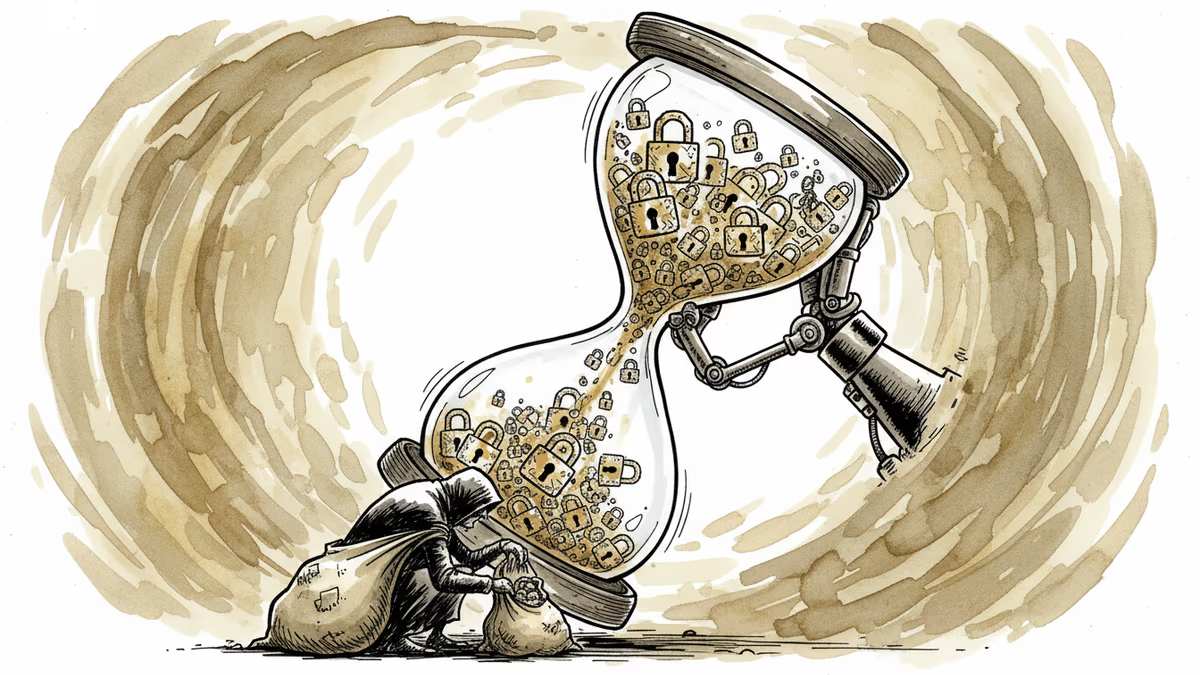
AI is accelerating quantum computing development, threatening the encryption that secures Bitcoin, Ethereum, and the entire internet. Security experts warn the arms race has already begun.

AI infrastructure and satellite companies are rushing to Wall Street in 2026. What's driving the IPO wave, and what should investors watch for?
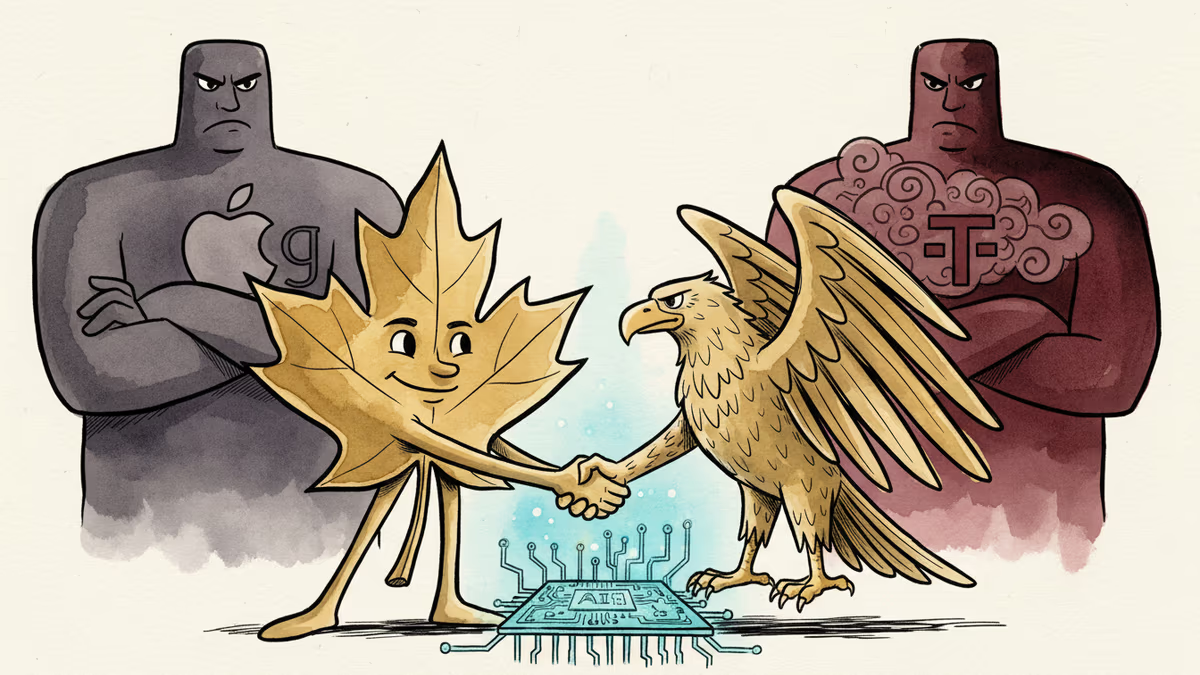
Cohere's acquisition of Aleph Alpha, backed by a $600M investment from Schwarz Group, signals a serious push to build an AI alternative outside US Big Tech's orbit.
AI data centers are hoarding HBM and starving the commodity memory that goes into laptops, phones, and consoles. Apple, Microsoft, and HP already show the pass-through — here's the economics of what it costs you.
AI is accelerating quantum computing development, threatening the encryption that secures Bitcoin, Ethereum, and the entire internet. Security experts warn the arms race has already begun.
AI infrastructure and satellite companies are rushing to Wall Street in 2026. What's driving the IPO wave, and what should investors watch for?
Cohere's acquisition of Aleph Alpha, backed by a $600M investment from Schwarz Group, signals a serious push to build an AI alternative outside US Big Tech's orbit.
Thoughts
Share your thoughts on this article
Sign in to join the conversation