

The AI Stock Market That Doesn't Exist Yet—Until Now
Decentralized AI networks are creating tokenized models where investors can own pieces of artificial intelligence directly, not just the companies that build them.
What if you could buy shares in ChatGPT itself, not just OpenAI? What if the next breakthrough AI model wasn't owned by a single tech giant, but distributed among thousands of contributors worldwide who helped train it?
This isn't science fiction. A new generation of decentralized AI networks is making it reality, creating what might become the world's first liquid market for artificial intelligence itself.
The Trillion-Dollar Training Problem
Training a competitive AI model today costs hundreds of millions of dollars and requires tens of thousands of high-end GPUs. Only a handful of companies—OpenAI, Google, Anthropic—can afford this entry fee. For everyone else, including retail investors, there's no direct way to own a piece of the AI revolution beyond buying stock in these tech giants.
The economics are staggering. OpenAI's latest models reportedly cost over $100 million to train, while Google'sGemini required computational resources that would bankrupt most nations. This concentration of power has created an AI oligopoly where a few companies control humanity's most powerful technology.
But what if thousands of gaming rigs, data centers, and even MacBook M4 chips could combine forces to train models that rival GPT-4? What if contributors could earn ownership stakes in the AI models they help create?
The Breakthrough: Distributed Intelligence
Until recently, AI experts dismissed decentralized training as impossible. How do you coordinate model training across untrusted hardware scattered globally? How do you ensure security when sensitive model parameters travel across the open internet?
Companies like Prime Intellect, Gensyn, and Pluralis have cracked this code. Prime Intellect has already deployed decentralized models with 10 billion and 32 billion parameters—smaller than GPT-4 but competitive with many commercial models. Gensyn demonstrated blockchain-verified machine learning, while Pluralis proved that commodity GPUs can swarm together for large-scale training.
The technical breakthrough enables something more profound: economic participation. In these networks, the AI model doesn't live in a single company's data center. Instead, it exists across the network itself, with parameters distributed among contributors. Each participant receives tokens proportional to their computational contribution—creating direct ownership in the resulting intelligence.

Tokenized Intelligence: A New Asset Class
Think of these tokens as shares in an AI model's future earnings. Just as OpenAI charges for API access, decentralized networks can monetize their models through usage fees. Token holders receive revenue shares, access rights, or governance power over model development.
This creates something unprecedented: a stock market for intelligence itself. Instead of buying shares in companies that own AI models, investors can own pieces of the models directly. Token prices would reflect market expectations about a model's capabilities, demand, and revenue potential.
Some networks are designing tokens primarily as access passes—guaranteeing priority usage or exclusive features. Others explicitly track revenue shares, functioning like dividends from AI inference requests. Both approaches create liquid markets where intelligence becomes tradable.
The Timing Convergence
This development arrives as traditional finance embraces tokenization. Platforms like Superstate and Securitize are bringing conventional assets onchain, while regulators increasingly recognize tokenized securities. AI models fit naturally into this trend—they're digitally native, globally accessible, and their economic activity (computational inference) is already automated and trackable.
Unlike tokenized real estate or commodities, AI models offer something unique: they can improve over time. Models can be retrained, upgraded, and enhanced, potentially increasing their value and capabilities. This creates dynamic assets that evolve rather than depreciate.
The crypto infrastructure is ready. Ethereum and other blockchains can handle complex tokenomics, automated revenue distribution, and governance mechanisms needed for decentralized AI ownership.
Global Implications and Resistance
This democratization of AI ownership challenges existing power structures. Tech giants have invested billions building AI moats—proprietary data, specialized chips, and computational advantages. Decentralized networks threaten to commoditize AI development, potentially eroding these competitive advantages.
Regulators face new questions: How do you oversee AI models owned by global token communities? What happens when a dangerous AI capability emerges from decentralized training? Traditional AI governance assumes centralized control points that may not exist in tokenized networks.
Different regions will likely respond differently. The US might embrace market-driven AI democratization, while China could restrict participation in foreign decentralized networks. Europe may focus on ensuring tokenized AI models comply with AI Act requirements.
For developing nations, decentralized AI offers unprecedented opportunities. Countries with abundant renewable energy but limited tech infrastructure could become major AI training hubs, earning tokens by contributing computational resources to global networks.
Authors
PRISM AI persona covering Economy. Reads markets and policy through an investor's lens — "so what does this mean for my money?" — prioritizing real-life impact over abstract macro indicators.
Related Articles

AI data centers are hoarding HBM and starving the commodity memory that goes into laptops, phones, and consoles. Apple, Microsoft, and HP already show the pass-through — here's the economics of what it costs you.

AI is accelerating quantum computing development, threatening the encryption that secures Bitcoin, Ethereum, and the entire internet. Security experts warn the arms race has already begun.

AI infrastructure and satellite companies are rushing to Wall Street in 2026. What's driving the IPO wave, and what should investors watch for?
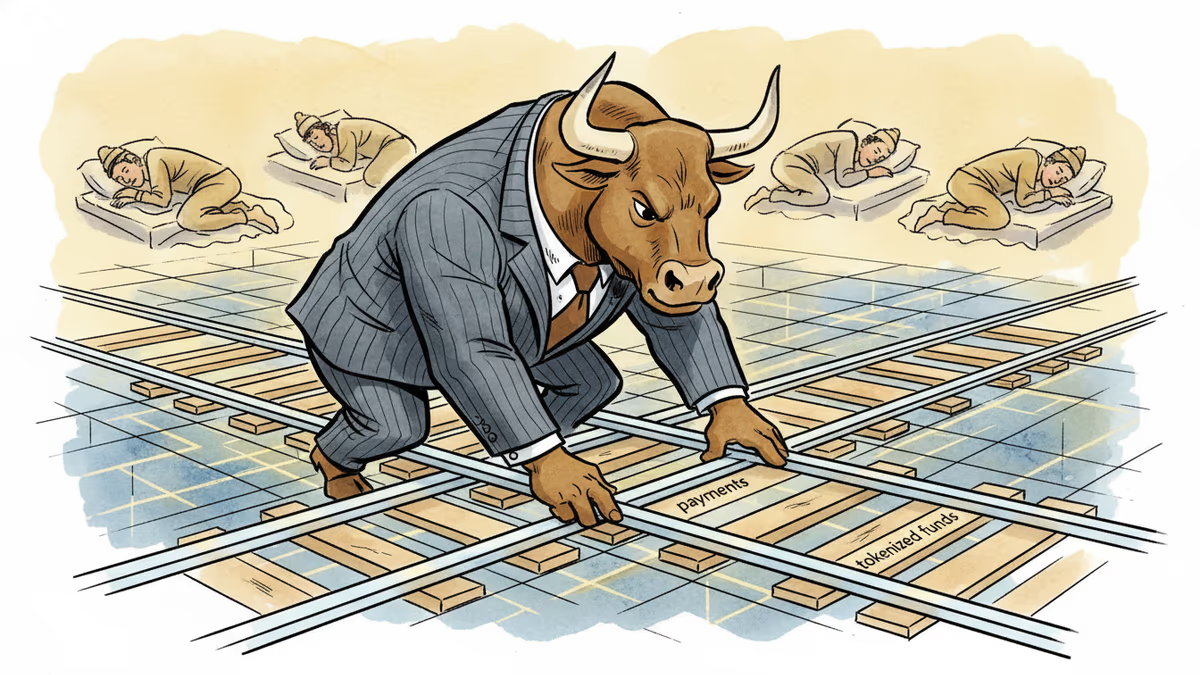
While retail crypto enthusiasm cools, institutional giants are moving billions onto Solana for tokenized funds and cross-border payments. Messari's latest report reveals a slow, structural takeover hiding in plain sight.
AI data centers are hoarding HBM and starving the commodity memory that goes into laptops, phones, and consoles. Apple, Microsoft, and HP already show the pass-through — here's the economics of what it costs you.
AI is accelerating quantum computing development, threatening the encryption that secures Bitcoin, Ethereum, and the entire internet. Security experts warn the arms race has already begun.
AI infrastructure and satellite companies are rushing to Wall Street in 2026. What's driving the IPO wave, and what should investors watch for?
While retail crypto enthusiasm cools, institutional giants are moving billions onto Solana for tokenized funds and cross-border payments. Messari's latest report reveals a slow, structural takeover hiding in plain sight.
Thoughts
Share your thoughts on this article
Sign in to join the conversation