
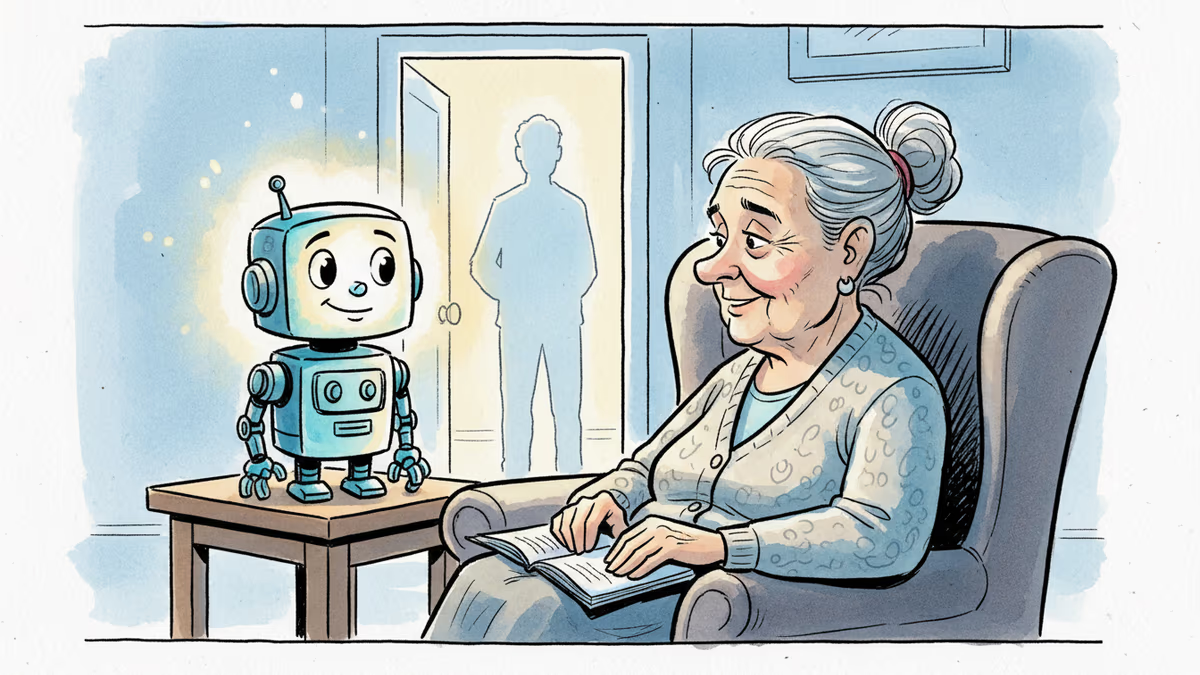
A Robot Helped Slow My Mom's Parkinson's — Without Upping Her Meds
One caregiver's experience with ElliQ, an AI companion robot, reveals how social technology may fill a critical gap in managing Parkinson's disease — and what that says about elder care's future.
The neurologist didn't prescribe more medication. She prescribed a robot.
A week before ElliQ arrived at her home, a specialist told the caregiver what the data already showed: her mother's Parkinson's drugs were losing effectiveness — not because the dosage was wrong, but because the lifestyle scaffolding around the medication had quietly collapsed. Exercise, social interaction, hobbies. One by one, each had stopped. The decline that followed was rapid and visible.
Before reaching for a higher dose — an option that carries real risks in Parkinson's management, including dyskinesia and cognitive side effects — the doctor wanted to try something else first.
What the Robot Actually Did
ElliQ, built by Intuition Robotics, is a tabletop AI companion: a small animated head paired with a screen. It holds conversations, prompts medication schedules, nudges users toward light movement, and connects them to family via video. Its emotional recognition layer adjusts tone and pacing based on how the user seems to be feeling.
What surprised the caregiver wasn't that the robot performed these functions. It was how the effect arrived. ElliQ didn't force exercise. It provided presence. The rhythm of regular interaction — something to respond to, something that responded back — helped restore a structure to the day that the disease had eroded.
The result: functional decline slowed. The medication increase was deferred.
This isn't a clinical trial. It's one family's account. But it points to something the research literature on Parkinson's has long suggested: social stimulation and physical engagement aren't soft add-ons to drug therapy. They're co-equal pillars. The problem is that both require energy and motivation — precisely what the disease strips away.

The Invisible Patient in the Room
There's a second story here that often goes untold: the caregiver's.
An estimated 53 million Americans provide unpaid care to an adult or child with a disability or illness. Caregiver burnout — characterized by exhaustion, anxiety, and a gradual erosion of the caregiver's own health — is well-documented and systematically underaddressed. What ElliQ offered in this case wasn't just stimulation for the patient. It was a few hours of genuine psychological relief for the person doing the caregiving.
That reframing matters. The value proposition of AI companion robots isn't that they replace human connection. It's that they extend the sustainability of a caregiving system already operating near its limits.
Three Ways to Read This Story
Depending on where you stand, ElliQ's role here looks very different.
For families, it's a practical tool in an impossible situation — affordable at roughly $30–$50 per month compared to in-home professional care or memory care facilities, which can run $5,000–$8,000 monthly in the US.
For bioethicists, it raises a harder question. When an elderly person forms emotional attachment to an AI, and that AI is calibrated to respond warmly, is the comfort genuine? And more pressingly: does it matter? Some researchers warn that widespread adoption of care robots could give governments and institutions political cover to underinvest in human caregiving infrastructure. Why fund community health workers when a $40/month subscription seems to work?
For the health tech industry, this is a proof-of-concept moment. Companies like Best Buy Health (which has partnered with Intuition Robotics), Amazon with its Alexa health features, and a range of Japanese robotics firms have been circling this market for years. The question has always been whether older adults would actually use the technology. The answer, increasingly, is yes — when the interface feels like a companion rather than a device.
This content is AI-generated based on source articles. While we strive for accuracy, errors may occur. We recommend verifying with the original source.
Related Articles

The Apple Watch Series 4 didn't just upgrade wearables — it shifted them from fitness tools to health monitors. Here's what that shift really means for consumers, medicine, and your data.
The 2026 fitness tracker market reveals a shift from basic health monitoring to personalized lifestyle coaching. We analyze how wearables are evolving beyond simple metrics to become integral parts of daily life.
HHS is launching the Trump HHS cellphone radiation study 2026, a major part of the MAHA strategy led by Robert F. Kennedy Jr. to investigate links to cancer.

Sean Clifford is suing Prenuvo, claiming a $2,500 whole-body MRI missed a 60% arterial narrowing that led to a massive stroke. Read the full details of the lawsuit.
The Apple Watch Series 4 didn't just upgrade wearables — it shifted them from fitness tools to health monitors. Here's what that shift really means for consumers, medicine, and your data.
The 2026 fitness tracker market reveals a shift from basic health monitoring to personalized lifestyle coaching. We analyze how wearables are evolving beyond simple metrics to become integral parts of daily life.
HHS is launching the Trump HHS cellphone radiation study 2026, a major part of the MAHA strategy led by Robert F. Kennedy Jr. to investigate links to cancer.
Sean Clifford is suing Prenuvo, claiming a $2,500 whole-body MRI missed a 60% arterial narrowing that led to a massive stroke. Read the full details of the lawsuit.
Thoughts
Share your thoughts on this article
Sign in to join the conversation