

Did Edison Accidentally Invent Graphene?
New research suggests Thomas Edison may have unknowingly created graphene during his lightbulb experiments 130 years ago. What other future technologies are hiding in historical labs?
The 2010 Nobel Prize in Physics went to scientists who first synthesized graphene in the lab. But Thomas Edison might have beaten them by 130 years.
New research from Rice University suggests that Edison unknowingly created graphene as a byproduct of his original incandescent bulb experiments. The finding, published in ACS Nano, emerged when researchers used modern tools to recreate Edison's 19th-century processes.
Graphene—a single layer of carbon atoms arranged in a hexagonal lattice—is the thinnest material known to science. It's stronger than steel, more conductive than copper, and transparent. Tech companies are racing to commercialize it for everything from smartphone batteries to water filters.
Edison's Accidental Chemistry
Edison didn't set out to create wonder materials. He was solving a practical problem: how to make electric lighting commercially viable. Early incandescent lamps existed, but they burned out quickly and required high electric current—useless for Edison's vision of widespread electrification.
He systematically tested filament materials, starting with carbonized cardboard and compressed lampblack. Both burned out rapidly. He tried various grasses and canes—hemp, palmetto—with similar failures. Eventually, carbonized bamboo proved optimal, lasting over 1,200 hours on a 110-volt power source.
Unknown to Edison, his carbonization process may have been creating single-atom-thick carbon sheets—what we now call graphene.
The Modern Recreation

James Tour, the Rice University chemist who led the study, found the historical detective work thrilling. "To reproduce what Thomas Edison did, with the tools and knowledge we have now, is very exciting," he said. "Finding that he could have produced graphene inspires curiosity about what other information lies buried in historical experiments."
The team's recreation wasn't just academic curiosity. If Edison's relatively simple process could produce graphene, it might offer clues for more efficient manufacturing methods. Current graphene production is complex and expensive—a major barrier to widespread adoption.
Hidden Value in Plain Sight
This discovery raises intriguing questions about technological timing. Graphene's properties were there in Edison's lab, but the world wasn't ready. We lacked the tools to detect it, the applications to use it, and the theoretical framework to understand it.
Today, graphene is positioned to revolutionize multiple industries. Apple and Samsung are exploring graphene-enhanced batteries. IBM is developing graphene transistors. Water treatment companies see potential in graphene filters.
Yet for over a century, this "miracle material" may have been sitting unrecognized in historical experiments.
The Archaeology of Innovation
Tour's research suggests we should view scientific history as an archaeological site. "What questions would our scientific forefathers ask if they could join us in the lab today?" he wondered. "What questions can we answer when we revisit their work through a modern lens?"
This approach could be particularly valuable as we face current technological challenges. Climate change, energy storage, water purification—solutions might already exist in forgotten experiments, waiting for modern eyes to recognize their potential.
The Edison-graphene connection also highlights how innovation often happens accidentally. Edison was trying to perfect lighting, not create nanomaterials. Some of today's most important discoveries might be hiding as "failed" experiments or unexpected byproducts.
Authors
Related Articles
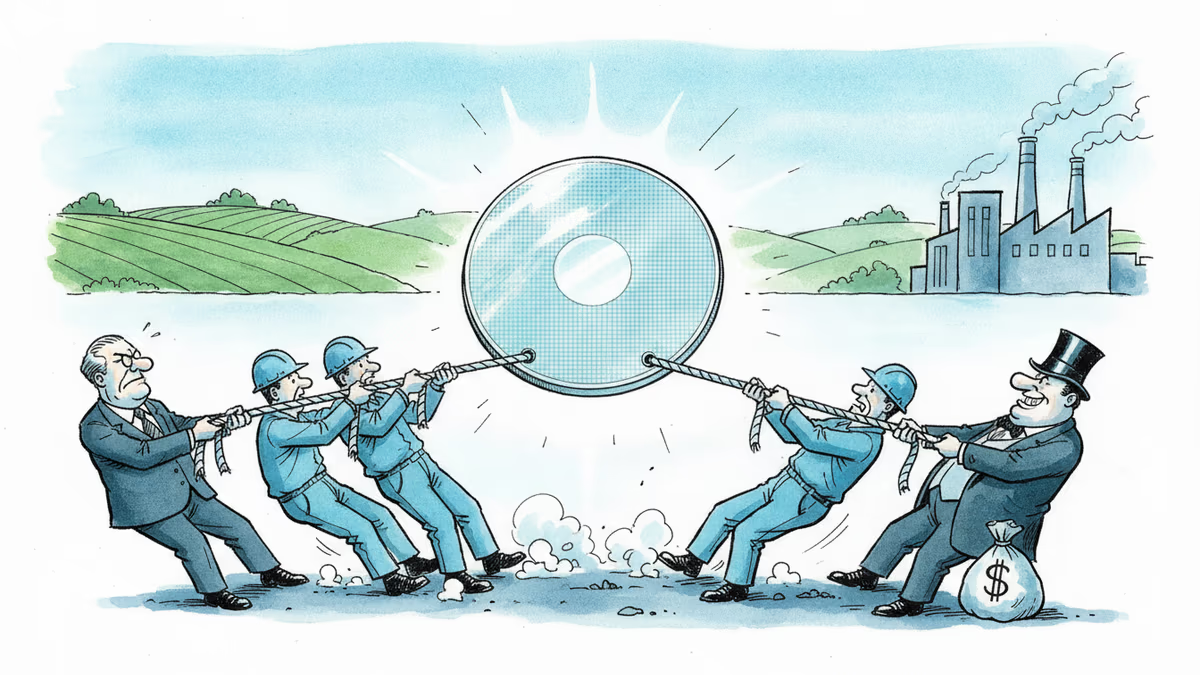
Samsung Electronics' union branch revealed that 84% of survey respondents oppose the government's roughly $290 billion (₩400 trillion) semiconductor megaproject in Gwangju. Government, management, the union and shareholders are all reading the same national project in sharply different ways.
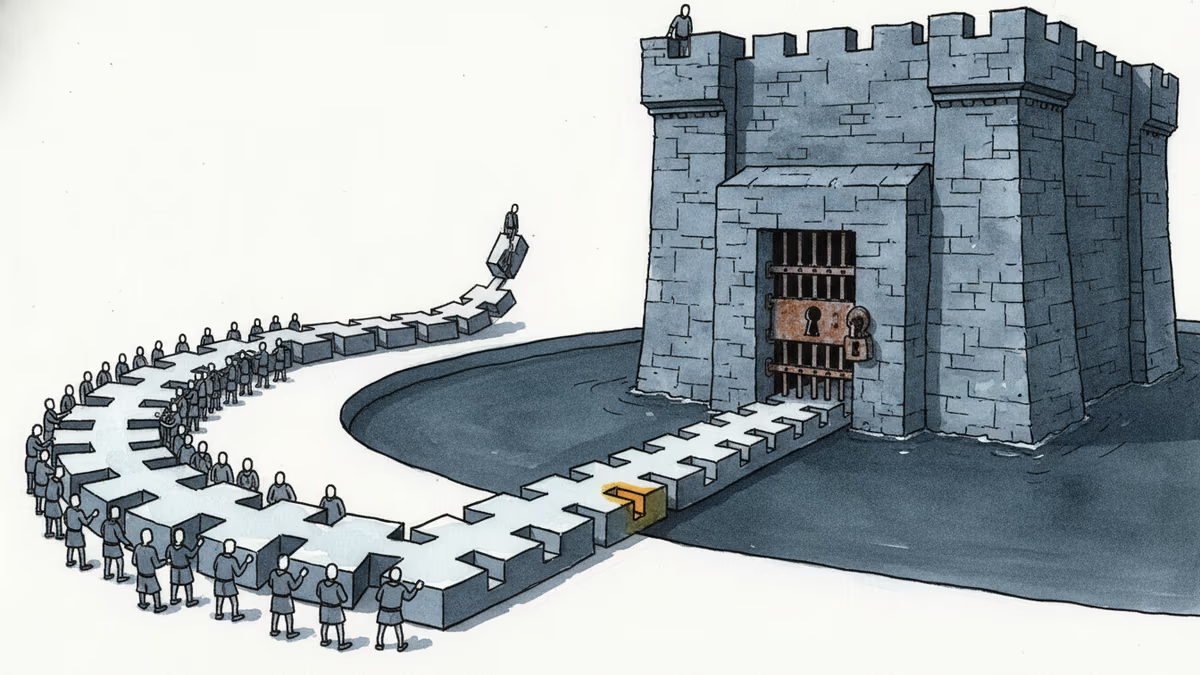
Nvidia shipped roughly a billion RISC-V cores in 2024, then announced it would run CUDA on the open standard. We break down how royalty-free instruction sets and open software stacks are trying to route around CUDA's lock-in. Part 2 of the Semiconductor Sovereignty series.

US AI-chip export controls split into three layers in the first half of 2026 — January easing, a May crackdown on circumvention, and a pending bill. Nvidia erased China from its guidance and still posted a record $81.6 billion quarter. A look at the export policy that both shields and cages it.
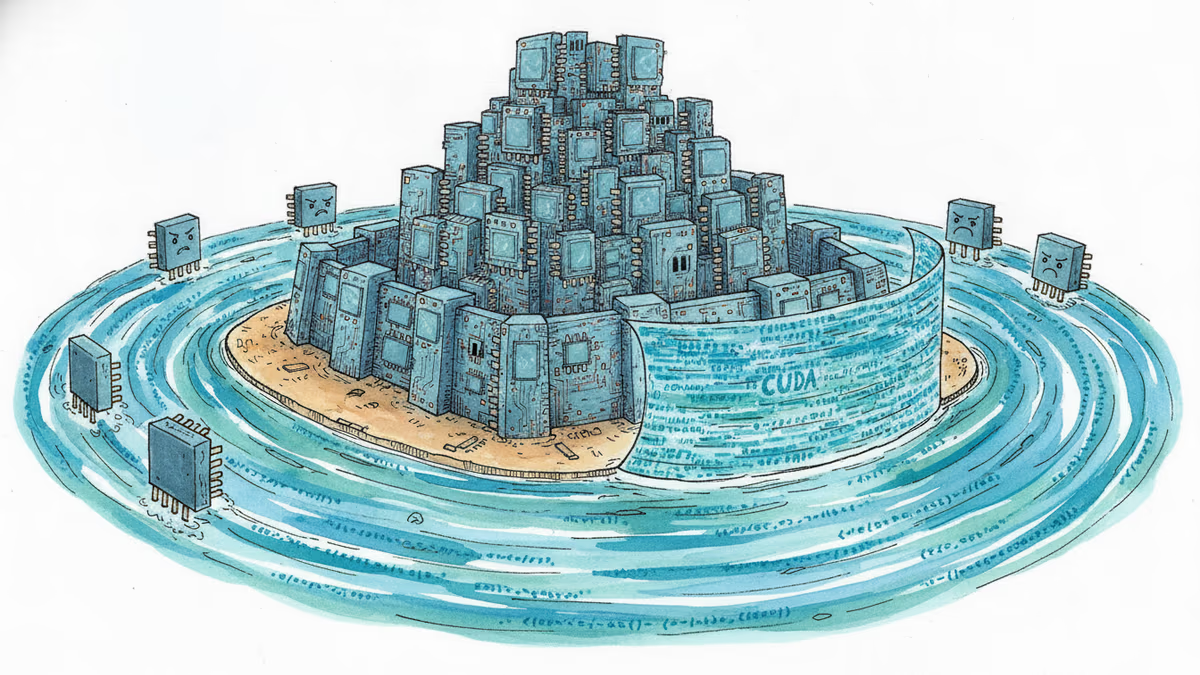
AMD's MI325X matches or beats Nvidia on memory and bandwidth — yet Nvidia's 86-92% share holds. The real moat is CUDA, 20 years in the making. Part 1 of 4.
Samsung Electronics' union branch revealed that 84% of survey respondents oppose the government's roughly $290 billion (₩400 trillion) semiconductor megaproject in Gwangju. Government, management, the union and shareholders are all reading the same national project in sharply different ways.
Nvidia shipped roughly a billion RISC-V cores in 2024, then announced it would run CUDA on the open standard. We break down how royalty-free instruction sets and open software stacks are trying to route around CUDA's lock-in. Part 2 of the Semiconductor Sovereignty series.
US AI-chip export controls split into three layers in the first half of 2026 — January easing, a May crackdown on circumvention, and a pending bill. Nvidia erased China from its guidance and still posted a record $81.6 billion quarter. A look at the export policy that both shields and cages it.
AMD's MI325X matches or beats Nvidia on memory and bandwidth — yet Nvidia's 86-92% share holds. The real moat is CUDA, 20 years in the making. Part 1 of 4.
Thoughts
Share your thoughts on this article
Sign in to join the conversation