
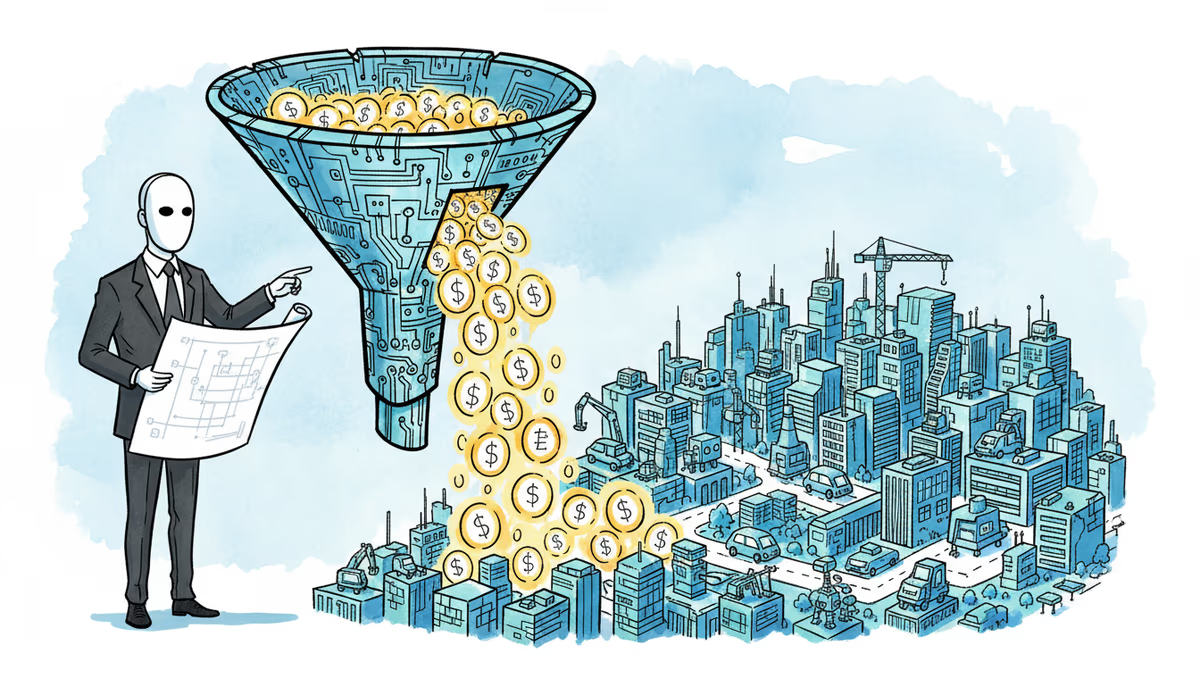
AI Is Leaving the Screen. $1.3B Is Betting on What Comes Next.
Eclipse Ventures just raised $1.3B to build an ecosystem of physical AI startups across transportation, energy, robotics, and defense. Here's why the strategy matters more than the money.
The internet took two decades to reshape daily life. Mobile took ten years. If Eclipse Ventures is right, the next wave won't wait that long — and it won't live on a screen.
The Palo Alto-based VC just closed $1.3 billion in fresh capital: a $591 million early-stage incubation fund and a separate growth-stage vehicle. The target? What partner Jiten Behl calls the defining technological era of the next decade — "physical AI," the collision of advanced intelligence with the real, tangible world.
What Eclipse Is Actually Building
The portfolio already tells the story. Arc builds electric boats. Redwood Materials recycles and reprocesses battery materials. Bedrock Robotics develops autonomous construction vehicles. Wayve works on self-driving tech. Mind Robotics is an industrial robotics lab. Transportation, energy, infrastructure, compute, defense — Eclipse is deliberately planting flags across every sector where atoms matter as much as bits.
But the more interesting part isn't the individual bets. It's the architecture behind them.
Behl describes Eclipse's strategy as building a "web" — an intentional ecosystem where portfolio companies don't just coexist but actively partner with each other and with each other's partners. The logic: scale is the hardest problem in physical AI, and you build it faster by stitching together complementary companies early rather than waiting for each to grow independently. "If you can put it together in a way where companies partner early on to build scale, to build proof points, it just then enables them to go after the next set of demand," Behl said.

Data is the connective tissue. Autonomous construction vehicles generate terrain and operational data. Battery recycling firms generate materials and logistics data. Layer those datasets together across sectors, and you can train AI models that no single-sector player could build alone. "That's the moat," Behl said plainly.
Eclipse is also going a step further: incubating companies directly from within the new fund. Behl confirmed the process has already started, though he stayed vague on specifics. The firm is particularly interested in startups that operate across enterprise sectors — the connective tissue between verticals, not just the verticals themselves.
Why Now — And Why This Might Be Harder Than It Looks
The timing is deliberate. Behl points to a confluence of four forces: talent (researchers leaving big labs to found companies), technological readiness (sensors, compute, and foundation models finally cheap and capable enough), demand (enterprises actively looking to automate physical operations), and policy (defense and infrastructure spending creating real procurement pipelines).
That's a credible thesis. But physical AI has a graveyard that software AI doesn't. Waymo has been "almost there" for nearly a decade. Autonomous trucking startups have burned through billions with limited commercial scale. Industrial robotics has been perpetually "five years away" from mainstream deployment. The gap between a convincing demo and a profitable, deployable product in the physical world is notoriously wide — and expensive to cross.
Eclipse's ecosystem strategy is a direct response to this problem. By building companies that can share customers, data, and proof points, the fund is trying to compress the time it takes to reach commercial credibility. Whether that works depends on how well portfolio companies actually collaborate — which is notoriously difficult when they're also competing for the same enterprise contracts.
For investors watching from the outside, the $1.3 billion figure is less interesting than the structural bet underneath it. Eclipse is essentially arguing that the next defensible position in AI isn't a better model — it's a better data network. And that network has to be built in the physical world, not the cloud.
Authors
Related Articles
Factory just raised $150M at a $1.5B valuation to build AI coding agents for enterprises. In a market already crowded with Cursor, Claude Code, and Cognition, investors say there's still room. Here's why that bet might make sense — and why it might not.
NASA's Swift Observatory is falling out of orbit. A $30M commercial robot mission may save it—and rewrite the rules for space infrastructure maintenance.
At Nvidia's GTC 2026, a rambling Olaf robot had its mic cut mid-demo. The real story isn't the glitch — it's the questions the industry keeps avoiding.
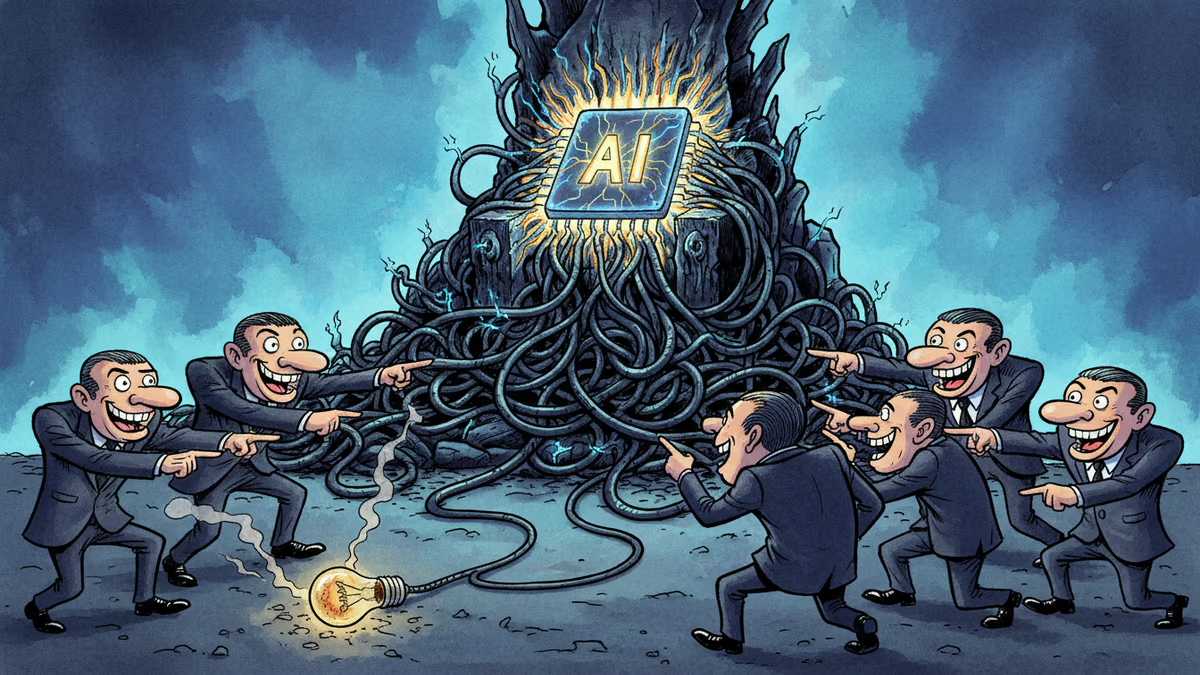
Over $500 billion has poured into AI startups. But with 36% of data center projects slipping timelines due to power shortages, the real opportunity may lie in energy infrastructure — batteries, transformers, and grid software.
Factory just raised $150M at a $1.5B valuation to build AI coding agents for enterprises. In a market already crowded with Cursor, Claude Code, and Cognition, investors say there's still room. Here's why that bet might make sense — and why it might not.
NASA's Swift Observatory is falling out of orbit. A $30M commercial robot mission may save it—and rewrite the rules for space infrastructure maintenance.
At Nvidia's GTC 2026, a rambling Olaf robot had its mic cut mid-demo. The real story isn't the glitch — it's the questions the industry keeps avoiding.
Over $500 billion has poured into AI startups. But with 36% of data center projects slipping timelines due to power shortages, the real opportunity may lie in energy infrastructure — batteries, transformers, and grid software.
Thoughts
Share your thoughts on this article
Sign in to join the conversation