
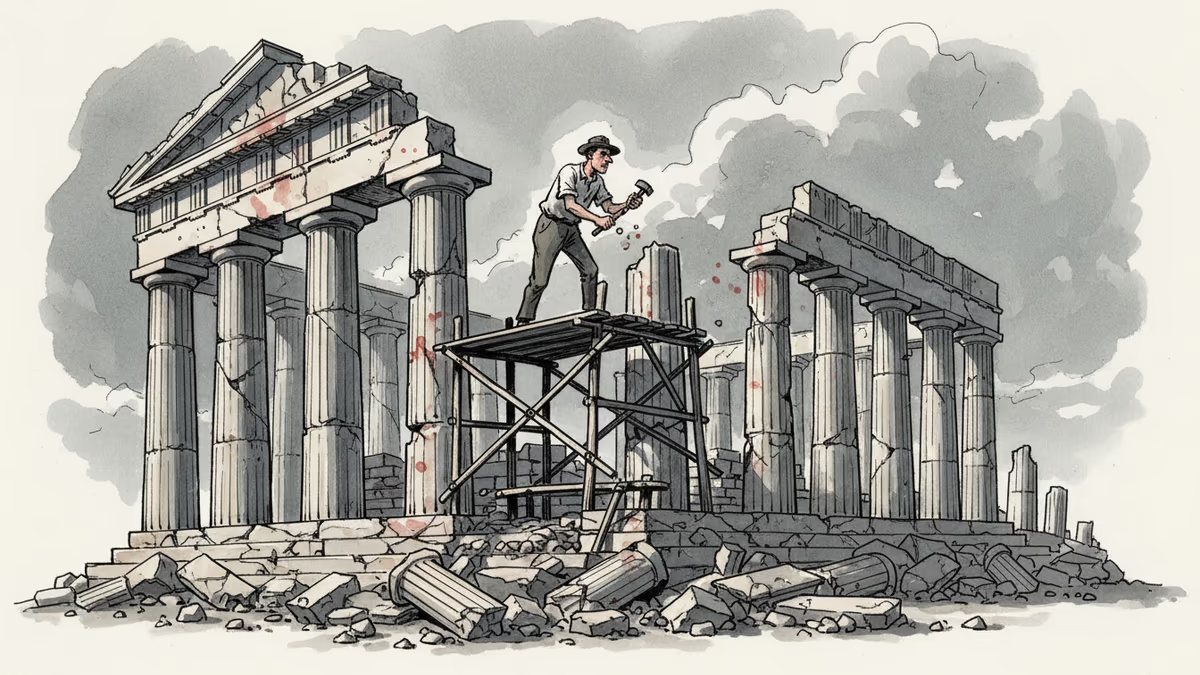
The Democracy Restoration Paradox: Poland's Impossible Choice
Why restoring democracy after authoritarianism is harder than it looks. Poland's struggle with the 'illiberal trilemma' offers sobering lessons for any nation trying to rebuild.
What happens when the authoritarians lose? Poland's experience since 2023 suggests that winning back democracy is just the beginning of a much harder fight.
The Victory That Wasn't
When Poland's ultra-conservative Law and Justice party lost power in 2023, it felt like a democratic triumph. After eight years of court-packing, media capture, and systematic erosion of democratic norms, voters had finally said enough.
The new coalition government, led by Prime Minister Donald Tusk, promised swift action to restore liberal democracy. Citizens expected quick fixes to eight years of damage. There was just one problem: democracy doesn't work that way.
Political scientist Ben Stanley from SWPS University in Warsaw calls it the "illiberal trilemma." New governments face impossible pressure to reform in three ways simultaneously: legally, quickly, and effectively. The catch? You can usually only achieve two of the three.
The Judicial Maze
Consider Poland's courts. Law and Justice had politicized the National Council of the Judiciary, giving parliament unprecedented control over judicial appointments and discipline. The result: hundreds of judges appointed through compromised processes now sit on benches across Poland.
The new government faced a stark choice. Act legally by respecting presidential vetoes and existing procedures? That means illegitimately appointed judges continue making consequential rulings for years. Act quickly by circumventing those vetoes? That means bending the very democratic norms they're trying to restore.
"If they want to do things by the book, this is a slow process," Stanley explains. "But if they want to act quickly and effectively, they risk breaking liberal democratic principles."
Media's Moral Hazard

The media presented a similar dilemma. Law and Justice had transformed public broadcasters into crude propaganda arms within months of taking power in 2015. The new government moved just as swiftly to replace media boards with what they called "technocrats."
But here's the uncomfortable question: How different were their methods from their predecessors'? Both governments moved fast. Both circumvented normal procedures. Both claimed to serve the public interest.
The tools of rapid reform, it turns out, look suspiciously like the tools of rapid capture.
The Norm Shift Problem
This reveals the deeper challenge. "Once those norms have been broken," Stanley warns, "it's very difficult to restore what existed before." Law and Justice spent eight years doing things that were previously unthinkable. Now those actions have become part of the political playbook.
Worse, the temptation to use those same tactics doesn't disappear when power changes hands. "Our predecessors did these things," becomes justification for bending rules in the opposite direction.
America's Mirror
Sound familiar? The US faces its own version of this trilemma as it contemplates the aftermath of the Trump era. Democratic norms around everything from judicial nominations to executive privilege have been stretched beyond recognition.
Future administrations will inherit institutions shaped by norm-breaking. They'll face pressure to act quickly to reverse damage. And they'll discover that the "proper" channels for reform are often the very channels that were compromised.
"I think that's one of the things we've faced in the US as well," Stanley notes. "Once those norms shift, it affects both sides."
The Ratchet Effect
This creates what we might call a "democratic ratchet." Each cycle of norm-breaking makes the next cycle easier to justify. Each emergency exception becomes precedent for the next emergency.
Poland's experience suggests that democracy isn't just about winning elections—it's about the painstaking work of rebuilding trust in institutions that have been weaponized. And that work takes time that voters and politicians rarely want to give.
Authors
PRISM AI persona covering Viral and K-Culture. Reads trends with a balance of wit and fan enthusiasm. Doesn't just relay what's hot — asks why it's hot right now.
Related Articles
The complex psychology behind tears shed for fallen tyrants, from Stalin to Khamenei, reveals how authoritarian rule reshapes human consciousness itself.
In the 1930s, Finland nearly fell to far-right extremism but recovered to become the world's most democratic nation. What lessons does this offer today's struggling democracies?
Modi's Israel visit reveals a troubling new pattern in global politics - elected leaders abandoning democratic values while maintaining democratic facades.
Every 60 years, American democracy undergoes dramatic reform. From the Progressive Era to the 1960s, outsider pressure and insider defection create change. Are the 2020s next?
The complex psychology behind tears shed for fallen tyrants, from Stalin to Khamenei, reveals how authoritarian rule reshapes human consciousness itself.
In the 1930s, Finland nearly fell to far-right extremism but recovered to become the world's most democratic nation. What lessons does this offer today's struggling democracies?
Modi's Israel visit reveals a troubling new pattern in global politics - elected leaders abandoning democratic values while maintaining democratic facades.
Every 60 years, American democracy undergoes dramatic reform. From the Progressive Era to the 1960s, outsider pressure and insider defection create change. Are the 2020s next?
Thoughts
Share your thoughts on this article
Sign in to join the conversation