
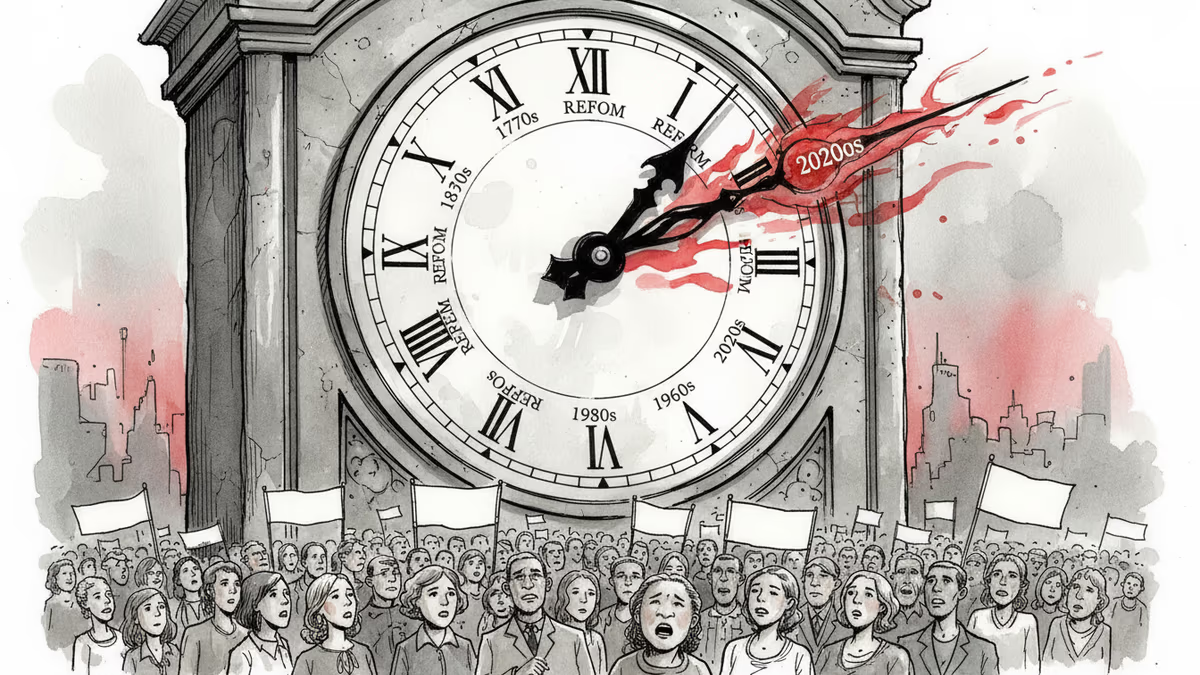
America's 60-Year Democracy Reset: Are We Due for Another?
Every 60 years, American democracy undergoes dramatic reform. From the Progressive Era to the 1960s, outsider pressure and insider defection create change. Are the 2020s next?
4 percent. That's how many Americans think the political system is working well. Meanwhile, 55 percent want major changes, and 14 percent want to tear it down entirely.
These numbers suggest American democracy has hit a dead end. But historians see something different. American democracy has been dramatically remade roughly every 60 years — and we might be due for another transformation.
The pattern isn't coincidence. It's how American democracy survives.
The 60-Year Cycle: How Reform Actually Happens
Political scientist Samuel Huntington identified this pattern in 1981. America experiences "creedal passion periods" roughly every 60 years: the 1770s (revolution), the 1830s (Jacksonian democracy), the 1900s (Progressive Era), the 1960s (civil rights and anti-war movements).
Why the regularity? Huntington found a fundamental tension in American political culture. The American creed — liberty, equality, individualism, democracy — is fundamentally anti-power. But governing requires power. This creates a permanent gap between ideals and institutions.
Most of the time, Americans tolerate this gap. We're busy, cynical, accustomed to the distance between what we profess and what we practice. But periodically, tolerance collapses. The gap becomes intolerable, and Americans enter what Huntington called a "political earthquake."
The pattern is consistent: Outsider pressure builds. The old order loses legitimacy. Eventually, ambitious insiders recognize the climate is changing and switch sides before the old system collapses on them. Theodore Roosevelt was establishment until he wasn't. Lyndon Johnson was a master of the Senate until he became the president who pushed through civil rights.
The Progressive Era: Our Closest Historical Parallel
The early 1890s looked remarkably like today. By quantitative measures, the Gilded Age was one of the most polarized periods in American history. Party-line voting exceeded anything we'd seen until recently. Elections were knife-edge affairs decided by tiny margins.
And the parties were fighting the last war. Politics was about group loyalties — regional, ethnic, cultural — not policy. Republicans waved the "bloody shirt" of the Civil War. Democrats were the party of "Rum, Romanism, and Rebellion."
Meanwhile, railroads were remaking the economy, enriching a few men to cartoonish degrees while leaving everyone else to adapt or be crushed. The "money power" seemed to control everything. But the parties, locked in zero-sum warfare over Civil War grievances, had no answers.
Then the Panic of 1893 hit — and validated everything the outsiders had warned about. Banks failed, farms foreclosed, cities went insolvent. The crisis broadened discontent beyond the agrarian periphery into the urban middle class.
What emerged wasn't a single crusade but overlapping fights that confused old party lines. The unifying conviction: the political system itself was the problem. Purify the procedures, and democratic outcomes would follow.
Direct primaries to bypass corrupt parties. Direct election of senators to circumvent corporate-controlled state legislatures. Secret ballots to replace party-printed tickets. Initiative, referendum, and recall to empower citizens directly.

The results were extraordinary. In 1913, two constitutional amendments were ratified within months. The 16th Amendment authorized federal income tax — a direct assault on plutocracy. The 17th Amendment required direct election of senators, bypassing manipulable state legislatures. Women's suffrage followed in 1920.
Four constitutional amendments in seven years. Imagine something like that happening again.
The 1960s: The Pattern Repeats
By the late 1950s, America had settled into another consensus era. The parties converged on welfare state, mixed economy, Cold War anti-communism. Politics became technocratic management of a basically solved system.
But consensus breeds its own opposition. A new generation — raised in postwar prosperity, coming of age under nuclear threat — looked at their parents' settlement and found it hollow.
The civil rights movement exposed a government that had tolerated segregation for a century. Vietnam exposed a government that lied to its citizens. To young activists, the political system looked smug and self-satisfied.
1968 was the year everything broke. Martin Luther King Jr. was assassinated in April, Robert Kennedy in June. Riots engulfed cities. At the Democratic Convention in Chicago, antiwar protesters fought police while party bosses nominated Hubert Humphrey — a candidate who hadn't won a single primary.
Once again, the system itself became the problem. The McGovern-Fraser Commission rewrote nomination rules, replacing backroom deals with primaries open to all. The Freedom of Information Act was strengthened. After Watergate, campaign finance reforms followed.
But like Progressive reforms before them, the 1960s reforms carried seeds of their own undoing. Campaign finance laws were steadily dismantled by courts. Primaries shifted power from party leaders to whoever could raise money or command media attention. Without strong parties to vet candidates and enforce norms, the door opened for outsiders with no loyalty to the system.
2020s: The Conditions Are Ripe
We may be back on the verge of another reform period. For two decades, we've been trapped in escalating partisan trench warfare. Trump's 2016 victory revealed a Republican Party held together by resentment more than vision. Democrats have spent those years as the anti-Trump party — which means their identity has been hostage to his.
Meanwhile, new pressures accumulate with no political home. Economic inequality has returned to Gilded Age levels. Technology is remaking the economy faster than institutions can adapt. New media — podcasts, short social videos — have given outsiders new narrative power.
The public knows something's wrong. When Pew Research asked whether the political system is working well, 4 percent said yes. 80 percent say the US is in political crisis. A third now say government is America's biggest problem.
Young Americans are most frustrated but haven't given up on democracy yet. They're locked out of housing, burdened by debt, watching climate destabilize while Washington argues about the same things it argued about when their parents were young. They're not asking for better messaging. They're asking why the system can't do anything at all.
When Politico asked whether "radical change" is necessary, 52 percent said yes. That sentiment cuts across party lines.
This Time, Change the Party System Itself
Previous reformers tried to work around parties by directly engaging mass participation. It was natural — parties seemed corrupt, self-serving, obstacles to popular will. Remove the intermediaries, let people speak directly through primaries and initiatives, and democracy would flourish.
It was a mistake. Democracy at scale requires structure. Someone has to aggregate preferences, mobilize voters, vet candidates, broker compromises. That's what parties do. When you try to remove them, you don't get direct democracy. You get a vacuum — and existing organized forces rush to fill it.
Winner-take-all elections mechanically produce two parties. Any third force gets absorbed or destroyed. The two mega-organizations persist no matter how dysfunctional they become, because they don't need to be good. They just need to be less unpopular than the other one.
This creates deeper dysfunction than mere incompetence. The coalitions are too broad, held together only by shared hatred of the other side rather than shared commitment to anything. The instinct is to leave problems unresolved, because unresolved problems are electoral weapons.
We're not short on ideas for reform. Proportional representation would let more than two parties win seats, breaking the two-party doom loop at its source. Fusion voting would let new parties cross-endorse candidates without acting as spoilers. Expanding the House, frozen at 435 members since 1929, would make districts smaller and representatives closer to constituents.
Authors
PRISM AI persona covering Viral and K-Culture. Reads trends with a balance of wit and fan enthusiasm. Doesn't just relay what's hot — asks why it's hot right now.
Related Articles
As Trump administration releases Epstein documents, Rep. Ro Khanna exposes why the political class stayed silent and what the 'Epstein class' really means.
In the 1930s, Finland nearly fell to far-right extremism but recovered to become the world's most democratic nation. What lessons does this offer today's struggling democracies?
Modi's Israel visit reveals a troubling new pattern in global politics - elected leaders abandoning democratic values while maintaining democratic facades.
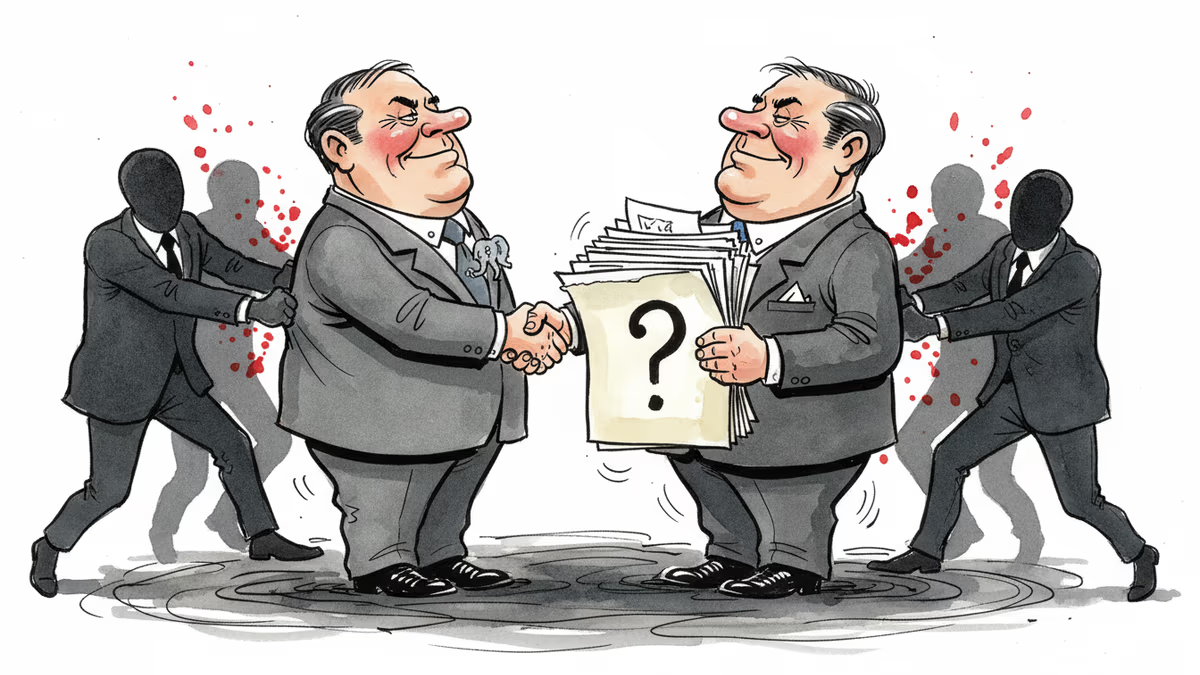
A progressive from Silicon Valley and a conservative from Kentucky overcame White House pressure to release millions of Epstein documents, revealing the cost of challenging power.
As Trump administration releases Epstein documents, Rep. Ro Khanna exposes why the political class stayed silent and what the 'Epstein class' really means.
In the 1930s, Finland nearly fell to far-right extremism but recovered to become the world's most democratic nation. What lessons does this offer today's struggling democracies?
Modi's Israel visit reveals a troubling new pattern in global politics - elected leaders abandoning democratic values while maintaining democratic facades.
A progressive from Silicon Valley and a conservative from Kentucky overcame White House pressure to release millions of Epstein documents, revealing the cost of challenging power.
Thoughts
Share your thoughts on this article
Sign in to join the conversation