
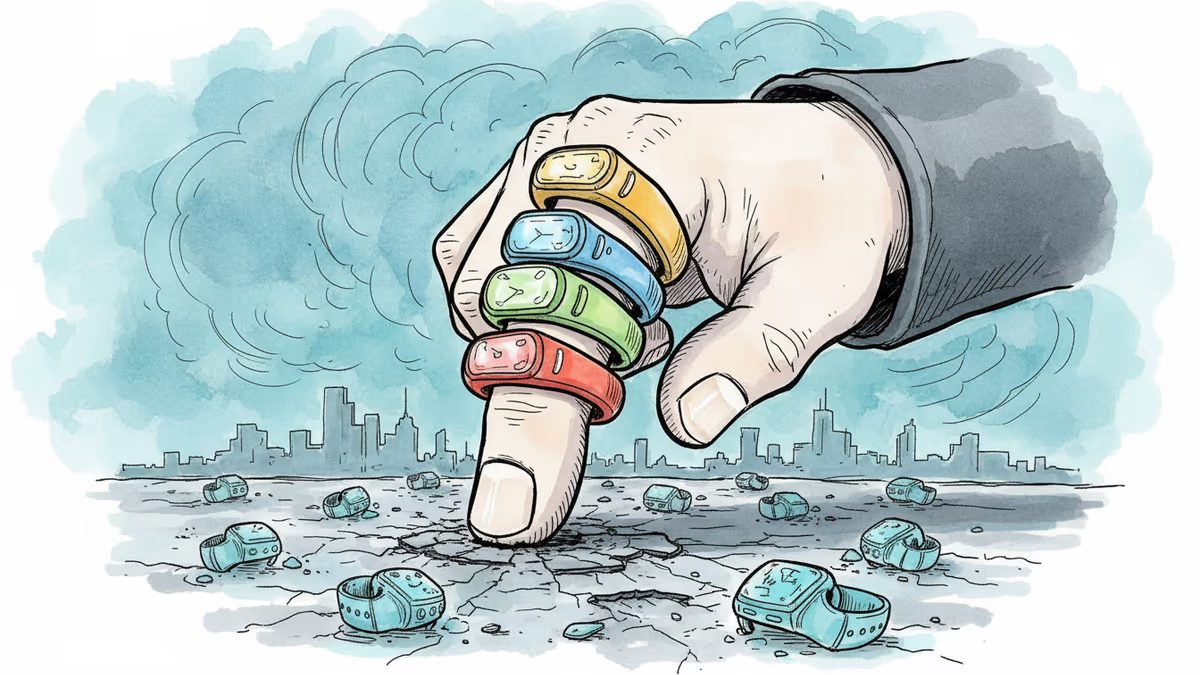
The Death of Smartwatches? Why Silicon Valley is Betting on Smart Rings
Smart rings are emerging as the next frontier in wearable technology, with Oura, Samsung, and newcomers battling for a rapidly growing market that could reshape health monitoring.
$1 billion. That's how much the smart ring market is expected to be worth by 2028. Five years ago, it barely existed.
While tech giants poured billions into making smartwatches bigger, brighter, and more complex, a Finnish startup called Oura took the opposite approach. They made health tracking invisible—a sleek titanium ring that monitors your body 24/7 without a single screen, button, or notification.
Now everyone wants in on the action.
The Screen-Free Revolution
Smart rings represent a fundamental shift in how we think about wearable technology. No buzzing notifications during meetings. No charging every night. No awkward screen interactions while exercising. Just slip it on your finger and forget about it.
The Oura Ring 4, our top pick at $349, packs heart rate monitoring, body temperature tracking, blood oxygen sensing, and sleep analysis into a device smaller than a wedding band. It automatically detects when you're getting sick—often 24-48 hours before symptoms appear—by tracking subtle changes in your body temperature and heart rate variability.
"It's like having a personal health assistant that never bothers you but always knows what's going on," says Dr. Sarah Chen, a sleep medicine specialist who's been testing smart rings with patients. "The data quality rivals hospital-grade monitors, but patients actually wear it because they forget it's there."
Market research firm IDC reports that smart ring shipments grew 300% year-over-year in 2025, while smartwatch growth has plateaued at single digits.
The Subscription Wars Begin
But success breeds competition—and controversy. Samsung launched the Galaxy Ring at $400 with no monthly fees, directly challenging Oura's $6/month subscription model. The Korean giant is betting on ecosystem lock-in: the Galaxy Ring works seamlessly with Samsung phones and Galaxy Watches, extending battery life and sharing health data across devices.

"We're not just selling a ring," Samsung's wearables VP told investors. "We're building the anti-Apple ecosystem for health."
Meanwhile, Indian startup Ultrahuman tried to undercut everyone at $349 with no subscription—until Oura's patent lawyers intervened. A U.S. trade commission banned Ultrahuman imports in October 2025, leaving American customers stranded and highlighting the brutal IP battles brewing in this nascent market.
Chinese manufacturer RingConn is now positioning itself as the budget alternative at $199, though early reviews suggest you get what you pay for in terms of accuracy and battery life.
Privacy Paranoia Meets Wellness Obsession
The smart ring boom reflects a deeper cultural tension. Americans are simultaneously more health-conscious and more privacy-paranoid than ever. Smart rings promise the ultimate quantified self—continuous biometric monitoring—while remaining invisible to others.
But that invisibility cuts both ways. Unlike a smartwatch that clearly signals "I'm tracking my health," smart rings enable covert monitoring. Employers, insurers, and governments are taking notice.
"We're creating a world where your body becomes a data stream," warns privacy researcher Dr. Michael Torres. "The question isn't whether this data will be misused—it's how soon."
The FDA hasn't yet established clear regulations for consumer health rings, leaving a regulatory gray area that companies are rushing to exploit before rules tighten.
The Medical Establishment's Mixed Signals
Doctors are divided. Emergency physicians praise smart rings for catching heart rhythm abnormalities and early illness signs. But sleep specialists question the accuracy of ring-based sleep tracking, noting that wrist-worn devices with accelerometers provide more reliable movement data.
Quest Diagnostics recently partnered with Oura to offer blood testing integrated with ring data—a move that could legitimize consumer health devices or blur the line between wellness gadgets and medical equipment.
"We're seeing patients make major health decisions based on ring data," says Dr. Jennifer Walsh, a cardiologist at Johns Hopkins. "Sometimes that's helpful. Sometimes it creates unnecessary anxiety. We need better guidelines on when to trust these devices."
The real question isn't whether smart rings will succeed—it's whether we're ready for a world where our health is always being watched, even when we forget we're being monitored.
Authors
Related Articles

Open earbuds are reshaping how we listen to audio, offering comfort and awareness that traditional earbuds can't match. Here's why they're going mainstream.

The evolution of touchscreen gloves reveals how technology adapts to human needs, but raises questions about our digital dependency in extreme weather.

While Oura Ring 4 dominates with subscription model, Samsung Galaxy Ring and others offer subscription-free alternatives. The wearable market's business model evolution.

Open earbuds are the latest audio trend, promising music without blocking your ears. But are they solving a real problem or creating new ones?
Open earbuds are reshaping how we listen to audio, offering comfort and awareness that traditional earbuds can't match. Here's why they're going mainstream.
The evolution of touchscreen gloves reveals how technology adapts to human needs, but raises questions about our digital dependency in extreme weather.
While Oura Ring 4 dominates with subscription model, Samsung Galaxy Ring and others offer subscription-free alternatives. The wearable market's business model evolution.
Open earbuds are the latest audio trend, promising music without blocking your ears. But are they solving a real problem or creating new ones?
Thoughts
Share your thoughts on this article
Sign in to join the conversation