
Smart Rings Face the Subscription Dilemma in 2025
While Oura Ring 4 dominates with subscription model, Samsung Galaxy Ring and others offer subscription-free alternatives. The wearable market's business model evolution.
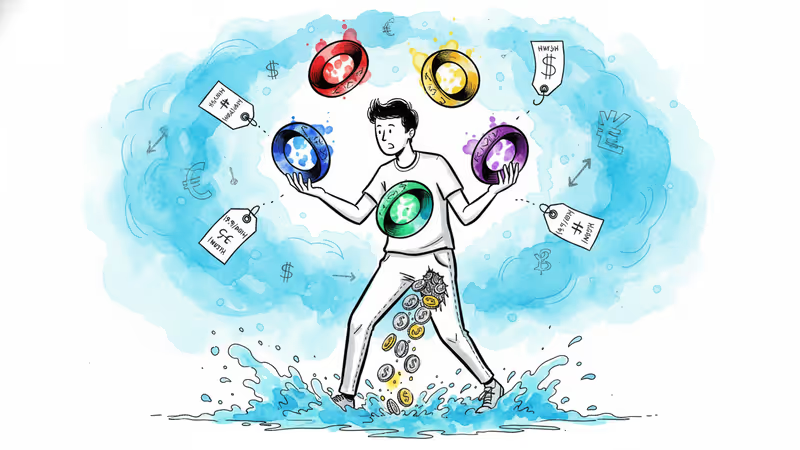
Pay $349 for a ring, then $5.99 every month forever. That's the Oura Ring proposition, and somehow, it's still winning the smart ring race. But as Samsung and others push subscription-free alternatives, the question isn't just which ring tracks your sleep best—it's whether you're willing to rent your health data.
Oura's Subscription Stranglehold
The Oura Ring 4 remains the gold standard, and it's not particularly close. After 10 years in the game, Oura has refined everything from sensor accuracy to app design. The fourth-generation model brings improved heart rate and blood oxygen algorithms, expanded automatic workout detection, and sizes from 4 to 15.
But Oura's real play isn't just hardware—it's becoming a health platform. The company recently launched AI-powered meal logging, glucose tracking (requires a $99Dexcom continuous glucose monitor), and even $99 blood panel testing through Quest Diagnostics. You get 50 biomarkers analyzed and displayed in the app.
This isn't just feature creep. Oura is positioning itself as your health data command center, making the monthly subscription feel less like a tax and more like a service. The question is whether competitors can match this ecosystem approach without the recurring revenue.
Samsung's Ecosystem Play
The $400Samsung Galaxy Ring nails the hardware fundamentals. Better charging case, more comfortable concave design, and no subscription fees. But here's the catch: it's designed for Samsung users, by Samsung users.
Want the full experience? You'll need a Galaxy Watch for extended battery life and a Galaxy Z Flip or Z Fold for gesture controls. Without discounts, we're talking $1,800 to $3,000 for the complete ecosystem. Samsung essentially replaced Oura's subscription model with an ecosystem lock-in strategy.

The trade-offs show. Sleep tracking accuracy lags behind Oura, and Samsung's AI health features feel more like beta experiments than polished tools. It's a first-generation product with first-generation growing pains.
The Subscription Rebels
Several companies are testing different monetization approaches. Ultrahuman Ring Air ($350) uses "PowerPlugs"—think app store for ring features. Smart alarms and cycle tracking are free, but advanced features like atrial fibrillation detection cost $24 annually.
RingConn Gen 2 Air ($200) goes full budget with impressive 8-9 day battery life and heavy AI integration. The AI features are hit-or-miss, but the hardware punches above its price point.
2026: Voice-First Future?
Next year brings interesting pivots. Stream Ring ($249-$349), from former Meta employees, focuses on voice notes and AI chat integration. Meanwhile, Pebble returns with the $75Index 01—a disposable ring with 2-year non-replaceable battery designed for voice memos and reminders, not health tracking.
These products suggest the smart ring category might fragment: health-focused rings versus productivity-focused ones.
The Real Competition
Smart rings aren't just competing against each other—they're fighting smartwatches, fitness trackers, and the "good enough" health apps on your phone. Oura's subscription model works because it offers something you can't get elsewhere: comprehensive health insights in a discreet form factor.
But as Apple Watch and Google Pixel Watch improve sleep tracking, and smartphone health features get more sophisticated, smart rings need to justify their existence beyond just being "more comfortable than a watch."
Authors
Related Articles

The Apple Watch Series 4 didn't just upgrade wearables — it shifted them from fitness tools to health monitors. Here's what that shift really means for consumers, medicine, and your data.
From 24/7 cuffless monitoring to Apple Watch notifications, home blood pressure management is undergoing a revolution. Here's what's changing and why it matters for your health.
The Aktiia Hilo band promises 24/7 blood pressure monitoring without the squeeze. As it heads to US market, we explore what continuous BP tracking really means for healthcare.
After losing 45% of revenue to Oura's patent dispute, Ultrahuman launches Ring Pro with 15-day battery life. Can the Indian startup reclaim its US market share in the booming smart ring category?
The Apple Watch Series 4 didn't just upgrade wearables — it shifted them from fitness tools to health monitors. Here's what that shift really means for consumers, medicine, and your data.
From 24/7 cuffless monitoring to Apple Watch notifications, home blood pressure management is undergoing a revolution. Here's what's changing and why it matters for your health.
The Aktiia Hilo band promises 24/7 blood pressure monitoring without the squeeze. As it heads to US market, we explore what continuous BP tracking really means for healthcare.
After losing 45% of revenue to Oura's patent dispute, Ultrahuman launches Ring Pro with 15-day battery life. Can the Indian startup reclaim its US market share in the booming smart ring category?
Thoughts
Share your thoughts on this article
Sign in to join the conversation