
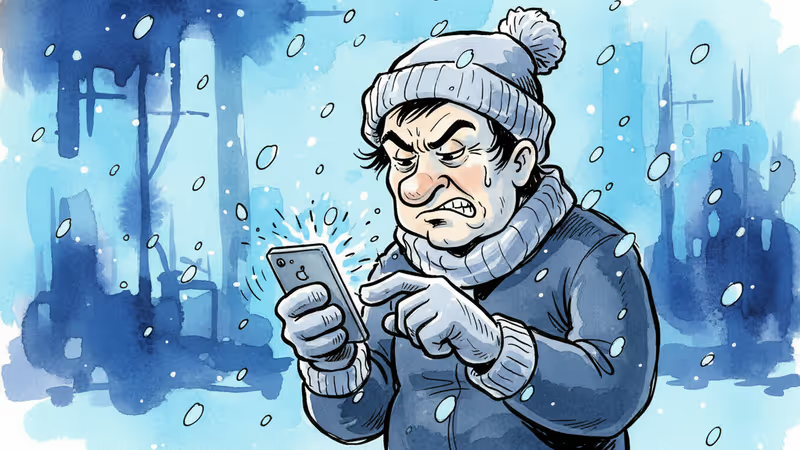
Why Your Winter Gloves Might Be Smarter Than You Think
The evolution of touchscreen gloves reveals how technology adapts to human needs, but raises questions about our digital dependency in extreme weather.
At 30 degrees Fahrenheit, you have a choice: keep your hands warm or use your smartphone. For most people, this isn't really a choice at all. We'll endure numb fingers rather than miss a text, lose navigation, or skip that Instagram story.
This daily winter struggle has spawned an entire category of products that didn't exist 15 years ago: touchscreen gloves. But as a recent comprehensive test reveals, the technology has evolved far beyond the clunky, barely-functional fingertip solutions of the early smartphone era.
From Fingertip Patches to Full-Hand Computing
The breakthrough came when manufacturers stopped thinking about touchscreen compatibility as an add-on feature. Glider Gloves weaves conductive copper directly into the yarn, making every part of your hand a potential touch interface. At just $9, they offer pinch-to-zoom, multi-finger typing, and swipe gestures that actually work.
This represents a fundamental shift in design philosophy. Early touchscreen gloves treated smartphone compatibility as a compromise—add some conductive material to fingertips and hope for the best. Modern solutions treat the entire glove as an interface device.
The trade-offs remain real, though. Thinner gloves like the Gliders offer superior touch accuracy but limited warmth. Thicker options provide better insulation but clumsy interaction. Some manufacturers are getting creative: The Heat Company's fold-over mittens use magnets to expose just your thumbs when needed, while Venustas heated gloves pack rechargeable batteries for up to 10 hours of warmth.
The Software Side of Cold Weather
Here's what many people don't realize: your phone's settings matter as much as your gloves. Both Android and iPhone offer sensitivity adjustments that can dramatically improve glove performance. Android's "Increased sensitivity" mode and iPhone's "Fast" haptic touch setting can make mediocre gloves feel responsive.
This highlights how modern problems require both hardware and software solutions. The best touchscreen experience in winter comes from optimizing both your gear and your device settings.

Beyond Personal Convenience
The touchscreen glove market reveals something deeper about our relationship with technology. For delivery drivers, construction workers, and others who work outdoors, these aren't luxury accessories—they're professional tools. The ability to operate GPS, confirm deliveries, or communicate with dispatch can be the difference between productivity and frustration.
But the market also reflects our broader digital dependency. We've created a world where basic functions—payment, transportation, communication—require constant smartphone access. Weather becomes a barrier to participation in digital society.
The Premium Problem
Interesting price dynamics are emerging. Basic functional touchscreen gloves cost under $15. Premium options like Kent Wang's deerskin gloves run $95, while heated models hit $100+. This suggests the market is bifurcating: practical solutions for everyone, and luxury versions for those willing to pay for style and advanced features.
The middle market seems thin, which might indicate that touchscreen capability is becoming commoditized. Once a premium feature, it's now table stakes for any winter glove.
Cultural Adaptations
Different regions are driving different innovations. Canadian and Scandinavian companies focus on extreme cold performance. Asian manufacturers emphasize precision for gaming and detailed smartphone tasks. American brands balance outdoor durability with urban style.
These regional differences suggest that touchscreen gloves aren't just solving a universal problem—they're adapting to local climate conditions, cultural smartphone usage patterns, and aesthetic preferences.
The next time you're deciding between warm hands and smartphone access, remember: that choice itself is becoming extinct.
Authors
Related Articles
Nothing launches Phone (4a) Pro in the US for $499, but without carrier partnerships, the UK company still faces an uphill battle against established players.

MWC 2026 showcases Honor's Robot Phone and other shape-shifting devices that challenge everything we know about mobile design. Are we ready for phones that transform themselves?
MWC 2026 promises breakthrough innovations from Xiaomi's European push to Honor's robot pivot. Here's what matters beyond the headlines.

Smartphone shipments to plummet 12.9% as AI giants hoard RAM. Prices hit record $523 while memory-hungry data centers squeeze out mobile manufacturers.
Nothing launches Phone (4a) Pro in the US for $499, but without carrier partnerships, the UK company still faces an uphill battle against established players.
MWC 2026 showcases Honor's Robot Phone and other shape-shifting devices that challenge everything we know about mobile design. Are we ready for phones that transform themselves?
MWC 2026 promises breakthrough innovations from Xiaomi's European push to Honor's robot pivot. Here's what matters beyond the headlines.
Smartphone shipments to plummet 12.9% as AI giants hoard RAM. Prices hit record $523 while memory-hungry data centers squeeze out mobile manufacturers.
Thoughts
Share your thoughts on this article
Sign in to join the conversation