

Databricks Instructed Retriever Delivers 70% RAG Performance Leap
Databricks unveils Instructed Retriever, boosting RAG performance by 70%. Learn how this new architecture solves metadata reasoning for enterprise AI agents.
Retrieval wasn't broken, but it wasn't ready for AI agents—until now. While traditional RAG systems focused on human-like keyword matching, the era of autonomous agents demands a deeper understanding of complex instructions and structured metadata.
In research published this week, Databricks introduced Instructed Retriever, a new architecture claiming up to a 70% improvement over traditional RAG on complex enterprise tasks. The system bridges the gap between raw text retrieval and logical metadata reasoning.
How Instructed Retriever Solves Enterprise RAG Challenges
Traditional RAG often treats queries as isolated text-matching exercises. This approach fails when a user asks: "Show me 5-star reviews from the past 6 months excluding Brand X." Standard systems struggle to translate these natural language constraints into database filters.

Michael Bendersky, research director at Databricks, told VentureBeat that agent errors often stem from poor data retrieval rather than a lack of reasoning. Instructed Retriever fixes this by redesigning the pipeline to propagate system specifications through every stage, using query decomposition and contextual re-ranking.
Availability and Enterprise Deployment
The technology is currently available within Databricks Agent Bricks as part of the Knowledge Assistant product. While not yet open-source, the company is releasing the StaRK-Instruct benchmark to help the broader research community evaluate instruction-heavy retrieval tasks.
Authors
Related Articles
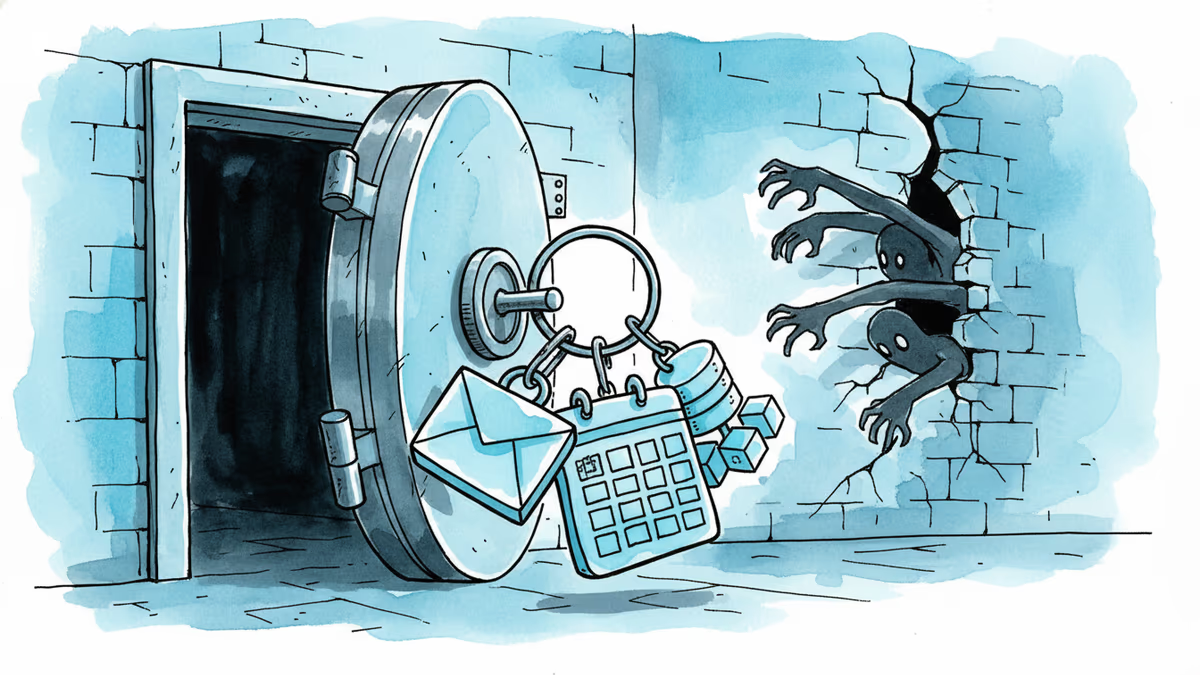
A critical vulnerability in Starlette—downloaded 325 million times per week—puts millions of AI agent servers at risk, exposing stored credentials for email, databases, and third-party services.

A small but growing group of developers has gone all-in on AI coding agents like Claude Code and OpenClaw. History suggests the rest of us won't be far behind.
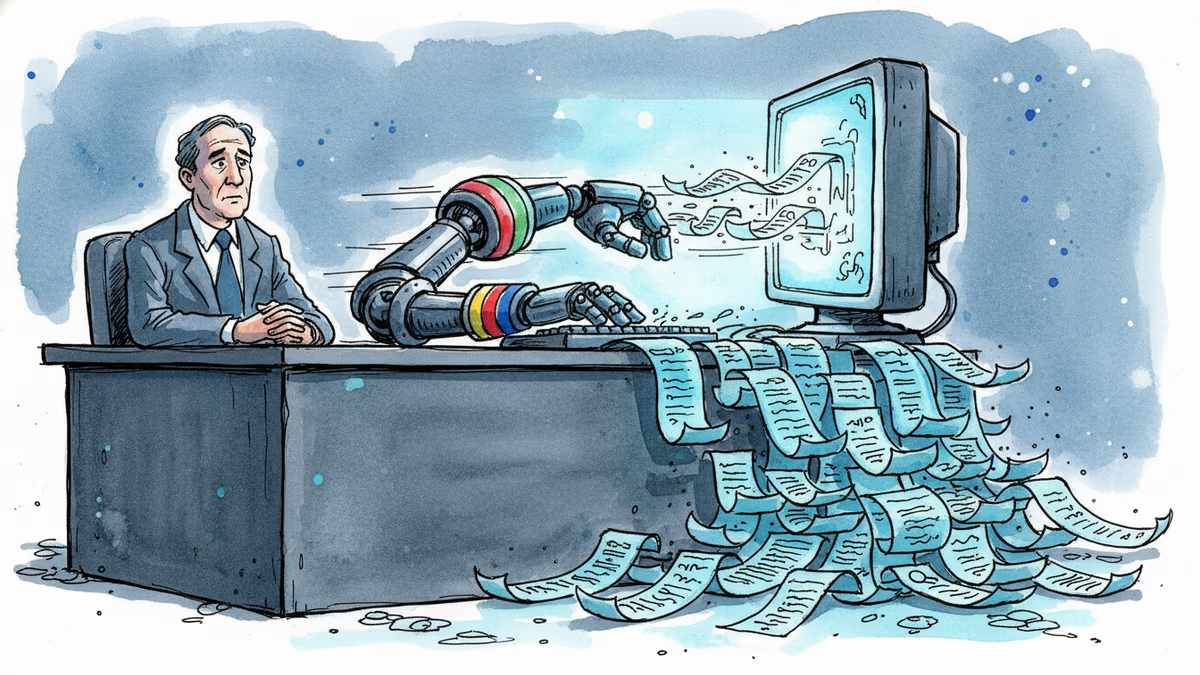
Google is building AI agents that search the web proactively, without user prompting. That's not just a product update — it's a fundamental shift in who controls the information you receive.

OpenAI has reorganized for the second time in a month, merging ChatGPT and Codex into a single agentic platform under president Greg Brockman's unified product leadership.
A critical vulnerability in Starlette—downloaded 325 million times per week—puts millions of AI agent servers at risk, exposing stored credentials for email, databases, and third-party services.
A small but growing group of developers has gone all-in on AI coding agents like Claude Code and OpenClaw. History suggests the rest of us won't be far behind.
Google is building AI agents that search the web proactively, without user prompting. That's not just a product update — it's a fundamental shift in who controls the information you receive.
OpenAI has reorganized for the second time in a month, merging ChatGPT and Codex into a single agentic platform under president Greg Brockman's unified product leadership.
Thoughts
Share your thoughts on this article
Sign in to join the conversation