
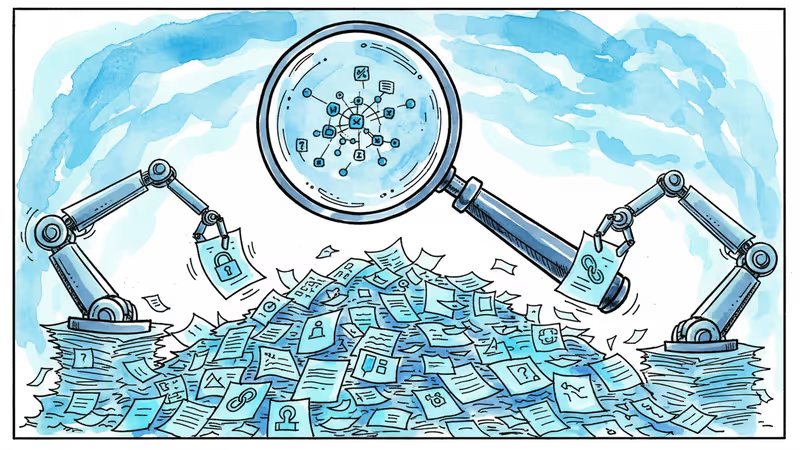
The Hidden War for AI's Most Valuable Resource
Handshake's acquisition of Cleanlab reveals the fierce competition for high-quality data labeling talent as AI companies realize clean data matters more than raw volume.
While everyone obsesses over AI models and compute power, a quieter battle is raging over something far more fundamental: the quality of data that trains these systems. Handshake's acquisition of data-auditing startup Cleanlab isn't just another tech deal—it's a signal that the AI industry is finally waking up to a harsh reality.
The Talent Grab Behind the Headlines
Handshake, the $3.3 billion company that started as a college recruiting platform, has been quietly building an AI data-labeling empire. Their latest move? Acquiring Cleanlab in what insiders call an "acqui-hire"—corporate speak for "we want your people, not necessarily your product."
The prize? Nine key employees, including three MIT PhD co-founders who've spent years solving a problem most AI companies didn't even know they had. Curtis Northcutt, Jonas Mueller, and Anish Athalye have developed algorithms that can spot bad data without needing a second human reviewer—a breakthrough that could reshape how AI models learn.
Cleanlab had raised $30 million from top-tier investors including Menlo Ventures and Bain Capital Ventures. At its peak, the startup employed over 30 people. Now those resources are flowing into Handshake's research organization, signaling just how valuable this expertise has become.
Why Data Quality Suddenly Matters
Here's what most people miss about the AI boom: it's not just about having more data—it's about having clean data. As Sahil Bhaiwala, Handshake's chief strategy officer, puts it, their in-house research team constantly asks: "Where are our models weak? What data should we be producing? How high quality is that data?"
Handshake has become the go-to platform for AI companies seeking specialized human labelers—doctors, lawyers, scientists—who can accurately tag complex data. They're already serving eight top AI labs, including OpenAI, with a forecasted $300 million annual revenue run rate for 2025, expected to reach the "high hundreds of millions" this year.

But volume without quality is worthless. As AI models become more sophisticated, they're also becoming more sensitive to training data errors. A mislabeled medical image or incorrectly tagged legal document can cascade through an entire model, creating systematic biases or failures.
The Strategic Chess Move
Northcutt revealed that Cleanlab received acquisition interest from other AI data-labeling companies, including competitors like Mercor, Surge, and Scale AI. But here's the twist: these competitors frequently use Handshake's platform to find their own expert labelers.
"If you're going to pick one, you should probably pick the source, not the middleman," Northcutt explained. It's a classic vertical integration play—Handshake is moving from being the marketplace to owning the entire quality assurance process.
This positions Handshake uniquely in the AI supply chain. They're not just connecting AI companies with human labelers; they're now ensuring those labels meet the highest standards. It's the difference between being a job board and being a quality-guaranteed staffing agency.
The Bigger Picture: AI's Infrastructure War
This acquisition reflects a broader shift in AI strategy. The early days of "move fast and break things" are giving way to "move carefully and build right." As AI systems become mission-critical—powering everything from medical diagnoses to financial decisions—the cost of bad training data becomes prohibitive.
Consider the implications for AI labs racing to build the next breakthrough model. They're no longer just competing on computational resources or algorithmic innovation. They're competing on data quality, and that requires human expertise at scale. Handshake is positioning itself as the critical infrastructure provider for this new reality.
The timing isn't coincidental. As AI models approach human-level performance in many domains, the marginal gains from simply adding more data are diminishing. The next competitive advantage lies in data quality—ensuring every training example is accurate, relevant, and properly labeled.
Authors
Related Articles
AGI, hallucination, inference, LLMs — AI's vocabulary isn't just technical shorthand. It shapes who holds power in the conversation. A clear-eyed glossary with the questions behind the terms.

A new paper proves that the self-play training method behind AlphaGo and AlphaZero structurally fails on a whole category of games. What that means for AI systems making real-world decisions.

Guide Labs' Steerling-8B can trace every output back to its training data. Are we finally moving beyond black-box AI toward true interpretability?
Google's latest Gemini 3.1 Pro model achieves record benchmark scores, leading professional task evaluations. But as AI models advance every few months, what's the real endgame?
AGI, hallucination, inference, LLMs — AI's vocabulary isn't just technical shorthand. It shapes who holds power in the conversation. A clear-eyed glossary with the questions behind the terms.
A new paper proves that the self-play training method behind AlphaGo and AlphaZero structurally fails on a whole category of games. What that means for AI systems making real-world decisions.
Guide Labs' Steerling-8B can trace every output back to its training data. Are we finally moving beyond black-box AI toward true interpretability?
Google's latest Gemini 3.1 Pro model achieves record benchmark scores, leading professional task evaluations. But as AI models advance every few months, what's the real endgame?
Thoughts
Share your thoughts on this article
Sign in to join the conversation