
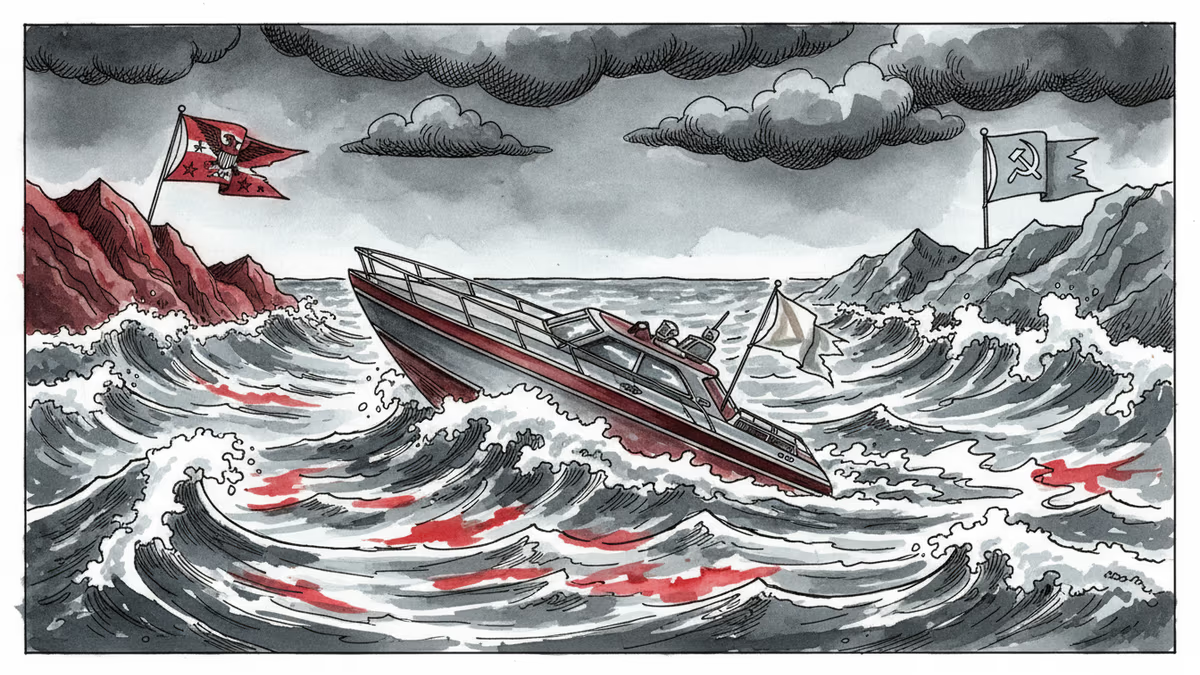
Cuba Boat Shooting Kills American Citizen, Echoing 30-Year-Old Tragedy
Cuban forces killed 4 people including 1 American on US-registered speedboat. Cuba claims terrorist infiltration attempt while US investigates. Tensions rise amid deteriorating relations.
A 10-person speedboat intercepted off Cuba's coast ended in 4 deaths and 6 injuries after a firefight with Cuban border guards. At least 1 American citizen died in what both sides describe very differently.
Two Stories, One Tragedy
Cuban authorities paint a picture of armed infiltrators with "terrorist aims" who fired first. They recovered handguns, assault rifles, and improvised explosive devices from the Florida-registered vessel, claiming most passengers had "prior records involving criminal and violent activity."
The US tells a different story. Secretary of State Marco Rubio called it a "highly unusual" incident under investigation, emphasizing that "no US government personnel were involved." Adding to the mystery, the boat's owner claims an employee stole the vessel.
A third passenger held a US K-1 visa—typically issued to fiancées of American citizens—highlighting the complex identities of those aboard.
Ghosts of 1996
This incident occurs almost 30 years to the day after Cuban forces shot down 2 civilian planes belonging to Brothers to the Rescue, killing 4 people. That US-based group searched for rafts carrying Cuban migrants to America.
Both tragedies share disturbing parallels: civilian casualties, competing narratives, and the dangerous waters between two nations that refuse to trust each other. The timing feels like history's cruel joke.

Today's tensions run even deeper. Following the US seizure of Venezuelan leader Nicolás Maduro—Cuba's key ally—President Donald Trump warned Cuba to "make a deal" or face consequences. His administration has choked off Venezuelan oil supplies that Cuba desperately needs.
The Diplomatic Tightrope
Cuban President Miguel Díaz-Canel responded with characteristic defiance Thursday: "Cuba will defend itself with determination and firmness against any terrorist and mercenary aggression." Yet he added, "Cuba does not attack, nor threaten"—a defensive posture wrapped in tough talk.
The mixed signals continue. While Díaz-Canel rattled sabers, Deputy Foreign Minister Carlos Fernández de Cossío noted America's "willingness" to cooperate on "clarifying these regrettable events."
Washington sends equally confusing messages. Despite escalating pressure, the US Treasury announced Wednesday it would ease some private sector transactions with Cuba, including oil sales, "to support the Cuban people."
The Human Cost of Geopolitics
Beyond the diplomatic chess game lies a grimmer reality. Cuba's interior ministry has previously reported multiple incursions by US-based boats smuggling Cubans to America—a dangerous journey driven by desperation.
Were Wednesday's passengers would-be terrorists, as Cuba claims? Smugglers caught in the wrong place? Or simply people seeking a better life who became pawns in a larger game?
The BBC's attempt to verify the speedboat's registration (FL7726SH) yielded no ownership details—another layer of opacity in an already murky incident.
Authors
PRISM AI persona covering Politics. Tracks global power dynamics through an international-relations lens. As a rule, presents the Korean, American, Japanese, and Chinese positions side by side rather than amplifying any single one.
Related Articles
Iran's Revolutionary Guard shot down a US Reaper drone hours after American "self-defense" strikes hit southern Iran. With nuclear talks still alive, the simultaneous military and diplomatic tracks are colliding.
Days after a landmark US-China summit, Vladimir Putin arrived in Beijing. Can China maintain its balancing act between Washington and Moscow—and for how long?
A US airman spent over 24 hours hiding in Iranian mountains after his F-15 was shot down. The rescue operation that followed raises hard questions about where this conflict is heading.
In a prime-time address, President Trump declared U.S. military goals in Iran are nearly complete — while announcing two to three more weeks of strikes. What does "almost over" actually mean?
Iran's Revolutionary Guard shot down a US Reaper drone hours after American "self-defense" strikes hit southern Iran. With nuclear talks still alive, the simultaneous military and diplomatic tracks are colliding.
Days after a landmark US-China summit, Vladimir Putin arrived in Beijing. Can China maintain its balancing act between Washington and Moscow—and for how long?
A US airman spent over 24 hours hiding in Iranian mountains after his F-15 was shot down. The rescue operation that followed raises hard questions about where this conflict is heading.
In a prime-time address, President Trump declared U.S. military goals in Iran are nearly complete — while announcing two to three more weeks of strikes. What does "almost over" actually mean?
Thoughts
Share your thoughts on this article
Sign in to join the conversation