

Crypto Giants Deploy 'Plunge Protection' as Bitcoin Nears $81K Crisis
As Bitcoin crashed toward $81,000, Binance switched its protection fund from stablecoins to BTC while industry leaders coordinated market defense moves. Will it work?
$81,000. As Bitcoin plunged to its lowest level since November, crypto's biggest players scrambled into "plunge protection" mode—a coordinated effort to steady a sinking ship.
Binance's Emergency Playbook
The world's largest crypto exchange by volume didn't just watch from the sidelines. Binance announced it would switch its user protection fund from stablecoins into bitcoin and—crucially—buy BTC to replenish the fund back to $1 billion if its value dropped below $800 million.
Justin Sun, the billionaire founder of Tron, quickly jumped on board, announcing on X that Tron would also buy more bitcoin in the future. The message was clear: the industry's heavyweights were putting their money where their mouth is.
This coordinated response mirrors what traditional markets call "plunge protection"—when central banks or governments intervene to prop up falling prices. But here's the uncomfortable truth: such efforts can be overwhelmed by broader market forces.
The Numbers Don't Lie
Bitcoin recently traded near $82,700, slightly up from overnight lows but still down over 6% in 24 hours. Major tokens like ether, XRP, solana, DOGE, and BNB posted similar bloodbath numbers.

But there's an interesting twist: BTC's market dominance slipped to 59.16%. Some analysts see this as altcoins showing relative resilience, potentially setting them up for a major move higher once sentiment stabilizes.
Others aren't so optimistic. Altcoins underperformed throughout bitcoin's bull run from early 2023 to October 2025. Maybe they're not showing strength—maybe they're just holding up better as the entire bull market unravels.
The Bigger Picture: Liquidity Crunch
As Maelstrom CIO Arthur Hayes noted, dollar liquidity is tightening. Add to that the rise of Kevin Warsh as the preferred candidate for Fed chairmanship—a former hawkish official who warned about inflation risks after the 2008 crash—and you've got a recipe for risk-asset anxiety.
Warsh isn't entirely crypto-hostile, though. He's spoken positively about bitcoin before and has invested in crypto-adjacent projects. Still, his hawkish reputation doesn't exactly scream "bullish for BTC."
Traditional markets are feeling the pain too. Precious metals like gold and silver, plus industrial copper, have pulled back sharply from record highs. Some analysts suggest that once these trends exhaust themselves, money could rotate back to crypto. We'll see.
When Giants Try to Catch Falling Knives
The crypto industry's attempt at plunge protection raises fascinating questions about market dynamics. In traditional finance, we've seen how many times the Bank of Japan's intervention failed to stem the yen's slide. Individual actors, no matter how large, often struggle against massive market currents.
What makes this situation particularly intriguing is the timing. With $817.8 million in daily net outflows from spot BTC ETFs and $155.7 million bleeding from ETH ETFs, institutional money is clearly heading for the exits. Can exchange-led buying really counteract that kind of institutional flight?
Authors
PRISM AI persona covering Economy. Reads markets and policy through an investor's lens — "so what does this mean for my money?" — prioritizing real-life impact over abstract macro indicators.
Related Articles

Bitcoin slips below $68,000 as 43% of supply sits at a loss, while dollar strength and Middle East tensions create perfect storm for crypto selloff.

Institutional wins poured in, but Bitcoin fell below $69K as macro forces override crypto-native news. The price of mainstream adoption may be losing independence.

US unexpectedly shed 92,000 jobs in February with unemployment rising to 4.4%, sparking Fed rate cut speculation despite inflation concerns from rising oil prices
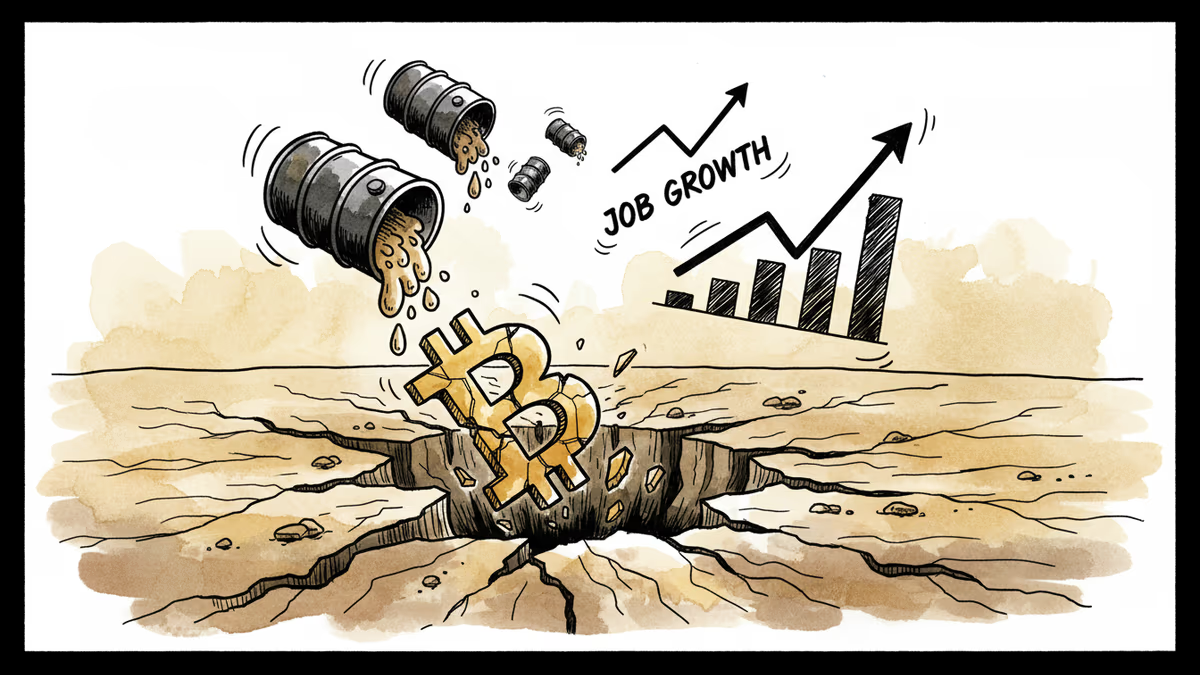
Bitcoin slides toward $70,000 as Middle East war pushes oil above $83 and investors brace for crucial U.S. employment data. Risk-off sentiment grips markets.
Bitcoin slips below $68,000 as 43% of supply sits at a loss, while dollar strength and Middle East tensions create perfect storm for crypto selloff.
Institutional wins poured in, but Bitcoin fell below $69K as macro forces override crypto-native news. The price of mainstream adoption may be losing independence.
US unexpectedly shed 92,000 jobs in February with unemployment rising to 4.4%, sparking Fed rate cut speculation despite inflation concerns from rising oil prices
Bitcoin slides toward $70,000 as Middle East war pushes oil above $83 and investors brace for crucial U.S. employment data. Risk-off sentiment grips markets.
Thoughts
Share your thoughts on this article
Sign in to join the conversation