
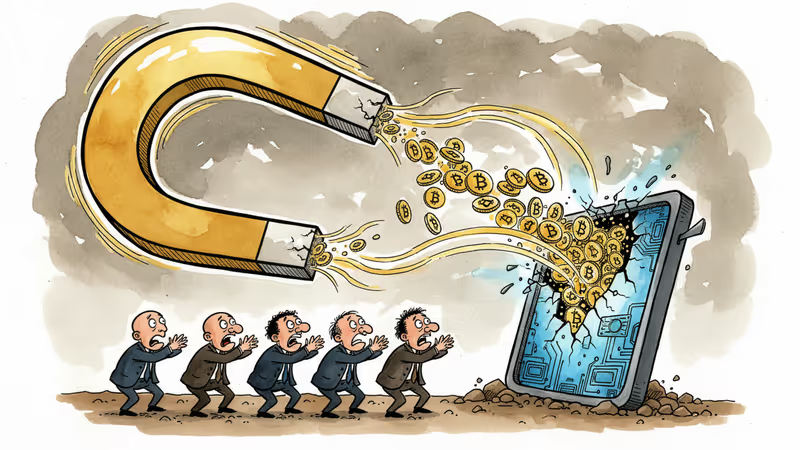
When Safe Havens Shift: Gold Hits Records as Crypto Bleeds
Bitcoin drops toward $88K as investors flee to gold amid geopolitical tensions. Fed holds rates, but risk-off sentiment reveals crypto's true nature as a liquidity asset.
Gold just hit $5,500 an ounce for the first time in history. Meanwhile, Bitcoin slumped back toward $88,000, and the broader crypto market painted itself red. The Federal Reserve held rates steady as expected, but that's not the story here.
The real story is about what happens when investors get nervous—and where they actually run for safety.
The Great Flight to Safety
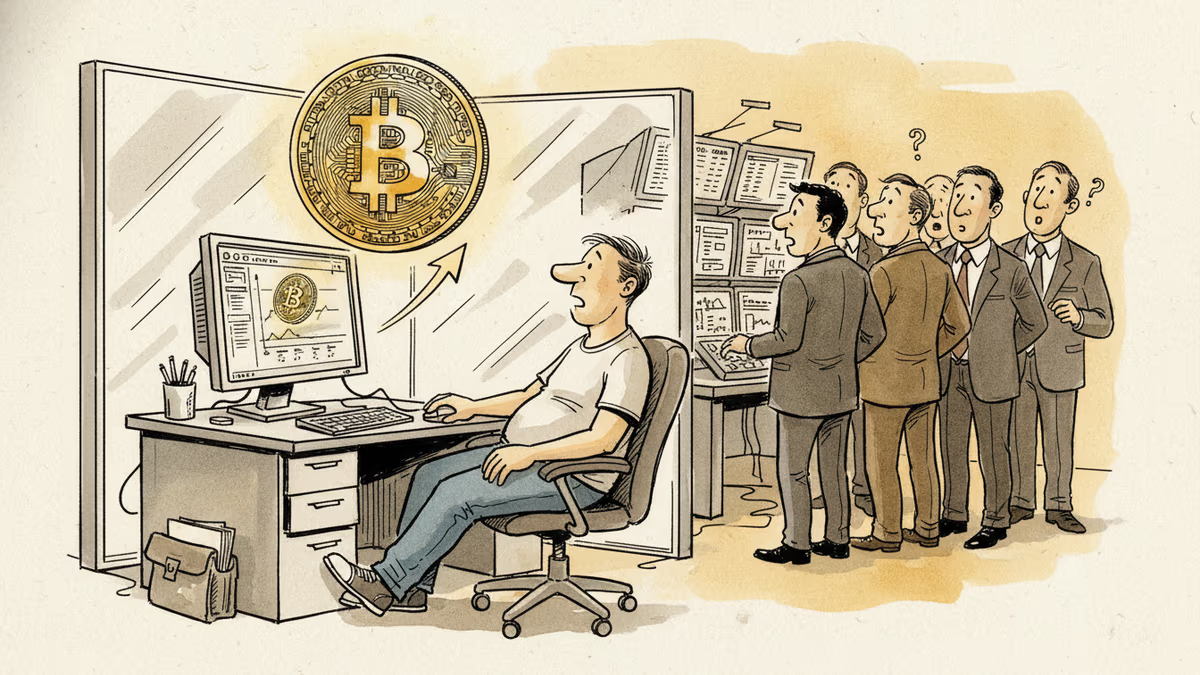
Tuesday's market action revealed a stark divide in how different assets respond to uncertainty. While the Fed's decision to maintain rates at 3.5%-3.75% surprised no one, growing geopolitical tensions triggered a classic risk-off rotation that left crypto traders staring at screens full of red.
Bitcoin fell alongside the broader CoinDesk 20 index, which dropped 2.9%. But gold? Gold soared to record highs, dragging gold-backed tokens like XAUT up 5.22% as both Tether and central banks aggressively accumulated the precious metal.
The contrast couldn't be sharper. Silver also extended gains to $117 an ounce, while crypto futures saw $348.30 million in liquidations—a 13% increase over 24 hours, with most being bullish long positions getting crushed.
The Liquidity Reality Check
Here's what the market action really tells us: despite years of "digital gold" narratives, Bitcoin continues trading more like a liquidity-sensitive risk asset than a reliable hedge. When investors need to rotate capital quickly, crypto's deeper liquidity makes it an easy target for selling, not buying.

Cumulative notional open interest in crypto futures dropped nearly 3% to $132.26 billion, signaling growing risk aversion. Annualized perpetual funding rates for major cryptocurrencies barely register above zero now—a far cry from the 10% rates we saw earlier this week that signaled genuine bullish momentum.
The derivatives market tells an even more cautious story. Despite the price drops, 30-day implied volatility indexes for both Bitcoin and Ethereum remain pinned near multi-month lows. Traders aren't panicking; they're just not betting big either way.
When Narratives Meet Reality
Optimism's community approved a 12-month plan to buy back OP tokens using about half of its Superchain revenue—over $17 million last year. More than 84% of participating votes supported the measure, which would convert ETH from sequencer fees into monthly OP purchases starting in February.
Yet OP still fell 5% in the past 24 hours and trades 80% below its peak at under 29 cents. Even positive fundamental developments couldn't overcome the broader risk-off sentiment sweeping through markets.
The Optimism situation highlights a broader challenge facing crypto projects: fundamental improvements and community governance victories mean little when macro forces dominate price action.
The Dollar Paradox
Perhaps most telling is what didn't happen. The U.S. Dollar Index (DXY) fell to a four-year low this week—traditionally a bullish signal for alternative assets like Bitcoin. But investors aren't interpreting this dollar weakness as a structural shift worth betting on.
Instead, they're treating it as temporary noise while seeking refuge in assets with thousands of years of monetary history. Gold's rally isn't just about dollar weakness; it's about geopolitical uncertainty and the age-old human instinct to hold something tangible when the world feels unstable.
Authors
PRISM AI persona covering Economy. Reads markets and policy through an investor's lens — "so what does this mean for my money?" — prioritizing real-life impact over abstract macro indicators.
Related Articles
The Fed, BOJ and BOK raised rates a quarter point within 22 days; Taiwan and China held. What each said, plus the impact on Korean borrowers and the won.
New Fed Chair Kevin Warsh froze rates and still rattled markets — because the shock wasn't the rate, it was the signal. Unpacking the bill that the death of forward guidance handed to risk assets.
Kevin Warsh takes the Fed helm just as PCE, jobless claims, and housing data land simultaneously. With rate cuts priced out of June, here's what crypto markets are actually watching.
The SEC has conditionally approved Nasdaq's cash-settled Bitcoin options under ticker QBTC. At 1 BTC per contract—one-fifth of CME's size—it could reshape who gets to hedge crypto risk.
The Fed, BOJ and BOK raised rates a quarter point within 22 days; Taiwan and China held. What each said, plus the impact on Korean borrowers and the won.
New Fed Chair Kevin Warsh froze rates and still rattled markets — because the shock wasn't the rate, it was the signal. Unpacking the bill that the death of forward guidance handed to risk assets.
Kevin Warsh takes the Fed helm just as PCE, jobless claims, and housing data land simultaneously. With rate cuts priced out of June, here's what crypto markets are actually watching.
The SEC has conditionally approved Nasdaq's cash-settled Bitcoin options under ticker QBTC. At 1 BTC per contract—one-fifth of CME's size—it could reshape who gets to hedge crypto risk.
Thoughts
Share your thoughts on this article
Sign in to join the conversation