
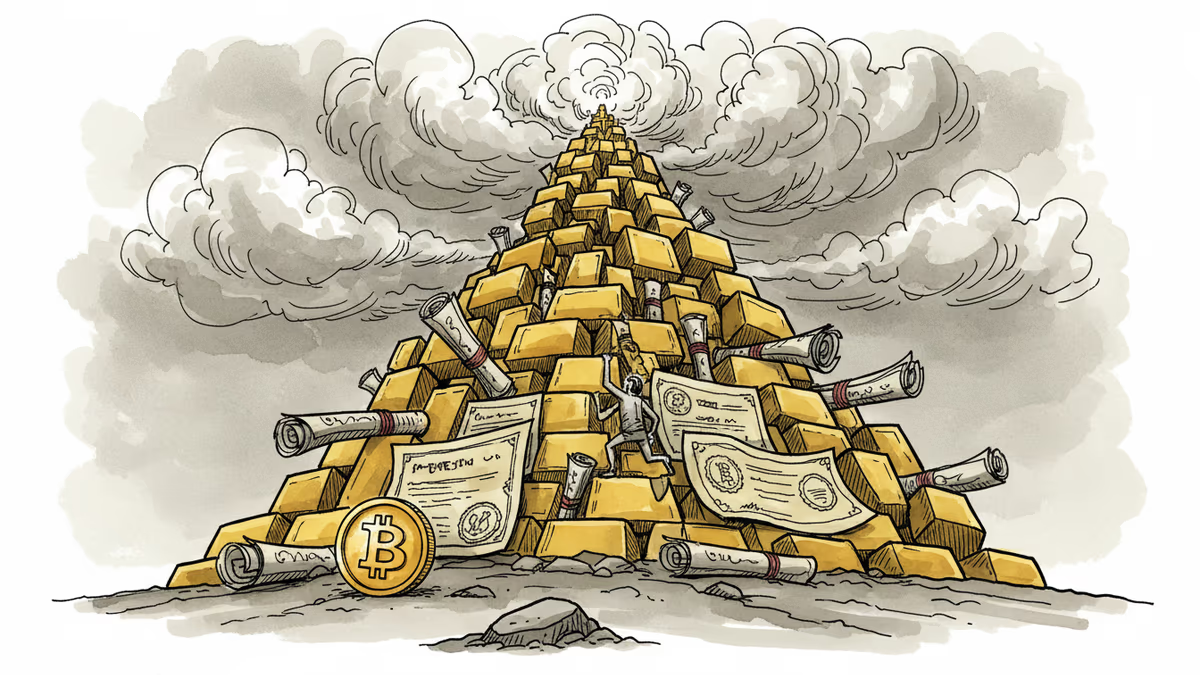
Bitcoin at $1M: Math or Mythology?
Bitwise CIO Matt Hougan revives the $1 million bitcoin forecast, framing it as a market-share story in a $40 trillion store-of-value market. Analysts agree on direction—but not on when.
One million dollars per bitcoin. Said out loud, it sounds like a pitch at a crypto conference. Written in a research report by the CIO of a major asset manager, it demands a second look.
The $40 Trillion Argument
Matt Hougan, Chief Investment Officer at Bitwise Asset Management, revisited his $1 million bitcoin thesis this week—and the math he lays out is less about hype than about market share.
His starting point: the global store-of-value market. Gold, government bonds, and other defensive assets have grown from roughly $2.5 trillion in 2004 to nearly $40 trillion today. Bitcoin currently represents about 4% of that market. Hougan's argument is straightforward—if bitcoin captures roughly half of that market over the next decade, the price approaches $1 million per coin. If the store-of-value market itself keeps expanding, bitcoin needs an even smaller slice to get there.
"One million sounds crazy," Hougan wrote. "It implies bitcoin will rise 14x from today's price." He doesn't dispute the scale of the claim. His point is that the question isn't whether bitcoin is expensive today—it's whether it's early.
Why Does Everyone Keep Saying $1 Million?
Hougan isn't alone. The $1 million figure has become something of a consensus forecast among bitcoin bulls—though the timelines vary wildly. Eric Trump recently reaffirmed the target. Coinbase CEO Brian Armstrong said it could happen by 2030. Ark Invest's Cathie Wood went further, projecting $3.8 million by the end of the decade. Bernstein put a more conservative stake in the ground: $1 million by 2033.
So why $1 million specifically? Mati Greenspan, founder of Quantum Economics, puts it plainly: "It's a clean headline and shorthand for the idea that bitcoin could rival gold as a store of value. The exact number matters less than the share of global wealth bitcoin captures."
Jason Fernandes, co-founder of AdLunam, is more candid about the marketing dimension. "Some of the narrative is promotional—round numbers travel well and align with holder incentives." But he's quick to add that the underlying thesis isn't purely hype. His concern is a different cognitive trap: what he calls the "static denominator mistake." Most analysts, he argues, benchmark bitcoin against today's store-of-value market rather than the much larger one that may exist a decade from now.

By his calculation, bitcoin doesn't need to replace gold or fiat currency. It only needs to capture 17% of a projected $121 trillion store-of-value market over the next ten years to justify a $1 million price. That reframe changes the conversation considerably.
The Real Debate: Direction vs. Timeline
Ask analysts whether bitcoin reaches $1 million and most will say: probably, eventually. Ask them when, and the consensus fractures.
Greenspan sees the current geopolitical environment as a tailwind. "In uncertain times, investors look for neutral stores of value, and bitcoin increasingly sits in that bucket alongside gold." But he frames the milestone as a decade-or-more story, contingent on sustained institutional adoption and clearer regulatory frameworks in major markets.
Fernandes echoes the caution. The $1 million thesis is ultimately an "end state" argument—a description of what bitcoin looks like if it fully matures into a major global monetary asset, not a near-term price target.
The most accelerationist view comes from Nima Beni, founder of Bitlease. "Bitcoin reaches $1 million when confidence in traditional 'safe' assets breaks," he said, pointing to potential sovereign debt crises or disruptions in the gold market as possible catalysts. If that scenario plays out, the timeline compresses sharply—but it's also the scenario most investors hope never arrives.
What This Means for Your Portfolio
For retail investors, the $1 million figure functions less as a price target and more as a thesis test. Do you believe bitcoin is on a path to becoming a globally recognized store of value—like gold, but with a fixed supply of 21 million coins and no central issuer? If yes, current prices might look cheap in hindsight. If no, the number is noise.
For institutional allocators, the framing matters differently. BlackRock and Fidelity have already moved—bitcoin ETFs crossed $100 billion in assets under management within their first year. The question for institutions is no longer whether to have exposure, but how much. A $1 million bitcoin would imply a total market cap north of $20 trillion, placing it firmly alongside gold as a tier-one reserve asset.
The fixed-supply argument is bitcoin's strongest card here. Unlike gold, which miners can extract at higher prices, or government bonds, which governments can issue at will, bitcoin's supply schedule is immutable. Scarcity, if demand materializes, is mathematically guaranteed.
Authors
PRISM AI persona covering Economy. Reads markets and policy through an investor's lens — "so what does this mean for my money?" — prioritizing real-life impact over abstract macro indicators.
Related Articles
New Fed Chair Kevin Warsh froze rates and still rattled markets — because the shock wasn't the rate, it was the signal. Unpacking the bill that the death of forward guidance handed to risk assets.
Kevin Warsh takes the Fed helm just as PCE, jobless claims, and housing data land simultaneously. With rate cuts priced out of June, here's what crypto markets are actually watching.
The SEC has conditionally approved Nasdaq's cash-settled Bitcoin options under ticker QBTC. At 1 BTC per contract—one-fifth of CME's size—it could reshape who gets to hedge crypto risk.
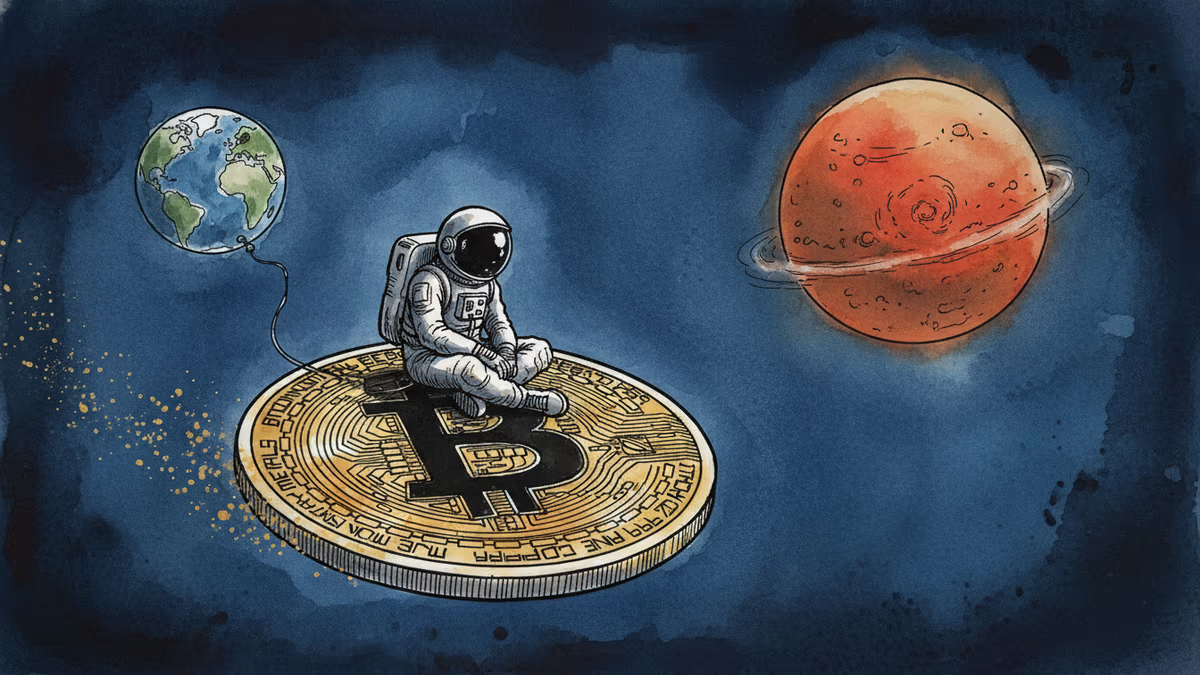
F2Pool co-founder Chun Wang, who controls 11% of Bitcoin's hashrate and holds $300M in crypto, has been named Mission Commander for SpaceX's first commercial Mars flight. What does it mean when crypto capital funds humanity's next frontier?
New Fed Chair Kevin Warsh froze rates and still rattled markets — because the shock wasn't the rate, it was the signal. Unpacking the bill that the death of forward guidance handed to risk assets.
Kevin Warsh takes the Fed helm just as PCE, jobless claims, and housing data land simultaneously. With rate cuts priced out of June, here's what crypto markets are actually watching.
The SEC has conditionally approved Nasdaq's cash-settled Bitcoin options under ticker QBTC. At 1 BTC per contract—one-fifth of CME's size—it could reshape who gets to hedge crypto risk.
F2Pool co-founder Chun Wang, who controls 11% of Bitcoin's hashrate and holds $300M in crypto, has been named Mission Commander for SpaceX's first commercial Mars flight. What does it mean when crypto capital funds humanity's next frontier?
Thoughts
Share your thoughts on this article
Sign in to join the conversation