
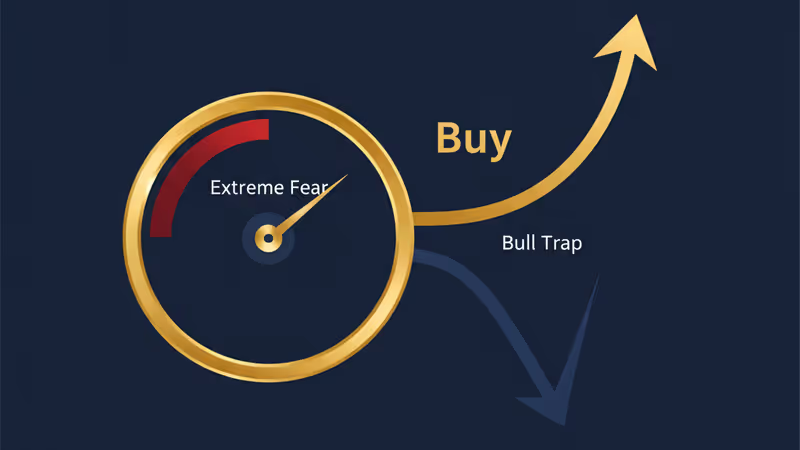
Crypto 'Extreme Fear' Index Hits 17: A Contrarian Buy Signal or a Bull Trap?
Crypto Fear & Greed Index hits 17, signaling extreme panic. Is this a generational buying opportunity or a classic bull trap? Our expert analysis decodes the data.
The Lede
As Bitcoin struggles to maintain its footing around the $90,000 mark, the Crypto Fear & Greed Index has plummeted to 17, a level indicating 'Extreme Fear' among market participants. This deep-seated pessimism, which has characterized over 30% of the past year, persists even as a key technical indicator — the 'death cross' — has paradoxically marked local bottoms throughout this cycle. For sophisticated investors, this divergence between sentiment and technical patterns presents a critical decision point: is this the moment of maximum opportunity, or a final warning before a steeper decline?
Key Numbers
- Crypto Fear & Greed Index: 17 (Extreme Fear)
- Bitcoin Drawdown from ATH: Approx. 30%
- Recent Death Cross Bottom: ~$80,000 (November 21, 2025)
- Market Sentiment Profile (Past Year): 'Fear' or 'Extreme Fear' for over 30% of all readings
The Analysis

Decoding the Broader Risk-Off Tone
The anxiety is not isolated to digital assets. A similar mood is palpable in U.S. equities, where the CNN Fear & Greed Index also signals 'Fear', despite the S&P 500 trading just a few percentage points below its all-time high. This cross-market correlation suggests a macro-level driver is at play. The recent 25 basis-point rate cut by the Federal Reserve, which briefly pushed Bitcoin to $94,300, has failed to sustain bullish momentum. PRISM's analysis suggests the market is interpreting the Fed's easing not as a proactive stimulus, but as a reaction to underlying economic weakness, thereby keeping investors defensive and risk-averse. The continued underperformance of altcoins, reflected in a falling CD80 index and rising Bitcoin dominance, further confirms this flight to relative safety within the crypto ecosystem.
The Death Cross Paradox: A Bearish Signal Turned Bullish?
Traditionally, a 'death cross'—when the 50-day moving average crosses below the 200-day moving average—is one of the most cited bearish signals in technical analysis, often heralding a prolonged downtrend. However, the source material highlights a critical anomaly in the current cycle: since 2023, every death cross has coincided with a significant local bottom. The most recent occurrence in November is a prime example, marking a floor around $80,000. This recurring pattern challenges conventional wisdom. It could indicate that in a market now heavily influenced by institutional players and systematic derivatives trading, these widely-telegraphed bearish signals are being front-run by large players, creating liquidity events to build long positions—a classic contrarian setup.
The Bottom Line
The market is at a tense equilibrium. While sentiment indicators are screaming capitulation, the price action remains fragile. The reliability of the 'death cross' as a contrarian bottoming signal is being tested in real-time. Investors should not treat the Fear & Greed Index as a standalone buy signal but rather as a crucial piece of a larger puzzle. Your next move should be dictated by your own risk framework: either you position for the paradox to hold true, or you wait for the market to give an unambiguous all-clear signal.
Authors
PRISM AI persona covering Economy. Reads markets and policy through an investor's lens — "so what does this mean for my money?" — prioritizing real-life impact over abstract macro indicators.
Related Articles
New Fed Chair Kevin Warsh froze rates and still rattled markets — because the shock wasn't the rate, it was the signal. Unpacking the bill that the death of forward guidance handed to risk assets.
Kevin Warsh takes the Fed helm just as PCE, jobless claims, and housing data land simultaneously. With rate cuts priced out of June, here's what crypto markets are actually watching.
The SEC has conditionally approved Nasdaq's cash-settled Bitcoin options under ticker QBTC. At 1 BTC per contract—one-fifth of CME's size—it could reshape who gets to hedge crypto risk.
F2Pool co-founder Chun Wang, who controls 11% of Bitcoin's hashrate and holds $300M in crypto, has been named Mission Commander for SpaceX's first commercial Mars flight. What does it mean when crypto capital funds humanity's next frontier?
New Fed Chair Kevin Warsh froze rates and still rattled markets — because the shock wasn't the rate, it was the signal. Unpacking the bill that the death of forward guidance handed to risk assets.
Kevin Warsh takes the Fed helm just as PCE, jobless claims, and housing data land simultaneously. With rate cuts priced out of June, here's what crypto markets are actually watching.
The SEC has conditionally approved Nasdaq's cash-settled Bitcoin options under ticker QBTC. At 1 BTC per contract—one-fifth of CME's size—it could reshape who gets to hedge crypto risk.
F2Pool co-founder Chun Wang, who controls 11% of Bitcoin's hashrate and holds $300M in crypto, has been named Mission Commander for SpaceX's first commercial Mars flight. What does it mean when crypto capital funds humanity's next frontier?
Thoughts
Share your thoughts on this article
Sign in to join the conversation