

Korea Zinc Wins Court Battle, Clearing Path for $7.55B Tennessee Refinery
A Seoul court dismissed an injunction against Korea Zinc's capital increase, paving the way for its $7.55B Tennessee refinery. The win for Chairman Choi comes amid an intensifying management control dispute.
A multi-billion dollar U.S. expansion is back on track. A Seoul court just handed Korea Zinc's chairman a crucial victory in a high-stakes corporate battle, dismissing an injunction that threatened to derail its $7.55 billion (11 trillion won) investment in a Tennessee critical metals refinery.
The Court's Green Light
According to Yonhap, the Seoul Central District Court on Wednesday rejected a request from major shareholders Young Poong Corp. and MBK Partners to block Korea Zinc's planned capital increase. The zinc producer intends to fund the project by selling shares worth 2.85 trillion won to a joint venture it plans to create with the U.S. Department of War. The court's decision effectively removes a major obstacle for the landmark U.S. investment.
A Tale of Two Motives
The legal challenge highlights a deepening rift within the company's ownership. Young Poong and MBK Partners argued that the share issuance was primarily aimed at defending the management control of Chairman Choi Yun-beom. In contrast, Korea Zinc countered that the move was essential for stabilizing critical mineral supply chains and forging a strategic partnership with the U.S. government.
This content is AI-generated based on source articles. While we strive for accuracy, errors may occur. We recommend verifying with the original source.
Related Articles
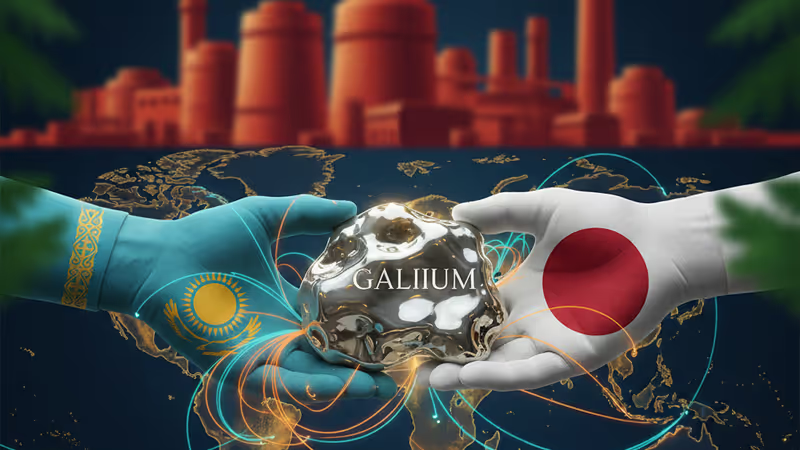
Mitsubishi Corp. will begin importing gallium from Kazakhstan in 2026, a strategic move to reduce Japan's reliance on China for the metal crucial to EVs and semiconductors.
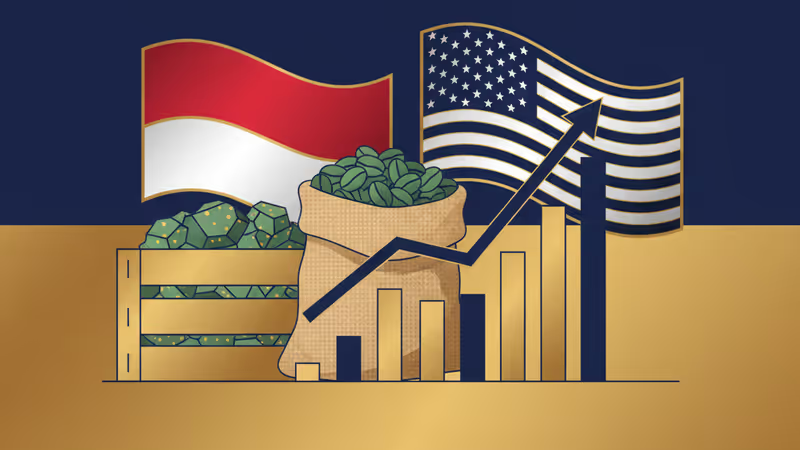
The U.S. and Indonesia have reached a new tariff agreement. Indonesia gets exemptions for palm oil and coffee, while the U.S. secures access to critical minerals.
BP's first external CEO in a century, Meg O'Neill, signals a dramatic pivot back to fossil fuels, driven by activist investors. What this means for the energy sector.

XRP's price has fallen 1.7% despite the launch of 'earnXRP', a new DeFi yield product. Analytics firm Santiment notes that current negative social sentiment could be a contrarian signal for a rebound.
Mitsubishi Corp. will begin importing gallium from Kazakhstan in 2026, a strategic move to reduce Japan's reliance on China for the metal crucial to EVs and semiconductors.
The U.S. and Indonesia have reached a new tariff agreement. Indonesia gets exemptions for palm oil and coffee, while the U.S. secures access to critical minerals.
BP's first external CEO in a century, Meg O'Neill, signals a dramatic pivot back to fossil fuels, driven by activist investors. What this means for the energy sector.
XRP's price has fallen 1.7% despite the launch of 'earnXRP', a new DeFi yield product. Analytics firm Santiment notes that current negative social sentiment could be a contrarian signal for a rebound.