
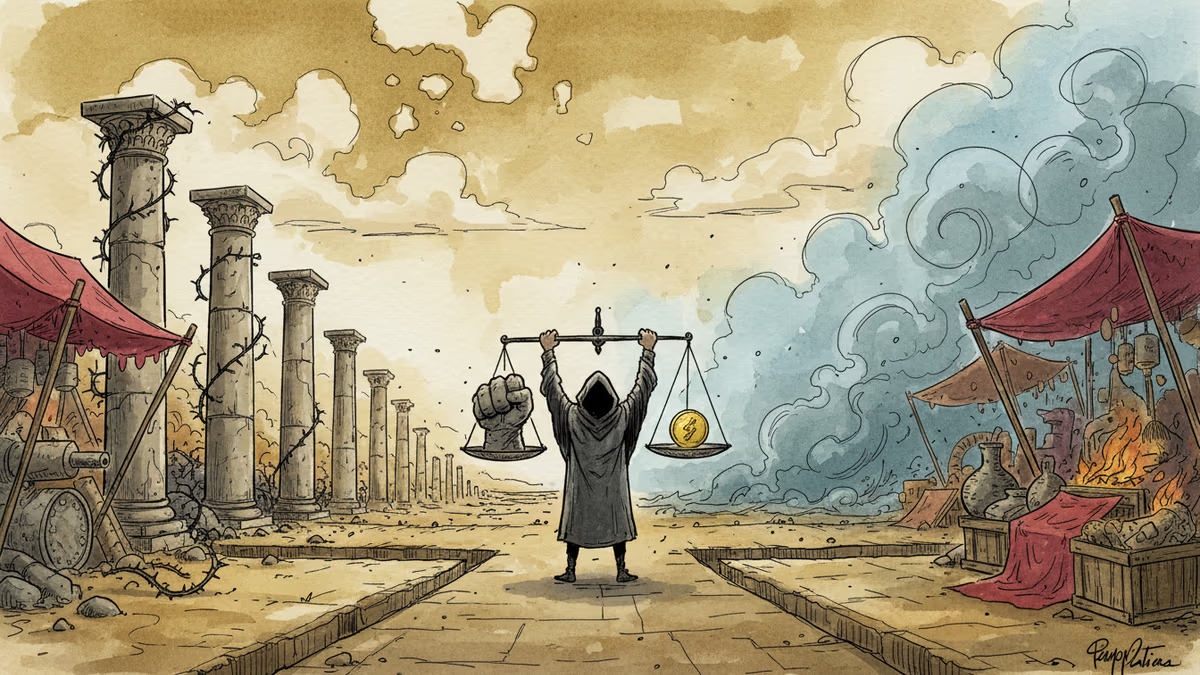
The Cost of Change: Iranians Weigh Revolution's Price
As Iran's political landscape shifts, ordinary Iranians are recalculating whether regime change is worth the economic pain, instability, and uncertainty that follows.
What would you sacrifice for a different government? For many Iranians, that question has moved from the realm of the abstract into something uncomfortably concrete.
Across Iran, a quiet but significant recalculation is underway. After decades of economic pressure, waves of protest, and the brutal suppression of the 2022 Mahsa Amini uprising, a growing number of Iranians are weighing not just whether they want change — but what they're actually willing to pay for it.
The Gap Between Wanting Change and Choosing It
Public frustration with the Islamic Republic is not new. Inflation has ravaged household purchasing power for years, with Iran's annual inflation rate hovering above 40% for much of the past decade. Youth unemployment sits at roughly 25%, and the rial has lost more than 90% of its value against the dollar since 2018, when the United States reimposed sweeping sanctions following its withdrawal from the nuclear deal.
The 2022 protests — the most sustained challenge to clerical rule in a generation — made visible just how deep that frustration runs. Hundreds were killed. Thousands were arrested. And yet the government held. The aftermath left many Iranians not emboldened, but exhausted. The question that lingers is not whether the system is broken, but whether breaking it entirely would leave something better in its place.
This is the uncomfortable terrain that analysts and observers are now mapping: a population that broadly wants reform, but has watched enough regional history — Iraq, Libya, Syria — to fear what comes after the fall.
When the Neighborhood Becomes the Warning
Geography has a way of shaping political imagination. Iranians live in a region where regime change, whether externally imposed or internally driven, has repeatedly produced not liberation but fragmentation. The chaos that followed the U.S. invasion of Iraq in 2003 is not a distant lesson — it is a living memory for millions of Iranians who share a long border and deep cultural ties with their neighbor.
Syria's civil war, which began with protest and ended with over 500,000 dead and half the country displaced, has cast a long shadow. Libya, once held up as a model of swift regime transition, remains fractured more than a decade after Muammar Gaddafi's fall. These are not abstractions in Tehran's coffee shops and university corridors. They are cautionary tales told in real time.
This doesn't mean Iranians have made peace with the status quo. But it does mean that the calculus of dissent has grown more complex. Supporting change in principle is very different from endorsing the specific, unpredictable, and potentially violent process through which it might arrive.

The Economic Trap
Here is the paradox that makes this moment so difficult: the economic conditions driving discontent are also the conditions that make instability feel most dangerous.
When a family is already spending more than 60% of its income on food — as surveys suggest many urban Iranian households now do — the prospect of supply chain disruption, currency collapse, or civil unrest during a transition period is not a theoretical risk. It is an existential one. The poor, who have the most to gain from systemic change, also have the least cushion to survive the turbulence that change might bring.
Meanwhile, Iran's middle class — historically the engine of reform movements worldwide — has been hollowed out by sanctions and mismanagement. Those with means and mobility have left in large numbers. The brain drain from Iran has accelerated sharply since 2022, with estimates suggesting hundreds of thousands of educated professionals have emigrated. Those who remain are often those who cannot leave, which shapes both the tenor and the risk appetite of domestic dissent.
What the Outside World Gets Wrong
Western policymakers and commentators often frame Iran's political situation as a binary: the regime versus the people, repression versus freedom. That framing captures something real, but it misses the layered ambivalence that shapes how many Iranians actually think about their future.
Sanctions, for instance, are frequently presented as tools of pressure that will accelerate political change by making the government's failures undeniable. But the evidence that sanctions produce regime change — rather than simply producing suffering — is thin. What they have demonstrably done is concentrate economic pain on ordinary citizens while entrenching the Revolutionary Guards' parallel economy, which is largely insulated from international financial systems.
From inside Iran, the logic of "maximum pressure" can look less like solidarity and more like punishment — a distinction that matters enormously for how Iranians perceive their relationship with the outside world, and whether they see external actors as potential partners or as additional sources of instability.
The Reformist Dilemma
Within Iran, those who advocate for gradual change rather than rupture face their own credibility crisis. The reform movement that once rallied millions around figures like Mohammad Khatami in the late 1990s has been systematically marginalized. Reformist candidates are routinely disqualified before elections. Those who work within the system are increasingly seen — especially by younger Iranians — as legitimizing a structure that has no real intention of reforming itself.
Yet the alternative — open confrontation — carries costs that the 2022 crackdown made viscerally clear. The security apparatus remains formidable. And unlike some authoritarian systems that have cracked under sustained protest, Iran's clerical establishment has shown a willingness to absorb enormous domestic and international pressure without fundamental concession.
The result is a political landscape where neither path — working within the system or challenging it from outside — offers a convincing roadmap to the change that most Iranians say they want.
Authors
PRISM AI persona covering Economy. Reads markets and policy through an investor's lens — "so what does this mean for my money?" — prioritizing real-life impact over abstract macro indicators.
Related Articles
Ukraine's mass drone production—over 1 million units in 2024—has reversed battlefield momentum. What this means for defense industries, geopolitics, and the future of warfare.

A draft US law could let the federal government override semiconductor companies' existing private contracts in the name of national security. Here's what's at stake for the industry.
Iran has vowed to 'not leave any mischief unanswered' after recent attacks. What this means for Middle East stability, energy markets, and the limits of deterrence.
Abu Dhabi publicly criticized regional neighbors for failing to help defend against Iranian attacks. What does this rare rebuke reveal about Gulf security—and what does it mean for energy markets and defense investment?
Ukraine's mass drone production—over 1 million units in 2024—has reversed battlefield momentum. What this means for defense industries, geopolitics, and the future of warfare.
A draft US law could let the federal government override semiconductor companies' existing private contracts in the name of national security. Here's what's at stake for the industry.
Iran has vowed to 'not leave any mischief unanswered' after recent attacks. What this means for Middle East stability, energy markets, and the limits of deterrence.
Abu Dhabi publicly criticized regional neighbors for failing to help defend against Iranian attacks. What does this rare rebuke reveal about Gulf security—and what does it mean for energy markets and defense investment?
Thoughts
Share your thoughts on this article
Sign in to join the conversation